Matsuno Yuichi, Torisu Takehiro, Umeno Junji, Shibata Hiroki, Hirano Atsushi, Fuyuno Yuta, Okamoto Yasuharu, Fujioka Shin, Kawasaki Keisuke, Moriyama Tomohiko, Nagasue Tomohiro, Zeze Keizo, Hirakawa Yoichiro, Kawatoko Shinichiro, Koga Yutaka, Oda Yoshinao, Esaki Motohiro, Kitazono Takanari
Department of Medicine and Clinical Science, Graduate School of Medical Sciences, Fukuoka, Japan.
Division of Genomics, Medical Institute of Bioregulation, Kyushu University, Fukuoka, Japan.
Intest Res. 2022 Apr;20(2):260-268. doi: 10.5217/ir.2021.00124. Epub 2022 Apr 29.
BACKGROUND/AIMS: Recent studies suggested a favorable effect of indigo naturalis (IN) in inducing remission for refractory ulcerative colitis (UC), however, the maintenance effect of IN for patients with UC remains unknown. Therefore, we conducted a prospective uncontrolled open-label study to analyze the efficacy and safety of IN for patients with UC.
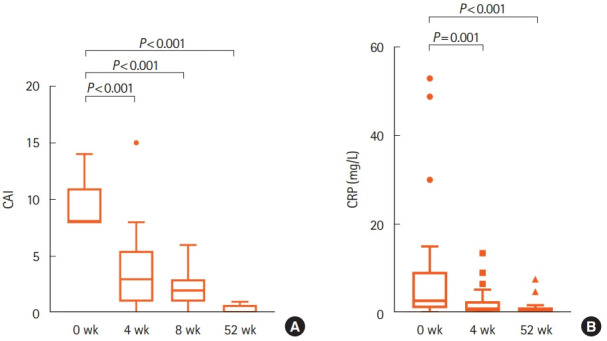
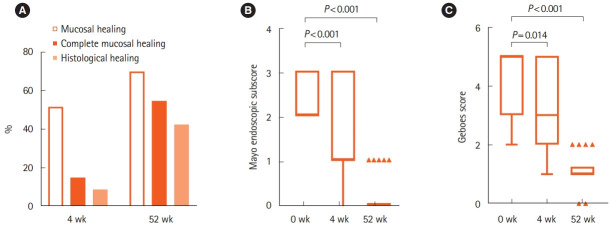
Patients with moderate to severe active UC (clinical activity index [CAI] ≥ 8) took 2 g/day of IN for 52 weeks. CAI at weeks 0, 4, 8, and 52 and Mayo endoscopic subscore (MES) and Geboes score (GS) at weeks 0, 4, and 52 were assessed. Clinical remission (CAI ≤ 4), mucosal healing (MES ≤ 1), and histological healing (GS ≤ 1) rates at each assessment were evaluated. Overall adverse events (AEs) during study period were also evaluated. The impact of IN on mucosal microbial composition was assessed using 16S ribosomal RNA gene sequences.
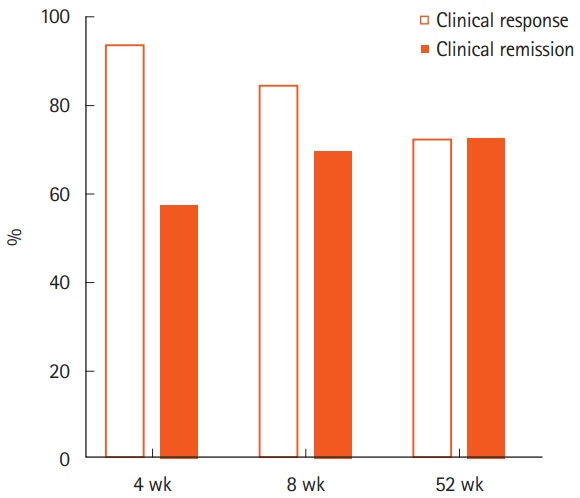
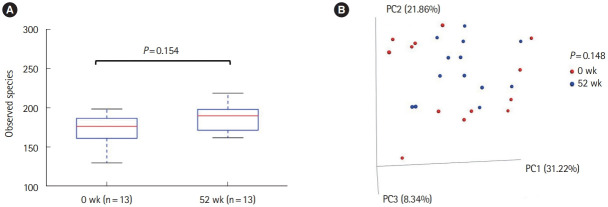
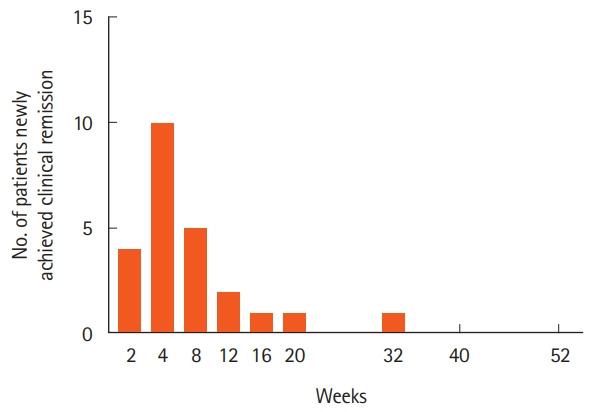
Thirty-three patients were enrolled. The rates of clinical remission at weeks 4, 8, and 52 were 67%, 76%, and 73%, respectively. The rates of mucosal healing at weeks 4 and 52 were 48% and 70%, respectively. AEs occurred in 17 patients (51.5%) during follow-up. Four patients (12.1%) showed severe AEs, among whom 3 manifested acute colitis. No significant alteration in the mucosal microbial composition was observed with IN treatment.
One-year treatment of moderate to severe UC with IN was effective. IN might be a promising therapeutic option for maintaining remission in UC, although the relatively high rate of AEs should be considered.
背景/目的:近期研究表明,青黛(IN)对难治性溃疡性结肠炎(UC)的诱导缓解具有良好效果,然而,IN对UC患者的维持疗效仍不清楚。因此,我们开展了一项前瞻性非对照开放标签研究,以分析IN对UC患者的疗效和安全性。
中度至重度活动性UC患者(临床活动指数[CAI]≥8)每天服用2 g IN,持续52周。评估第0、4、8和52周时的CAI,以及第0、4和52周时的梅奥内镜亚评分(MES)和格博斯评分(GS)。评估每次评估时的临床缓解(CAI≤4)、黏膜愈合(MES≤1)和组织学愈合(GS≤1)率。还评估了研究期间的总体不良事件(AE)。使用16S核糖体RNA基因序列评估IN对黏膜微生物组成的影响。
共纳入33例患者。第4、8和52周时的临床缓解率分别为67%、76%和73%。第4和52周时的黏膜愈合率分别为48%和70%。随访期间有17例患者(51.5%)发生AE。4例患者(12.1%)出现严重AE,其中3例表现为急性结肠炎。IN治疗后未观察到黏膜微生物组成有明显改变。
IN治疗中度至重度UC一年有效。IN可能是维持UC缓解的一种有前景的治疗选择,尽管应考虑相对较高的AE发生率。