• 文献检索
  • 文档翻译
  • 深度研究
  • 学术资讯
  • Suppr Zotero 插件Zotero 插件
  • 邀请有礼
  • 套餐&价格
  • 历史记录
应用&插件
Suppr Zotero 插件Zotero 插件浏览器插件Mac 客户端Windows 客户端微信小程序
定价
高级版会员购买积分包购买API积分包
服务
文献检索文档翻译深度研究API 文档MCP 服务
关于我们
关于 Suppr公司介绍联系我们用户协议隐私条款
关注我们

Suppr 超能文献

核心技术专利:CN118964589B侵权必究
粤ICP备2023148730 号-1Suppr @ 2026

文献检索

告别复杂PubMed语法,用中文像聊天一样搜索,搜遍4000万医学文献。AI智能推荐,让科研检索更轻松。

立即免费搜索

文件翻译

保留排版,准确专业,支持PDF/Word/PPT等文件格式,支持 12+语言互译。

免费翻译文档

深度研究

AI帮你快速写综述,25分钟生成高质量综述,智能提取关键信息,辅助科研写作。

立即免费体验

使用人工智能与多基因风险评分指导乳腺癌筛查的成本效益比较。

Cost-effectiveness of using artificial intelligence versus polygenic risk score to guide breast cancer screening.

机构信息

School of Pharmacy, Memorial University of Newfoundland, 300 Prince Philip Drive, St. John's, NL A1B 3V6, Canada.

出版信息

BMC Cancer. 2022 May 6;22(1):501. doi: 10.1186/s12885-022-09613-1.

DOI:10.1186/s12885-022-09613-1
PMID:35524200
原文链接:https://pmc.ncbi.nlm.nih.gov/articles/PMC9074290/
Abstract

BACKGROUND

Current guidelines for mammography screening for breast cancer vary across agencies, especially for women aged 40-49. Using artificial Intelligence (AI) to read mammography images has been shown to predict breast cancer risk with higher accuracy than alternative approaches including polygenic risk scores (PRS), raising the question whether AI-based screening is more cost-effective than screening based on PRS or existing guidelines. This study provides the first evidence to shed light on this important question.

METHODS

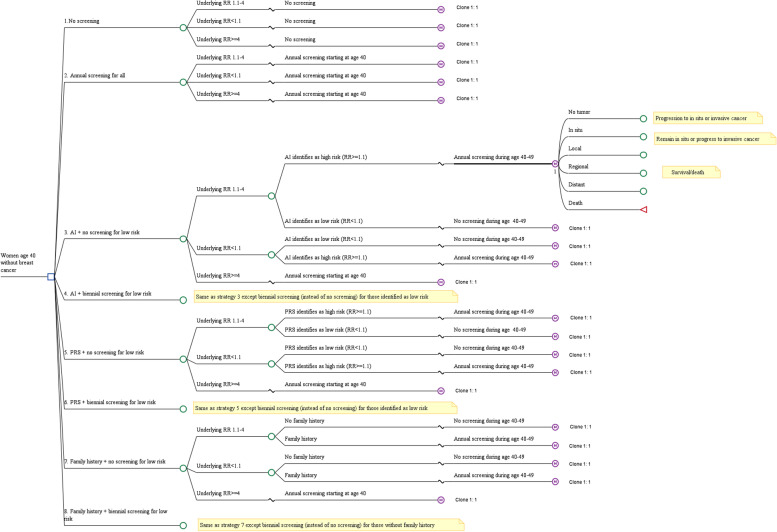
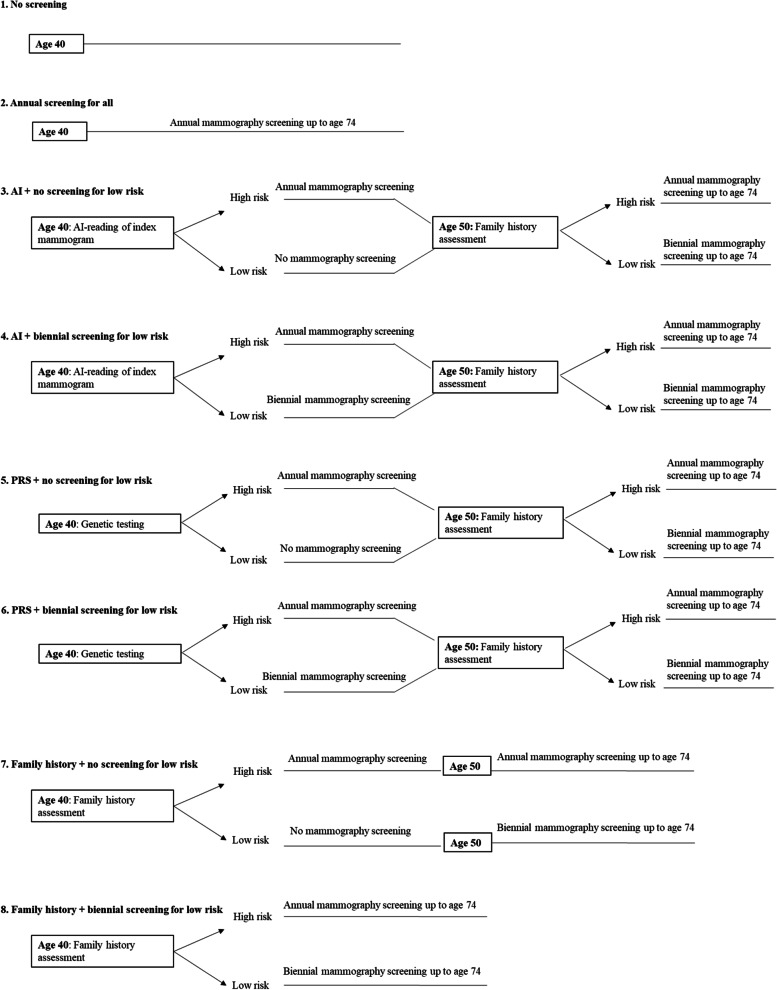
This study is a model-based economic evaluation. We used a hybrid decision tree/microsimulation model to compare the cost-effectiveness of eight strategies of mammography screening for women aged 40-49 (screening beyond age 50 follows existing guidelines). Six of these strategies were defined by combinations of risk prediction approaches (AI, PRS or family history) and screening frequency for low-risk women (no screening or biennial screening). The other two strategies involved annual screening for all women and no screening, respectively. Data used to populate the model were sourced from the published literature.

RESULTS

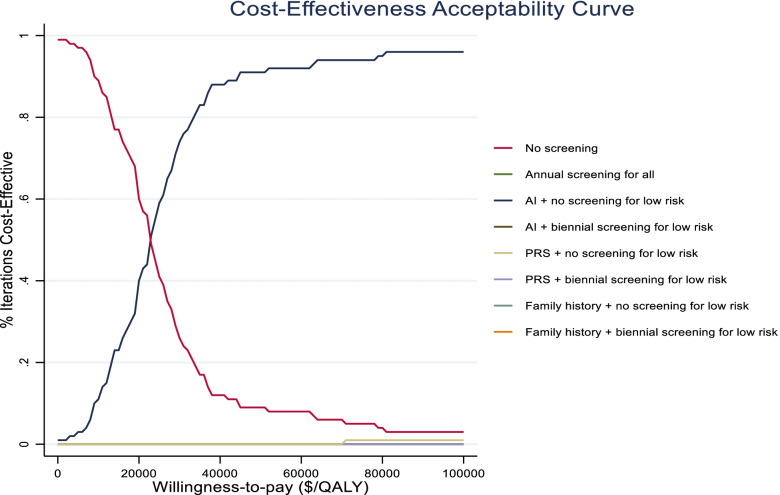
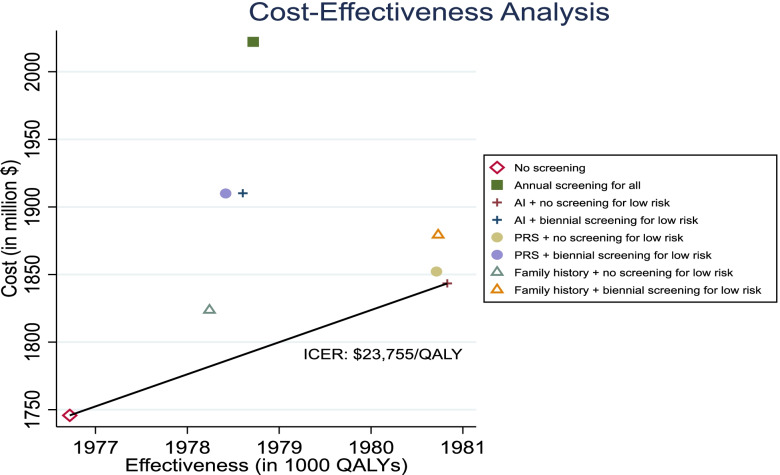
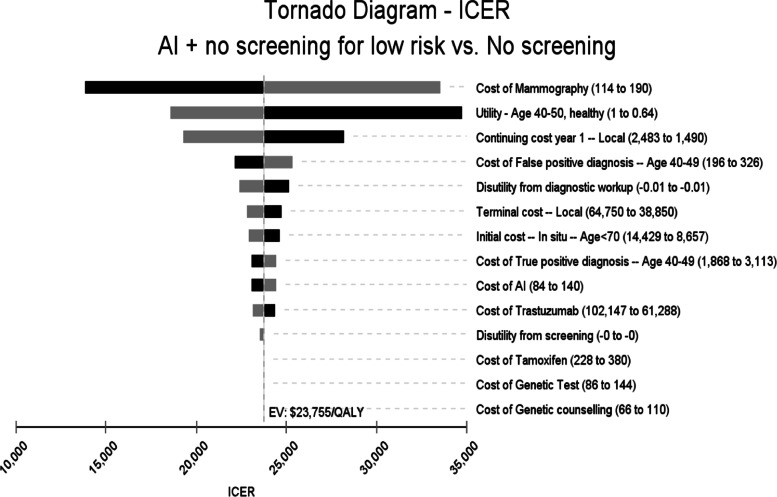
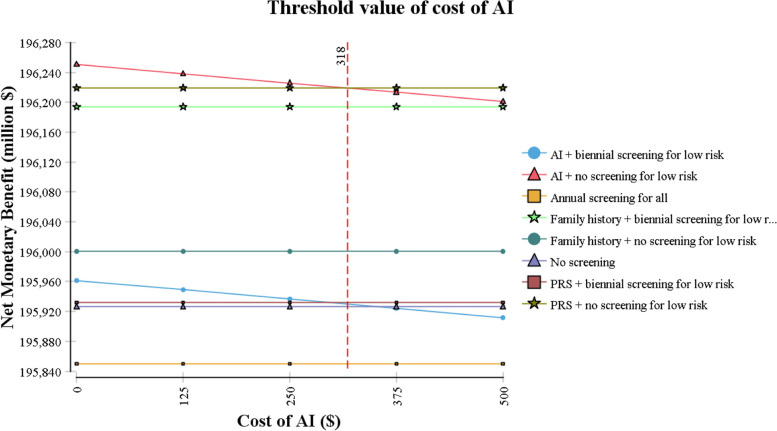
Risk prediction using AI followed by no screening for low-risk women is the most cost-effective strategy. It dominates (i.e., costs more and generates fewer quality adjusted life years (QALYs)) strategies for risk prediction using PRS followed by no screening or biennial screening for low-risk women, risk prediction using AI or family history followed by biennial screening for low-risk women, and annual screening for all women. It also extendedly dominates (i.e., achieves higher QALYs at a lower incremental cost per QALY) the strategy for risk prediction using family history followed by no screening for low-risk women. Meanwhile, it is cost-effective versus no screening, with an incremental cost-effectiveness ratio of $23,755 per QALY gained.

CONCLUSIONS

Risk prediction using AI followed by no breast cancer screening for low-risk women is the most cost-effective strategy. This finding can be explained by AI's ability to identify high-risk women more accurately than PRS and family history (which reduces the possibility of delayed breast cancer diagnosis) and fewer false-positive diagnoses from not screening low-risk women.

摘要

背景

目前,乳腺癌乳房 X 光筛查的指南因机构而异,特别是对于 40-49 岁的女性。使用人工智能(AI)读取乳房 X 光图像已被证明可以比其他方法(包括多基因风险评分(PRS))更准确地预测乳腺癌风险,这引发了一个问题,即基于 AI 的筛查是否比基于 PRS 或现有指南的筛查更具成本效益。本研究首次提供了阐明这一重要问题的证据。

方法

这是一项基于模型的经济评估。我们使用混合决策树/微观模拟模型来比较八种 40-49 岁女性乳房 X 光筛查策略的成本效益(50 岁以上的筛查遵循现有指南)。其中六种策略是通过风险预测方法(AI、PRS 或家族史)和低危女性筛查频率(不筛查或每两年筛查一次)的组合来定义的。另外两种策略分别涉及所有女性的年度筛查和不筛查。用于填充模型的数据来自已发表的文献。

结果

使用 AI 进行风险预测,然后对低危女性不进行筛查,是最具成本效益的策略。它优于使用 PRS 进行风险预测,然后对低危女性不进行筛查或每两年筛查一次,使用 AI 或家族史进行风险预测,然后对低危女性每两年筛查一次,以及对所有女性进行年度筛查的策略。它还广泛优于使用家族史进行风险预测,然后对低危女性不进行筛查的策略。同时,它与不筛查相比具有成本效益,增量成本效益比为每获得一个质量调整生命年(QALY)增加 23755 美元。

结论

使用 AI 进行风险预测,然后对低危女性不进行乳腺癌筛查,是最具成本效益的策略。这一发现可以用 AI 比 PRS 和家族史更准确地识别高危女性(减少乳腺癌诊断延迟的可能性)以及不筛查低危女性导致的假阳性诊断更少来解释。
https://cdn.ncbi.nlm.nih.gov/pmc/blobs/f2b6/9074290/9b4e063090b1/12885_2022_9613_Fig6_HTML.jpg
https://cdn.ncbi.nlm.nih.gov/pmc/blobs/f2b6/9074290/512f00c667af/12885_2022_9613_Fig1_HTML.jpg
https://cdn.ncbi.nlm.nih.gov/pmc/blobs/f2b6/9074290/4874b5944357/12885_2022_9613_Fig2_HTML.jpg
https://cdn.ncbi.nlm.nih.gov/pmc/blobs/f2b6/9074290/83faf020ac5b/12885_2022_9613_Fig3_HTML.jpg
https://cdn.ncbi.nlm.nih.gov/pmc/blobs/f2b6/9074290/905c0cc8dc74/12885_2022_9613_Fig4_HTML.jpg
https://cdn.ncbi.nlm.nih.gov/pmc/blobs/f2b6/9074290/cc06ba0bd407/12885_2022_9613_Fig5_HTML.jpg
https://cdn.ncbi.nlm.nih.gov/pmc/blobs/f2b6/9074290/9b4e063090b1/12885_2022_9613_Fig6_HTML.jpg
https://cdn.ncbi.nlm.nih.gov/pmc/blobs/f2b6/9074290/512f00c667af/12885_2022_9613_Fig1_HTML.jpg
https://cdn.ncbi.nlm.nih.gov/pmc/blobs/f2b6/9074290/4874b5944357/12885_2022_9613_Fig2_HTML.jpg
https://cdn.ncbi.nlm.nih.gov/pmc/blobs/f2b6/9074290/83faf020ac5b/12885_2022_9613_Fig3_HTML.jpg
https://cdn.ncbi.nlm.nih.gov/pmc/blobs/f2b6/9074290/905c0cc8dc74/12885_2022_9613_Fig4_HTML.jpg
https://cdn.ncbi.nlm.nih.gov/pmc/blobs/f2b6/9074290/cc06ba0bd407/12885_2022_9613_Fig5_HTML.jpg
https://cdn.ncbi.nlm.nih.gov/pmc/blobs/f2b6/9074290/9b4e063090b1/12885_2022_9613_Fig6_HTML.jpg

相似文献

1
Cost-effectiveness of using artificial intelligence versus polygenic risk score to guide breast cancer screening.使用人工智能与多基因风险评分指导乳腺癌筛查的成本效益比较。
BMC Cancer. 2022 May 6;22(1):501. doi: 10.1186/s12885-022-09613-1.
2
Personalizing mammography by breast density and other risk factors for breast cancer: analysis of health benefits and cost-effectiveness.基于乳腺癌密度和其他风险因素的个体化乳腺 X 光摄影:健康获益和成本效益分析。
Ann Intern Med. 2011 Jul 5;155(1):10-20. doi: 10.7326/0003-4819-155-1-201107050-00003.
3
Cost-Effectiveness of AI for Risk-Stratified Breast Cancer Screening.人工智能在风险分层乳腺癌筛查中的成本效益。
JAMA Netw Open. 2024 Sep 3;7(9):e2431715. doi: 10.1001/jamanetworkopen.2024.31715.
4
Incorporating Baseline Breast Density When Screening Women at Average Risk for Breast Cancer : A Cost-Effectiveness Analysis.在对乳腺癌平均风险的女性进行筛查时纳入基线乳房密度:成本效益分析。
Ann Intern Med. 2021 May;174(5):602-612. doi: 10.7326/M20-2912. Epub 2021 Feb 9.
5
Cost effectiveness analysis of a polygenic risk tailored breast cancer screening programme in Singapore.新加坡一项针对多基因风险的乳腺癌筛查计划的成本效益分析。
BMC Health Serv Res. 2021 Apr 23;21(1):379. doi: 10.1186/s12913-021-06396-2.
6
7
Assessing the Cost-Effectiveness of Updated Breast Cancer Screening Guidelines for Average-Risk Women.评估针对一般风险女性的更新乳腺癌筛查指南的成本效益。
Value Health. 2019 Feb;22(2):185-193. doi: 10.1016/j.jval.2018.07.880. Epub 2018 Sep 8.
8
Cost-effectiveness of annual versus biennial screening mammography for women with high mammographic breast density.对于乳腺钼靶检查显示乳房密度高的女性,每年一次与每两年一次乳腺钼靶筛查的成本效益分析。
J Med Screen. 2014 Dec;21(4):180-8. doi: 10.1177/0969141314549758. Epub 2014 Sep 3.
9
Cost-effectiveness of Breast Cancer Screening With Magnetic Resonance Imaging for Women at Familial Risk.家族性乳腺癌风险女性的磁共振成像乳腺癌筛查的成本效益分析。
JAMA Oncol. 2020 Sep 1;6(9):1381-1389. doi: 10.1001/jamaoncol.2020.2922.
10
Personalizing Breast Cancer Screening Based on Polygenic Risk and Family History.基于多基因风险和家族史的个体化乳腺癌筛查。
J Natl Cancer Inst. 2021 Apr 6;113(4):434-442. doi: 10.1093/jnci/djaa127.

引用本文的文献

1
Systematic review of cost effectiveness and budget impact of artificial intelligence in healthcare.人工智能在医疗保健领域成本效益和预算影响的系统评价
NPJ Digit Med. 2025 Aug 26;8(1):548. doi: 10.1038/s41746-025-01722-y.
2
Weighing the evidence on costs and benefits of polygenic risk-based approaches in clinical practice: A systematic review of economic evaluations.权衡临床实践中基于多基因风险方法的成本与效益证据:经济评估的系统综述
Am J Hum Genet. 2025 Aug 7;112(8):1735-1753. doi: 10.1016/j.ajhg.2025.05.012. Epub 2025 Jun 12.
3
Risk-adjusted breast screening: an Australian perspective and considerations for the Western Pacific.

本文引用的文献

1
Cost-effectiveness of risk-based breast cancer screening: A systematic review.基于风险的乳腺癌筛查的成本效益:一项系统综述。
Int J Cancer. 2021 Apr 12. doi: 10.1002/ijc.33593.
2
United States Life Tables, 2017.《2017年美国生命表》
Natl Vital Stat Rep. 2019 Jun;68(7):1-66.
3
Cost-Effectiveness of Risk-Stratified Colorectal Cancer Screening Based on Polygenic Risk: Current Status and Future Potential.基于多基因风险的风险分层结直肠癌筛查的成本效益:现状与未来潜力
风险调整后的乳腺筛查:澳大利亚视角及西太平洋地区的考量
Lancet Reg Health West Pac. 2025 Mar 19;57:101520. doi: 10.1016/j.lanwpc.2025.101520. eCollection 2025 Apr.
4
Implementing artificial intelligence in breast cancer screening: Women's preferences.在乳腺癌筛查中应用人工智能:女性的偏好。
Cancer. 2025 May 1;131(9):e35859. doi: 10.1002/cncr.35859.
5
Economic evaluation of personalised versus conventional risk assessment for women who have undergone testing for hereditary breast and ovarian cancer genes: a modelling study.针对已接受遗传性乳腺癌和卵巢癌基因检测的女性,个性化风险评估与传统风险评估的经济学评价:一项建模研究
J Med Genet. 2025 Jun 24;62(7):450-456. doi: 10.1136/jmg-2024-109948.
6
The Cost Effectiveness of Genomic Medicine in Cancer Control: A Systematic Literature Review.基因组医学在癌症控制中的成本效益:一项系统文献综述。
Appl Health Econ Health Policy. 2025 May;23(3):359-393. doi: 10.1007/s40258-025-00949-w. Epub 2025 Mar 29.
7
Harnessing Artificial Intelligence to Enhance Global Breast Cancer Care: A Scoping Review of Applications, Outcomes, and Challenges.利用人工智能提升全球乳腺癌护理水平:应用、成果及挑战的范围综述
Cancers (Basel). 2025 Jan 9;17(2):197. doi: 10.3390/cancers17020197.
8
Genetic Basis of Breast and Ovarian Cancer: Approaches and Lessons Learnt from Three Decades of Inherited Predisposition Testing.遗传性乳腺癌和卵巢癌的基因基础:三十年来遗传性易感性检测的方法和经验教训。
Genes (Basel). 2024 Feb 8;15(2):219. doi: 10.3390/genes15020219.
9
Explainable machine learning for breast cancer diagnosis from mammography and ultrasound images: a systematic review.从乳腺 X 光和超声图像进行乳腺癌诊断的可解释机器学习:系统综述。
BMJ Health Care Inform. 2024 Feb 2;31(1):e100954. doi: 10.1136/bmjhci-2023-100954.
10
Economic evaluations of artificial intelligence-based healthcare interventions: a systematic literature review of best practices in their conduct and reporting.基于人工智能的医疗保健干预措施的经济评估:对其实施和报告最佳实践的系统文献综述
Front Pharmacol. 2023 Aug 8;14:1220950. doi: 10.3389/fphar.2023.1220950. eCollection 2023.
JNCI Cancer Spectr. 2019 Oct 14;4(1):pkz086. doi: 10.1093/jncics/pkz086. eCollection 2020 Feb.
4
A Cost-effectiveness Analysis of Multigene Testing for All Patients With Breast Cancer.对所有乳腺癌患者进行多基因检测的成本效益分析。
JAMA Oncol. 2019 Dec 1;5(12):1718-1730. doi: 10.1001/jamaoncol.2019.3323.
5
A Deep Learning Mammography-based Model for Improved Breast Cancer Risk Prediction.基于深度学习的乳腺 X 线摄影模型提高乳腺癌风险预测。
Radiology. 2019 Jul;292(1):60-66. doi: 10.1148/radiol.2019182716. Epub 2019 May 7.
6
Assessing the Cost-Effectiveness of Updated Breast Cancer Screening Guidelines for Average-Risk Women.评估针对一般风险女性的更新乳腺癌筛查指南的成本效益。
Value Health. 2019 Feb;22(2):185-193. doi: 10.1016/j.jval.2018.07.880. Epub 2018 Sep 8.
7
Polygenic Risk Scores for Prediction of Breast Cancer and Breast Cancer Subtypes.多基因风险评分在乳腺癌及乳腺癌亚型预测中的应用。
Am J Hum Genet. 2019 Jan 3;104(1):21-34. doi: 10.1016/j.ajhg.2018.11.002. Epub 2018 Dec 13.
8
Cost-effectiveness and Benefit-to-Harm Ratio of Risk-Stratified Screening for Breast Cancer: A Life-Table Model.基于生命表模型的乳腺癌风险分层筛查的成本效益和获益-危害比分析。
JAMA Oncol. 2018 Nov 1;4(11):1504-1510. doi: 10.1001/jamaoncol.2018.1901.
9
Estimating Breast Cancer Survival by Molecular Subtype in the Absence of Screening and Adjuvant Treatment.在缺乏筛查和辅助治疗的情况下,根据分子亚型估算乳腺癌的生存率。
Med Decis Making. 2018 Apr;38(1_suppl):32S-43S. doi: 10.1177/0272989X17743236.
10
Cost-effectiveness of mammography from a publicly funded health care system perspective.从公共资助医疗保健系统的角度看乳腺钼靶检查的成本效益。
CMAJ Open. 2018 Feb 8;6(1):E77-E86. doi: 10.9778/cmajo.20170106.