Edison Family Center for Genome Sciences and Systems Biology, Washington University School of Medicine, St. Louis, MO 63110.
Center for Gut Microbiome and Nutrition Research, Washington University School of Medicine, St. Louis, MO 63110.
Proc Natl Acad Sci U S A. 2022 May 17;119(20):e2123411119. doi: 10.1073/pnas.2123411119. Epub 2022 May 9.
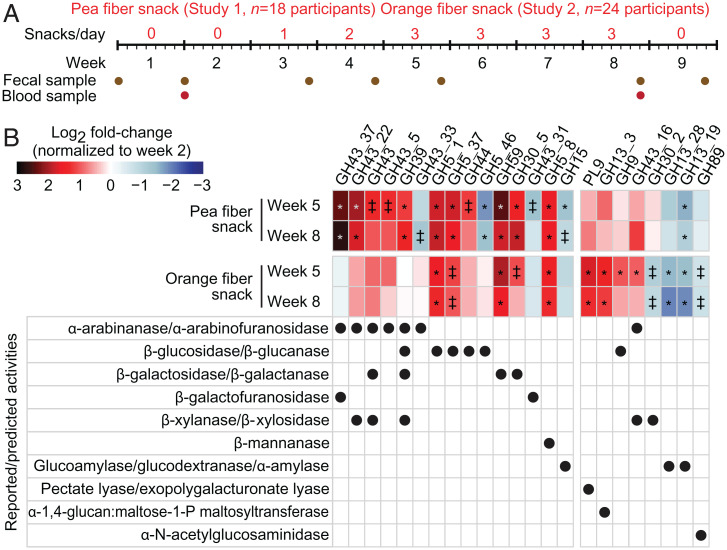
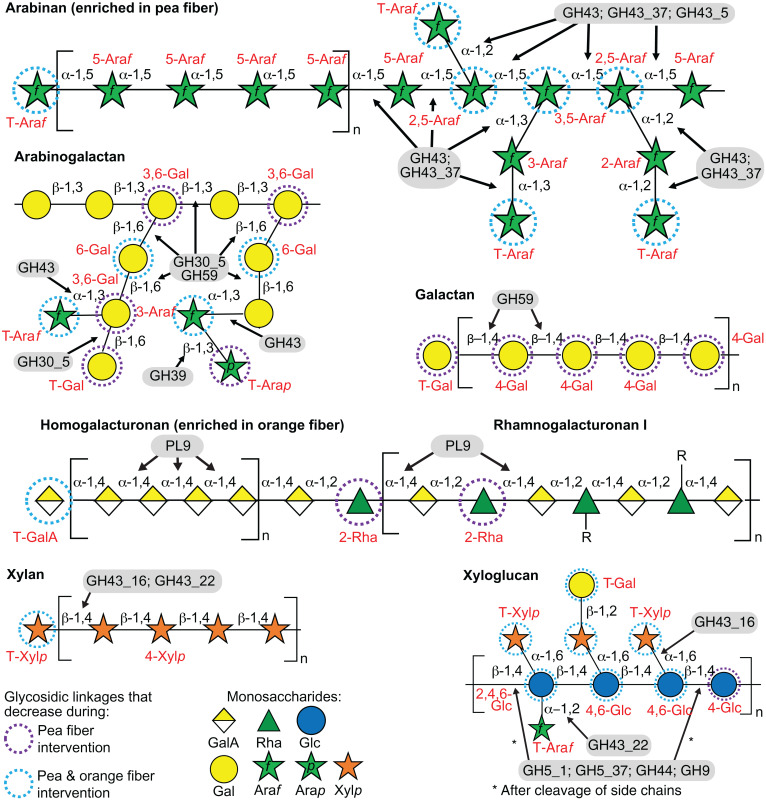
Increases in snack consumption associated with Westernized lifestyles provide an opportunity to introduce nutritious foods into poor diets. We describe two 10-wk-long open label, single group assignment human studies that measured the effects of two snack prototypes containing fiber preparations from two sustainable and scalable sources; the byproducts remaining after isolation of protein from the endosperm of peas and the vesicular pulp remaining after processing oranges for the manufacture of juices. The normal diets of study participants were supplemented with either a pea- or orange fiber-containing snack. We focused our analysis on quantifying the abundances of genes encoding carbohydrate-active enzymes (CAZymes) (glycoside hydrolases and polysaccharide lyases) in the fecal microbiome, mass spectrometric measurements of glycan structures (glycosidic linkages) in feces, plus aptamer-based assessment of levels of 1,300 plasma proteins reflecting a broad range of physiological functions. Computational methods for feature selection identified treatment-discriminatory changes in CAZyme genes that correlated with alterations in levels of fiber-associated glycosidic linkages; these changes in turn correlated with levels of plasma proteins representing diverse biological functions, including transforming growth factor type β/bone morphogenetic protein-mediated fibrosis, vascular endothelial growth factor-related angiogenesis, P38/MAPK-associated immune cell signaling, and obesity-associated hormonal regulators. The approach used represents a way to connect changes in consumer microbiomes produced by specific fiber types with host responses in the context of varying background diets.
随着西化生活方式导致零食消费的增加,为在不良饮食中引入营养食品提供了机会。我们描述了两项为期 10 周的开放性、单组分配人体研究,测量了两种零食原型的效果,这些原型含有两种可持续和可扩展来源的纤维制剂:从豌豆胚乳中分离蛋白质后剩余的副产品,以及用于制造果汁的橙子加工后剩余的泡囊果肉。研究参与者的正常饮食中补充了含有豌豆或橙纤维的零食。我们的分析重点是量化粪便微生物组中编码碳水化合物活性酶(CAZymes)(糖苷水解酶和多糖裂解酶)的基因丰度,粪便中聚糖结构(糖苷键)的质谱测量,以及基于适体的对反映广泛生理功能的 1300 种血浆蛋白水平的评估。用于特征选择的计算方法确定了 CAZyme 基因的治疗区分变化,这些变化与纤维相关的糖苷键水平的变化相关;这些变化反过来又与代表多种生物学功能的血浆蛋白水平相关,包括转化生长因子β/骨形态发生蛋白介导的纤维化、血管内皮生长因子相关的血管生成、P38/MAPK 相关的免疫细胞信号转导以及肥胖相关的激素调节剂。所使用的方法代表了一种将特定纤维类型产生的消费者微生物组的变化与不同背景饮食下宿主反应联系起来的方法。