Department of Orthopaedics, Shanghai General Hospital, Shanghai Jiaotong University, School of Medicine, Shanghai, China.
Department of Orthopaedics, Qingpu Branch of Zhongshan Hospital Affiliated with Fudan University, Shanghai, China.
Orthop Surg. 2022 Jun;14(6):1161-1166. doi: 10.1111/os.13211. Epub 2022 May 10.
To retrospectively analyze and compare the relationship between the success rate of patient-derived xenograft (PDX) modeling of osteosarcoma and prognosis (3-year overall survival rate and disease-free survival rate) and incidence of lung metastasis.
The sample group consisted of 57 osteosarcoma patients with definite pathological diagnoses from Shanghai General Hospital from 2015-2017. PDX models in 57 patients were analyzed by retrospective analyses. Among the patients currently inoculated, 20 were tumorigenic in the PDX model, and 37 were nontumorigenic. According to the tumorigenicity of PDXs, the corresponding osteosarcoma patients were divided into two groups. The effects of clinically related indicators on the model were retrospectively compared. The patients were followed, and the 3-year survival, 3-year disease-free survival (DFS), and lung metastasis rates were collected. The relationship between the modeling success and patient prognosis was investigated.
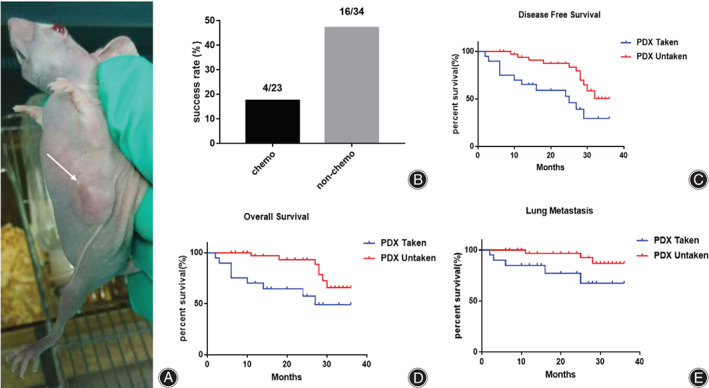
In the chemotherapy-treated group, the PDX modeling success rate was 17.4%, and in the nonchemotherapy group, the success rate was 47.1%. The success of PDX modeling was related to whether patients received chemotherapy. The success rate of PDX modeling is significantly reduced after receiving chemotherapy. The 3-year overall survival rate of the PDX-grafted group was 49.23%, and that of the PDX-nongrafted group was 65.71%. There was a significant difference between the two groups, showing a strong negative correlation between the 3-year survival rate and the success rate of the PDX model. The 3-year disease-free survival rate of the PDX-grafted group was 29.54%. The 3-year DFS of the PDX-nongrafted group was 50.34%. There was a significant difference between the two groups. Lower grafted rates indicate a higher DFS rate. The incidence of lung metastasis in the PDX-grafted group was 32.4%, and that in the nongrafted group was 13.1%. There was a significant difference between the two groups. The successful establishment of the PDX model indicates that patients are more likely to have lung metastases.
The success of PDX modeling often indicates poor prognosis (low 3-year overall survival rate and disease-free survival rate) and a greater possibility of lung metastasis. Therefore, PDX modeling in osteosarcoma patients can accurately predict the prognosis of patients and the risk of lung metastasis in advance to help us develop better therapeutic strategies.
回顾性分析比较骨肉瘤患者来源异种移植(PDX)建模成功率与预后(3 年总生存率和无病生存率)及肺转移发生率的关系。
选取 2015-2017 年上海交通大学附属第六人民医院明确病理诊断的骨肉瘤患者 57 例作为样本组,对 57 例患者的 PDX 模型进行回顾性分析。目前已接种的患者中,20 例 PDX 模型成瘤,37 例 PDX 模型不成瘤。根据 PDX 的成瘤性,将相应的骨肉瘤患者分为两组,对临床相关指标对模型的影响进行回顾性对比,对患者进行随访,收集 3 年生存、3 年无病生存率(DFS)及肺转移率,探究建模成功率与患者预后的关系。
化疗组 PDX 建模成功率为 17.4%,非化疗组成功率为 47.1%。PDX 建模的成功与患者是否接受化疗有关,接受化疗后 PDX 建模成功率明显降低。PDX 移植组 3 年总生存率为 49.23%,PDX 未移植组为 65.71%,两组间有显著差异,呈负相关,3 年生存率与 PDX 模型成功率呈负相关。PDX 移植组 3 年无病生存率为 29.54%,PDX 未移植组为 34.62%,两组间有显著差异。移植率越低,DFS 率越高。PDX 移植组肺转移发生率为 32.4%,未移植组为 13.1%,两组间有显著差异。PDX 模型的成功建立表明患者更有可能发生肺转移。
PDX 建模的成功往往预示着不良预后(3 年总生存率和无病生存率低)和更大的肺转移可能性。因此,PDX 建模可在骨肉瘤患者中准确预测患者的预后和肺转移风险,提前帮助我们制定更好的治疗策略。