Lotfi Keyhan, Hassanzadeh Keshteli Ammar, Saneei Parvane, Afshar Hamid, Esmaillzadeh Ahmad, Adibi Peyman
Department of Community Nutrition, School of Nutritional Sciences and Dietetics, Tehran University of Medical Sciences, Tehran, Iran.
Department of Medicine, University of Alberta, Edmonton, AB, Canada.
Front Nutr. 2022 Apr 25;9:843155. doi: 10.3389/fnut.2022.843155. eCollection 2022.
Despite the large evidence on the association between obesity and psychological disorders, studies investigating new anthropometric indices in relation to mental health are limited. We aimed to explore the association between A Body Shape Index (ABSI) and Body Roundness Index (BRI) and common psychological disorders (anxiety, depression, and psychological distress) among Iranian adults.
In this cross-sectional investigation, anthropometric measures of 3213 Iranian adults were gathered using a validated self-reported questionnaire. ABSI and BRI values of participants were calculated through pre-defined formulas. General Health Questionnaire (GHQ) and Hospital Anxiety and Depression Scale (HADS) validated for Iranians were used to assess psychological distress, anxiety, and depression.
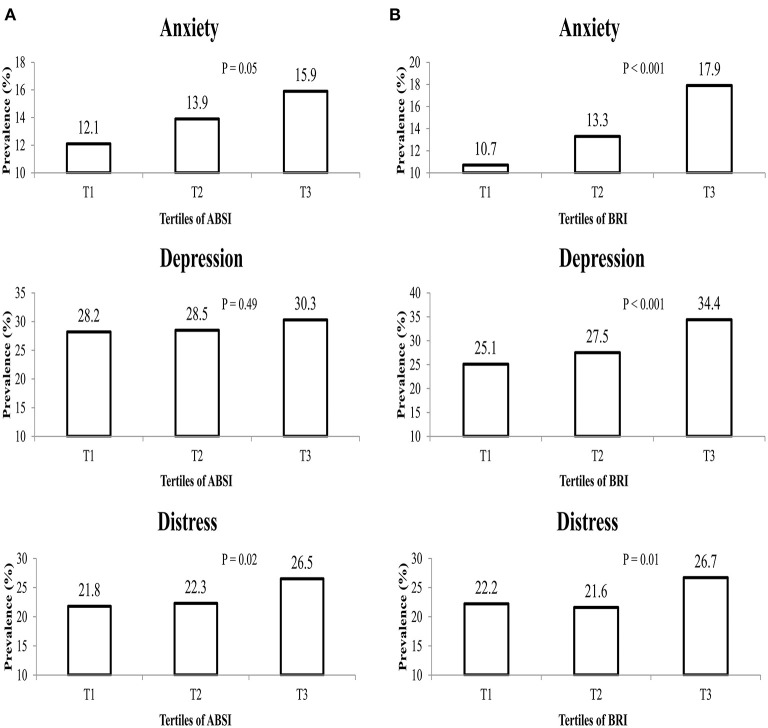
Mean age of participants was 36.6 ± 7.73, and 62.8% of them were women. ABSI and BRI were higher in subjects with anxiety and psychological distress. Also, depressed participants had higher BRI. After considering potential confounders, individuals in the last tertile of ABSI, compared to the first tertile, had higher odds of anxiety (OR: 1.41, 95%CI: 1.04, 1.93) and psychological distress (OR: 1.39, 95%CI: 1.09, 1.79). Also, a marginal association was found between the highest category of ABSI and depression (OR: 1.27; 95%CI: 1.00, 1.61). In the sex-stratified analysis, ABSI was positively related to odds of anxiety (OR: 1.58; 95%CI; 1.12, 2.22), depression (OR: 1.40; 95%CI; 1.07, 1.84), and psychological distress (OR: 1.51; 95%CI; 1.13, 2.01) among women, but not men. We failed to find any significant association between BRI and depression, anxiety and psychological distress.
We found that ABSI was associated with anxiety, depression and psychological distress among females, but not males. However, we did not find a significant relation between BRI and the outcomes. Further prospective studies are required to confirm our findings.
尽管有大量证据表明肥胖与心理障碍之间存在关联,但研究新的人体测量指数与心理健康关系的研究有限。我们旨在探讨伊朗成年人中身体形状指数(ABSI)和身体圆润度指数(BRI)与常见心理障碍(焦虑、抑郁和心理困扰)之间的关联。
在这项横断面调查中,使用经过验证的自我报告问卷收集了3213名伊朗成年人的人体测量数据。通过预定义公式计算参与者的ABSI和BRI值。使用经过伊朗人验证的一般健康问卷(GHQ)和医院焦虑抑郁量表(HADS)来评估心理困扰、焦虑和抑郁。
参与者的平均年龄为36.6±7.73岁,其中62.8%为女性。焦虑和心理困扰患者的ABSI和BRI较高。此外,抑郁参与者的BRI较高。在考虑潜在混杂因素后,ABSI处于最高三分位数的个体与处于最低三分位数的个体相比,焦虑(比值比:1.41,95%置信区间:1.04,1.93)和心理困扰(比值比:1.39,95%置信区间:1.09,1.79)的几率更高。此外,还发现ABSI的最高类别与抑郁之间存在边缘关联(比值比:1.27;95%置信区间:1.00,1.61)。在按性别分层的分析中,ABSI与女性焦虑(比值比:1.58;95%置信区间;1.12,2.22)、抑郁(比值比:1.40;95%置信区间;1.07,1.84)和心理困扰(比值比:1.51;95%置信区间;1.13,2.01)的几率呈正相关,但与男性无关。我们未发现BRI与抑郁、焦虑和心理困扰之间存在任何显著关联。
我们发现ABSI与女性的焦虑、抑郁和心理困扰有关,但与男性无关。然而,我们未发现BRI与这些结果之间存在显著关系。需要进一步的前瞻性研究来证实我们的发现。