Superfund and Emergency Management Division, Region 2, U.S. Environmental Protection Agency, NY, USA.
Office of Pollution Prevention and Toxics, U.S. Environmental Protection Agency, NC, USA.
Environ Int. 2022 Jun;164:107243. doi: 10.1016/j.envint.2022.107243. Epub 2022 Apr 12.
Systematic evidence maps are increasingly used to develop chemical risk assessments. These maps can provide an overview of available studies and relevant study information to be used for various research objectives and applications. Environmental epidemiological studies that examine the impact of chemical exposures on various 'omic profiles in human populations provide relevant mechanistic information and can be used for benchmark dose modeling to derive potential human health reference values.
To create a systematic evidence map of environmental epidemiological studies examining environmental contaminant exposures with 'omics in order to characterize the extent of available studies for future research needs.
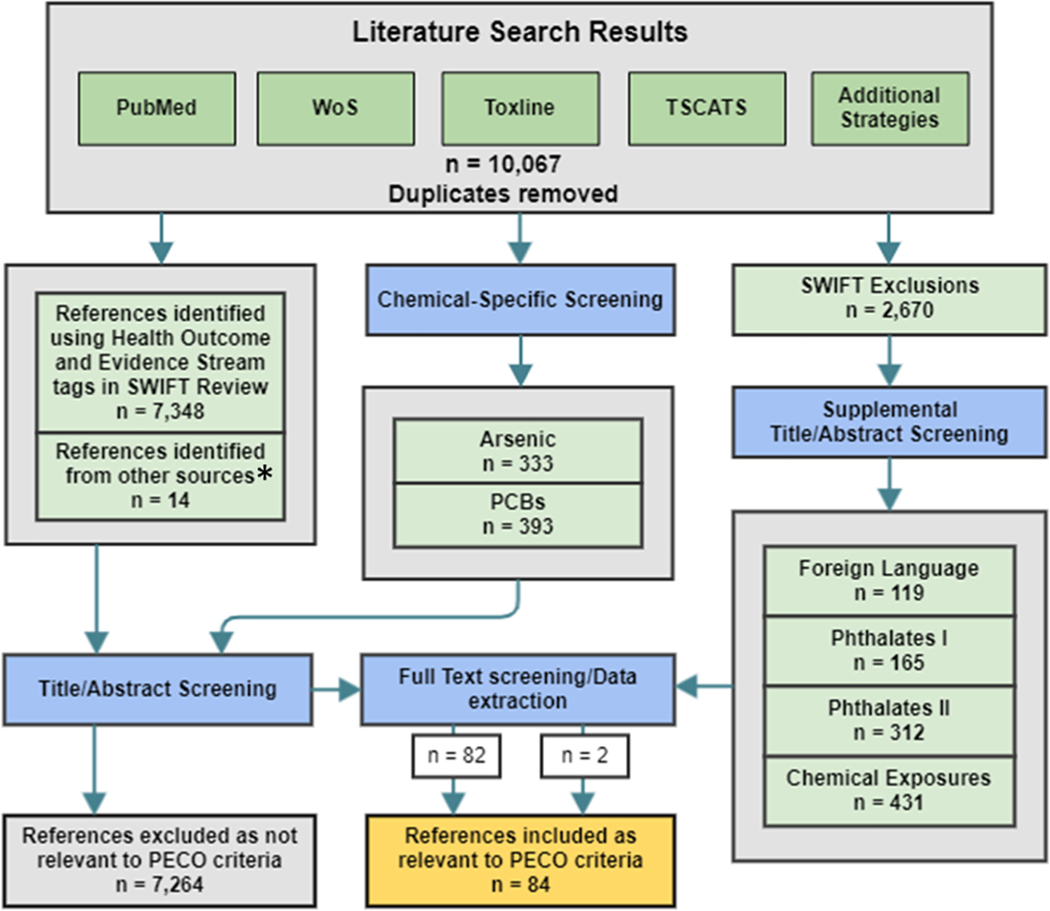
Systematic review methods were used to search and screen the literature and included the use of machine learning methods to facilitate screening studies. The Populations, Exposures, Comparators and Outcomes (PECO) criteria were developed to identify and screen relevant studies. Studies that met the PECO criteria after full-text review were summarized with information such as study population, study design, sample size, exposure measurement, and 'omics analysis.
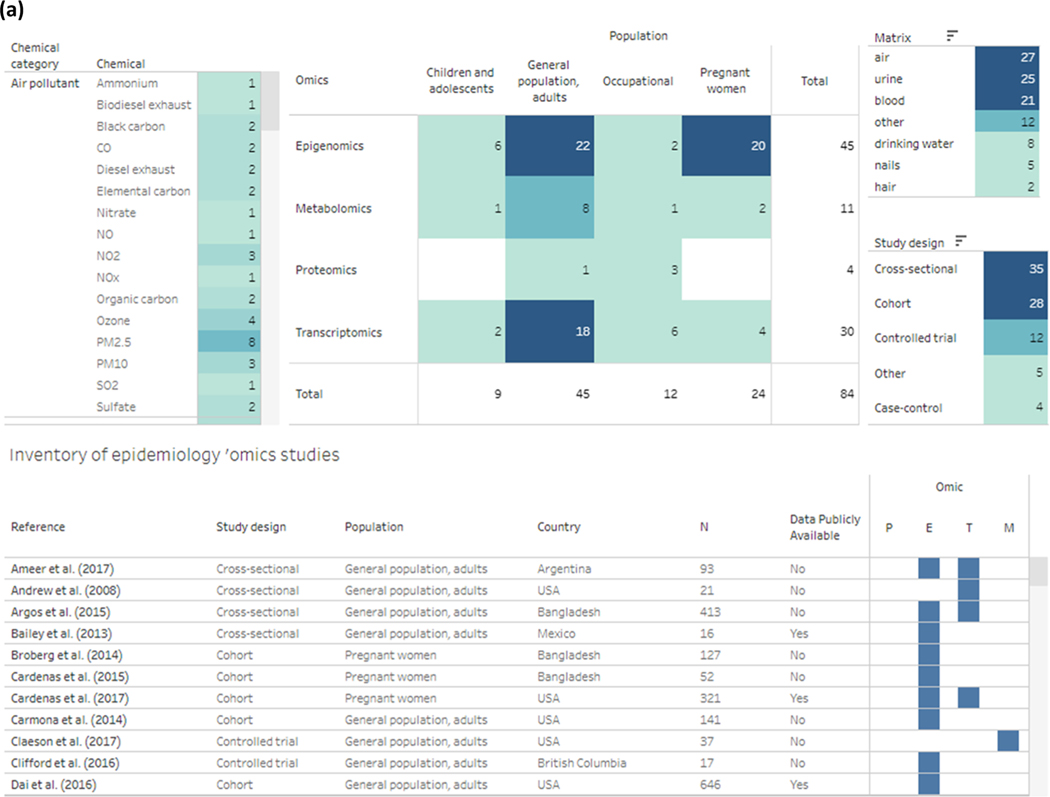
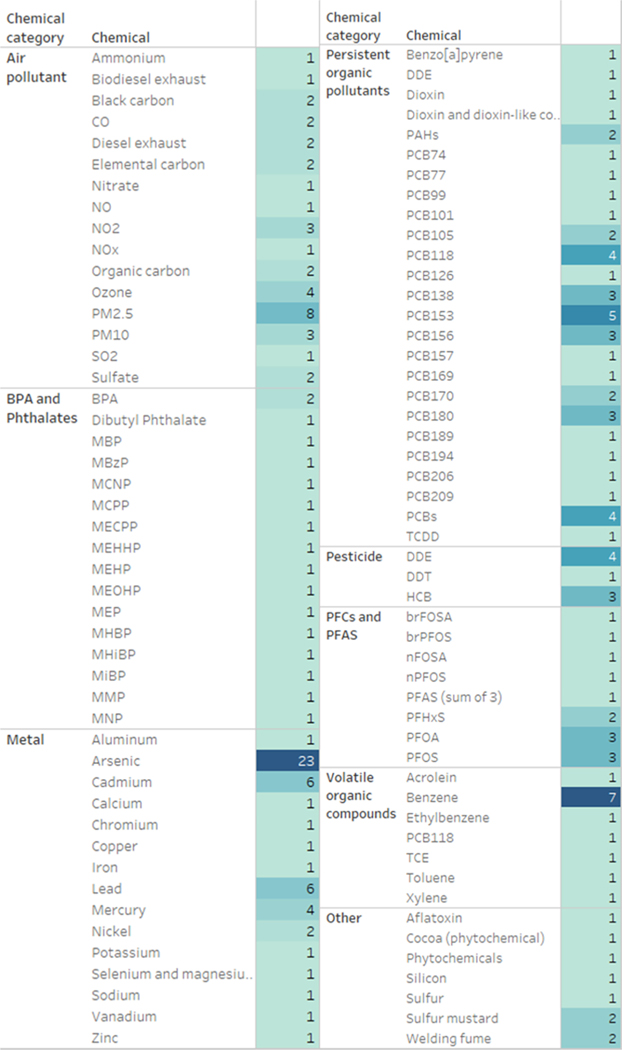
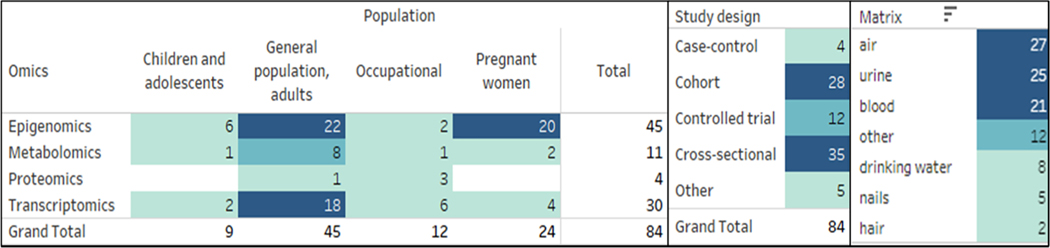
Over 10,000 studies were identified from scientific databases. Screening processes were used to identify 84 studies considered PECO-relevant after full-text review. Various contaminants (e.g. phthalate, benzene, arsenic, etc.) were investigated in epidemiological studies that used one or more of the four 'omics of interest: epigenomics, transcriptomics, proteomics, and metabolomics . The epidemiological study designs that were used to explore single or integrated 'omic research questions with contaminant exposures were cohort studies, controlled trials, cross-sectional, and case-control studies. An interactive web-based systematic evidence map was created to display more study-related information.
This systematic evidence map is a novel tool to visually characterize the available environmental epidemiological studies investigating contaminants and biological effects using 'omics technology and serves as a resource for investigators and allows for a range of applications in chemical research and risk assessment needs.
系统证据图谱越来越多地用于制定化学风险评估。这些图谱可以提供可用研究的概述和相关研究信息,用于各种研究目标和应用。研究化学暴露对人群中各种“组学”谱影响的环境流行病学研究提供了相关的机制信息,并可用于基准剂量建模,以得出潜在的人类健康参考值。
创建一个系统证据图谱,用于检查环境流行病学研究中与“组学”相关的环境污染物暴露情况,以描述未来研究需求的现有研究的范围。
使用系统评价方法搜索和筛选文献,并使用机器学习方法来促进筛选研究。制定了人群、暴露、对照和结局(PECO)标准,以识别和筛选相关研究。经过全文审查后符合 PECO 标准的研究,总结了研究人群、研究设计、样本量、暴露测量和“组学”分析等信息。
从科学数据库中确定了超过 10000 项研究。筛选过程用于识别经过全文审查后被认为与 PECO 相关的 84 项研究。在使用一种或多种感兴趣的“组学”(如表观基因组学、转录组学、蛋白质组学和代谢组学)的流行病学研究中,研究了各种污染物(如邻苯二甲酸酯、苯、砷等)。用于探索污染物暴露与单一或综合“组学”研究问题的流行病学研究设计是队列研究、对照试验、横断面和病例对照研究。创建了一个交互式网络系统证据图谱,以显示更多与研究相关的信息。
这个系统证据图谱是一种新颖的工具,可以直观地描述使用“组学”技术调查污染物和生物学效应的现有环境流行病学研究,并作为研究人员的资源,为化学研究和风险评估需求提供了多种应用。