The Novo Nordisk Foundation, Center for Biosustainability, Technical University of Denmark, 2800, Kogens Lyngby, Denmark.
Systems and Synthetic Biology Division, Department of Biology and Biological Engineering, Chalmers University of Technology, 412 96, Gothenburg, Sweden.
Sci Rep. 2022 May 12;12(1):7902. doi: 10.1038/s41598-022-11811-7.
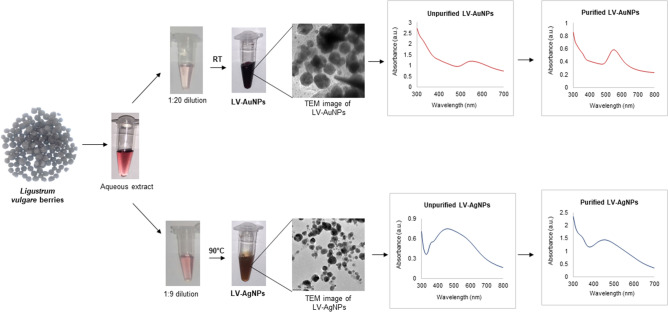
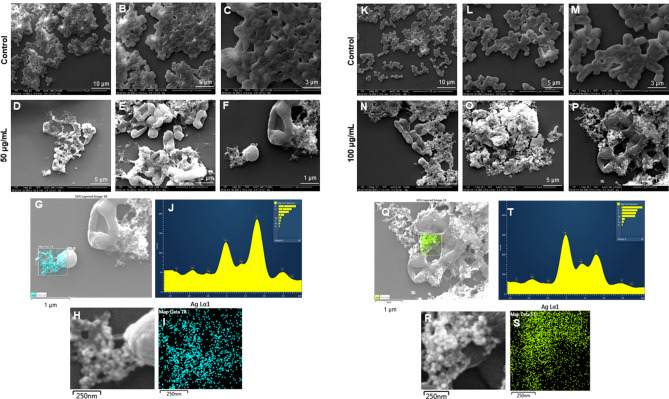
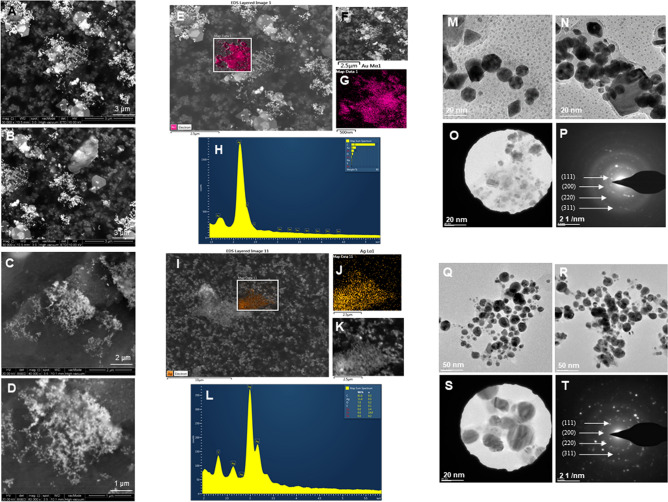
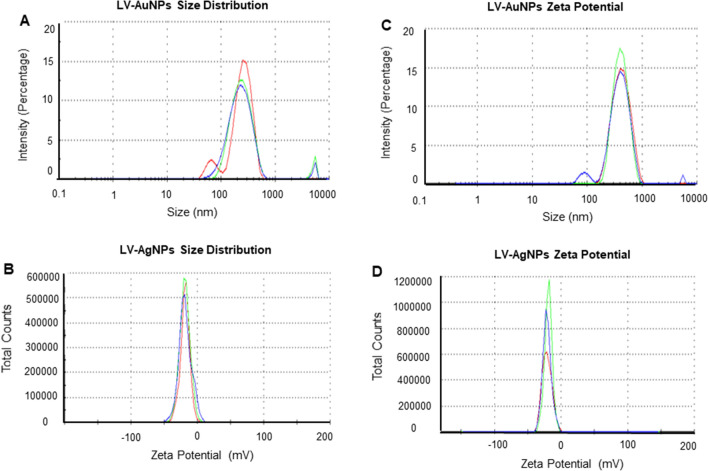
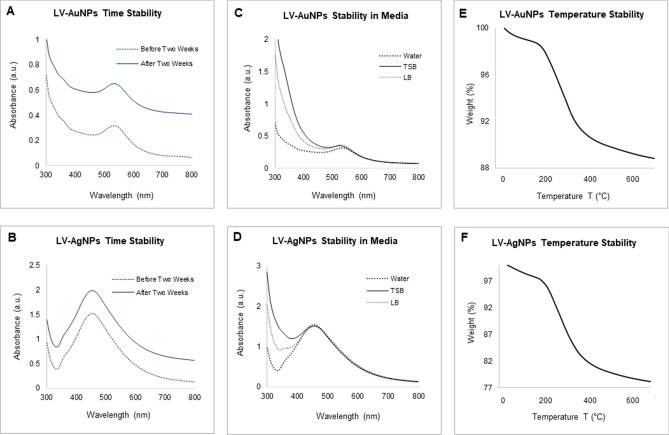
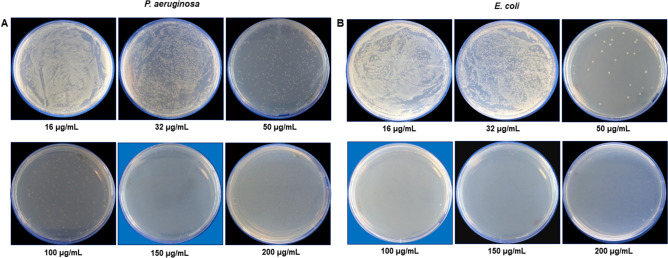
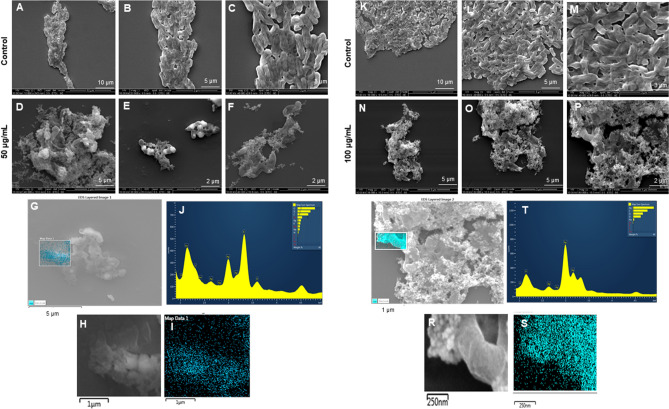
Increasing demand for green or biological nanoparticles has led to various green technologies and resources, which play a critical role in forming biocompatible or green nanoparticles. So far, numerous medicinal plants have been explored for this purpose, assuming that medicinal components from the plant's material will contribute to corona formation around nanoparticles and enhance their efficacy. Research is also extended to other green and waste resources to be utilized for this purpose. In the current study, we explored Ligustrum vulgare berries, also known as privet berries, to reduce gold and silver salts into nanoparticles. L. vulgare berries showed great potential to form these nanoparticles, as gold nanoparticles (LV-AuNPs) formed within 5 min at room temperature, and silver nanoparticles (LV-AgNPs) formed in 15 min at 90 °C. LV-AuNPs and LV-AgNPs were characterized by various analytical methods, including UV-Vis, SEM, EDX, TEM, DLS, sp-ICP-MS, TGA, FT-IR, and MALDI-TOF. The results demonstrate that the LV-AuNPs are polydisperse in appearance with a size range 50-200 nm. LV-AuNPs exhibit various shapes, including spherical, triangular, hexagonal, rod, cuboid, etc. In contrast, LV-AgNPs are quite monodisperse, 20-70 nm, and most of the population was spherical. The nanoparticles remain stable over long periods and exhibit high negative zeta potential values. The antimicrobial investigation of LV-AgNPs demonstrated that the nanoparticles exhibit antibacterial ability with an MBC value of 150 g/mL against P. aeruginosa and 100 g/mL against E. coli, as determined by plate assay, live and dead staining, and SEM cell morphology analysis.
对绿色或生物纳米粒子的需求不断增加,促使人们开发出各种绿色技术和资源,这些技术和资源在形成生物相容性或绿色纳米粒子方面发挥着关键作用。迄今为止,人们已经探索了许多药用植物来实现这一目标,因为人们假设植物材料中的药用成分将有助于在纳米粒子周围形成冠状物,并提高其功效。研究还扩展到其他绿色和废物资源,以将其用于这一目的。在本研究中,我们探索了女贞子(俗称 privet 浆果)来将金和银盐还原成纳米粒子。女贞子显示出形成这些纳米粒子的巨大潜力,因为金纳米粒子(LV-AuNPs)在室温下 5 分钟内形成,而银纳米粒子(LV-AgNPs)在 90°C 下 15 分钟内形成。LV-AuNPs 和 LV-AgNPs 通过各种分析方法进行了表征,包括 UV-Vis、SEM、EDX、TEM、DLS、sp-ICP-MS、TGA、FT-IR 和 MALDI-TOF。结果表明,LV-AuNPs 的外观呈多分散性,尺寸范围为 50-200nm。LV-AuNPs 表现出各种形状,包括球形、三角形、六边形、棒状、长方体等。相比之下,LV-AgNPs 相当单分散,尺寸为 20-70nm,大多数为球形。纳米粒子在很长一段时间内保持稳定,并表现出高的负 zeta 电位值。对 LV-AgNPs 的抗菌研究表明,纳米粒子表现出抗菌能力,平板测定、死活染色和 SEM 细胞形态分析表明,对铜绿假单胞菌的最小抑菌浓度(MBC)值为 150μg/mL,对大肠杆菌的 MBC 值为 100μg/mL。