Nutritional Epidemiology, Department of Nutrition and Food Sciences, Rheinische Friedrich-Wilhelms-University Bonn, Bonn, Germany.
J Nutr. 2022 Jul 6;152(7):1763-1772. doi: 10.1093/jn/nxac094.
Validation of the EAT-Lancet reference diet (ELR-diet), recently proposed by the EAT-Lancet Commission, within the context of real-life studies is necessary to elucidate its feasibility, nutritional value, sustainability, and health effects.
We aimed to develop a dietary index (DI) score to measure adherence to the ELR-diet. We further aimed to study the association between the DI score and 1) nutritional characteristics, 2) indicators of ecological sustainability, and 3) anthropometric markers and biomarkers for cardiometabolic health.
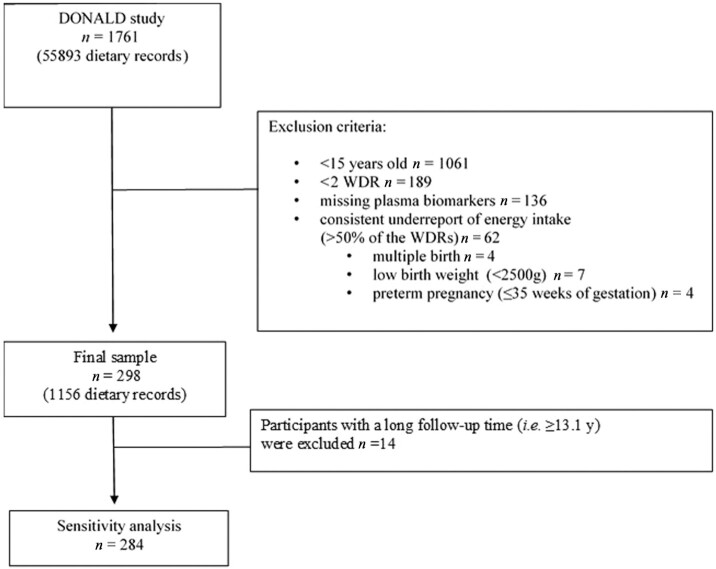
A DI score was constructed by comparing the categories defined by the ELR-diet with the dietary data of 2-5 sets of 3-d weighed dietary records from DONALD (Dortmund Nutritional and Anthropometric Longitudinal Designed) study participants (n = 298; ≥15 y of age). Prospective associations between the DI score and risk markers (anthropometric and cardiometabolic) in young adulthood (≥18 y old) were investigated using multivariate linear regression.
Adherence to the DI score components was considerable (majority > 50%), but varied within the population (2%-100%). The highest tertile of the DI score was inversely associated with the intake of protein (tertile 3 compared with tertile 1: 13.5 compared with 14.5 energy %), added sugars (10.5 compared with 12.4 energy %), and cholesterol (100 compared with 116 mg/1000 kcal), but positively associated with fiber intake (10.0 compared with 8.82 g/1000 kcal) (all P < 0.05). The DI score was inversely associated with greenhouse-gas emissions (tertile 1 compared with tertile 3: 6.48 compared with 5.85 kg of carbon dioxide equivalents/2500 kcal; P < 0.001) and land use (8.24 compared with 7.16 m2 × y/2500 kcal; P < 0.001). Inverse associations between the DI score and anthropometric markers during young adulthood were observed (e.g., BMI: tertile 1 compared with tertile 3: 22.9 compared with 21.9 kg/m2; P = 0.03) (all P < 0.05). No associations between the DI score and cardiometabolic risk markers were found (all P ≥ 0.05).
Adherence to the ELR-diet was associated with favorable nutritional characteristics and reduced environmental impact. Adherence to the DI score in adolescence was also beneficial with respect to anthropometric markers in early adulthood, although not for further cardiometabolic risk markers.
EAT-柳叶刀参考饮食(ELR-饮食)最近由 EAT-柳叶刀委员会提出,需要在现实生活研究中验证其可行性、营养价值、可持续性和健康影响。
我们旨在开发一种饮食指数(DI)评分来衡量对 ELR-饮食的依从性。我们还旨在研究 DI 评分与以下方面之间的关联:1)营养特征,2)生态可持续性指标,以及 3)人体测量标志物和心血管代谢健康的生物标志物。
通过将 ELR-饮食定义的类别与 DONALD(多特蒙德营养和人体测量纵向设计)研究参与者的 2-5 套 3 天称重饮食记录中的饮食数据进行比较(n=298;年龄≥15 岁)来构建 DI 评分。使用多元线性回归分析,研究了 DI 评分与年轻成年人(≥18 岁)的风险标志物(人体测量和心血管代谢)之间的前瞻性关联。
对 DI 评分成分的依从性相当高(大多数>50%),但在人群中存在差异(2%-100%)。DI 评分的最高三分位与蛋白质摄入呈负相关(三分位 3 与三分位 1 相比:13.5 与 14.5%能量%),与添加糖(10.5 与 12.4%能量%)和胆固醇(100 与 116mg/1000kcal)呈负相关,但与纤维摄入呈正相关(10.0 与 8.82g/1000kcal)(均 P<0.05)。DI 评分与温室气体排放呈负相关(三分位 1 与三分位 3 相比:6.48 与 5.85kg 二氧化碳当量/2500kcal;P<0.001)和土地利用(8.24 与 7.16m2×y/2500kcal;P<0.001)。在年轻成年人期间,观察到 DI 评分与人体测量标志物之间呈负相关(例如,BMI:三分位 1 与三分位 3 相比:22.9 与 21.9kg/m2;P=0.03)(均 P<0.05)。未发现 DI 评分与心血管代谢风险标志物之间存在关联(均 P≥0.05)。
对 ELR-饮食的依从性与良好的营养特征和降低的环境影响有关。青春期对 DI 评分的依从性也有利于早期成年时的人体测量标志物,尽管对进一步的心血管代谢风险标志物没有影响。