Research Centre on Didactics and Technology in the Education of Trainers (CIDTFF), University of Aveiro, 3810-193 Aveiro, Portugal.
Department of Education and Psychology, University of Aveiro, 3810-193 Aveiro, Portugal.
Int J Environ Res Public Health. 2022 Apr 20;19(9):5009. doi: 10.3390/ijerph19095009.
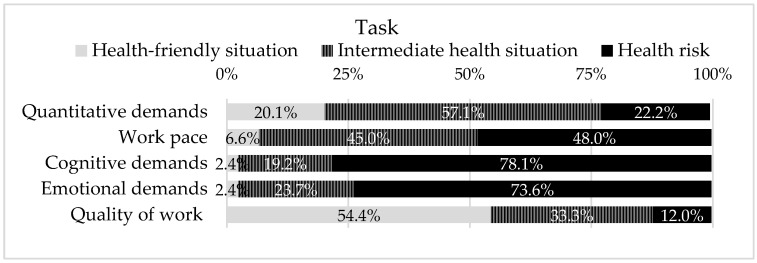
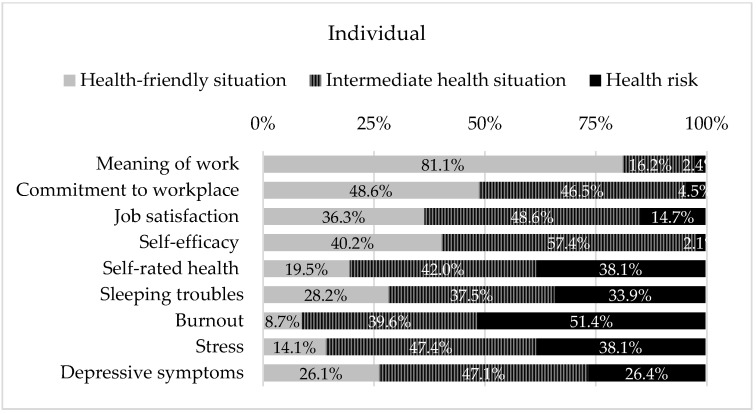
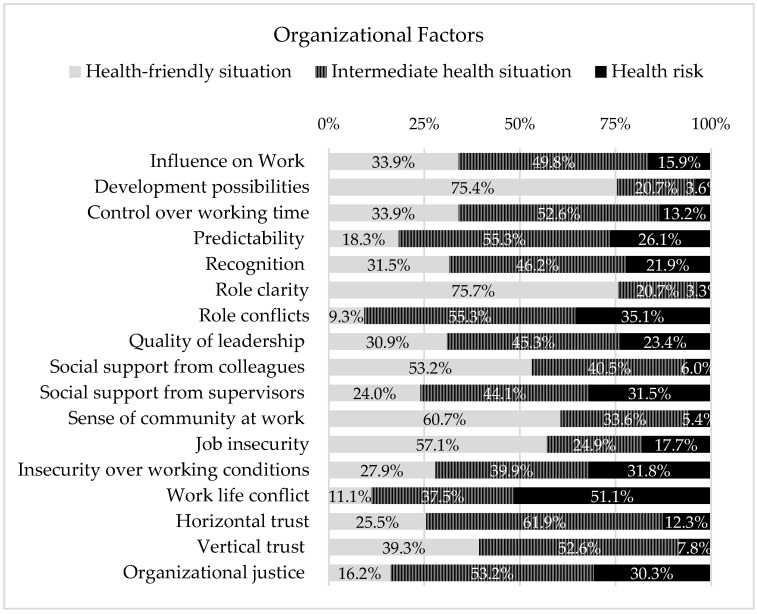
The prevention and management of chronic disease primarily requires risk reduction measures, through strategic coordination across various government areas. Recognizing that health workers and the public health workforce are integral to building strong and resilient health, the present study analyses the relation between Psychosocial Risk Factors (PRFs, to which formal caregivers are exposed in the healthcare settings), and the work system related elements of the Systems Engineering Initiative for Patient Safety (SEIPS 3.0) framework. An empirical study was carried out, involving 333 formal caregivers of healthcare services. A total of 31 PRFs were assessed (using the COPSOQ III), making it possible to find a relationship between the PRFs analyzed with three elements of the work system, namely Task (5 PRFs), Organizational factors (17 PRFs), and Individual (9 PRFs). The present work contributes not only in terms of outcomes that allow the development of mental illness prevention and mental health promotion actions for healthcare formal caregivers, but also in terms of the relevance that these factors can have on the quality of health services, as well as their users (patients), in line with SEIPS 3.0 model.
慢性病的预防和管理主要需要采取降低风险的措施,通过政府各领域之间的战略协调来实现。鉴于卫生工作者和公共卫生工作队伍是建立强大和有弹性卫生系统的组成部分,本研究分析了心理社会风险因素(PRFs)与与患者安全系统工程倡议(SEIPS 3.0)框架的工作系统相关要素之间的关系。进行了一项涉及 333 名医疗服务正式护理人员的实证研究。共评估了 31 个 PRFs(使用 COPSOQ III),从而可以发现分析的 PRFs 与工作系统的三个要素之间的关系,即任务(5 个 PRFs)、组织因素(17 个 PRFs)和个人(9 个 PRFs)。这项工作不仅在允许为医疗保健正式护理人员制定精神疾病预防和促进心理健康的行动方面取得了成果,而且在这些因素对卫生服务及其使用者(患者)的质量可能具有的相关性方面也取得了成果,符合 SEIPS 3.0 模型。