Paul C. Lauterbur Research Center for Biomedical Imaging, Shenzhen Institute of Advanced Technology, Chinese Academy of Sciences, Shenzhen, People's Republic of China.
Department of Medical Imaging, Henan Provincial People's Hospital and People's Hospital of Zhengzhou University, Zhengzhou, People's Republic of China.
Eur J Nucl Med Mol Imaging. 2022 Jul;49(8):2994-3004. doi: 10.1007/s00259-022-05832-7. Epub 2022 May 14.
Distinct physiological states arise from complex interactions among the various organs present in the human body. PET is a non-invasive modality with numerous successful applications in oncology, neurology, and cardiology. However, while PET imaging has been applied extensively in detecting focal lesions or diseases, its potential in detecting systemic abnormalities is seldom explored, mostly because total-body imaging was not possible until recently.
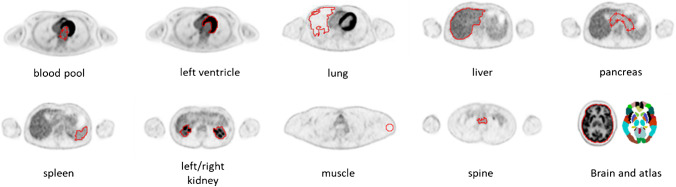
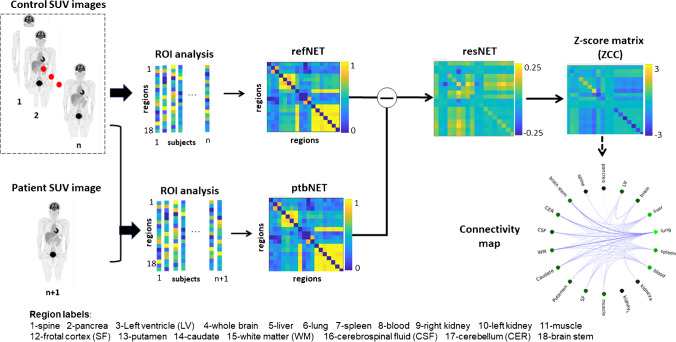
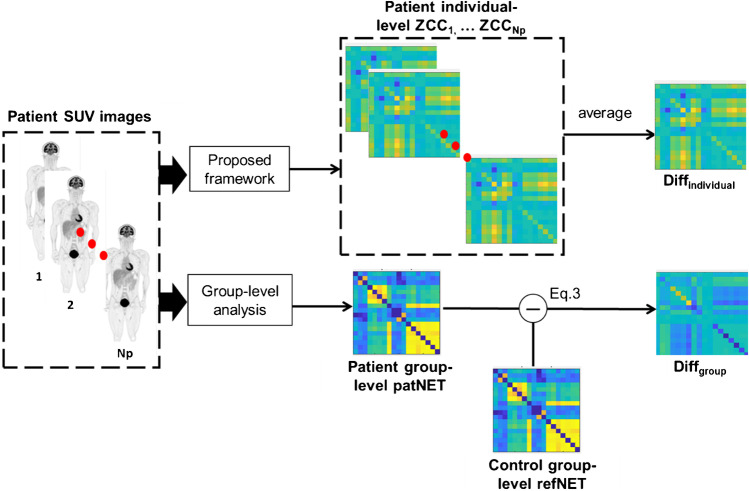
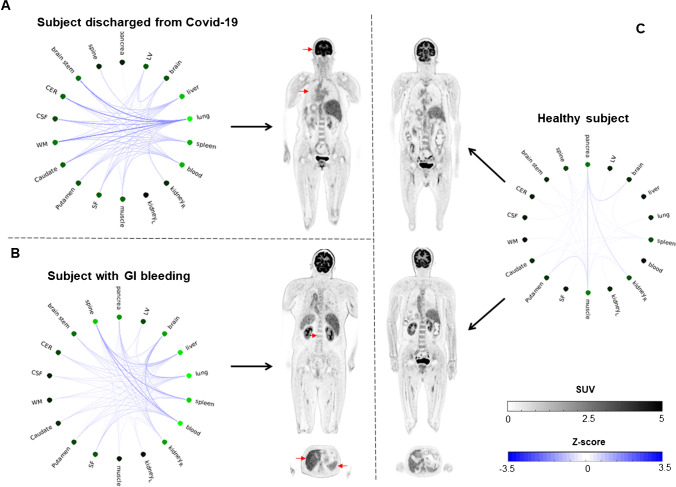
In this context, the present study proposes a framework capable of constructing an individual metabolic abnormality network using a subject's whole-body F-FDG SUV image and a normal control database. The developed framework was evaluated in the patients with lung cancer, the one discharged after suffering from Covid-19 disease, and the one that had gastrointestinal bleeding with the underlying cause unknown.
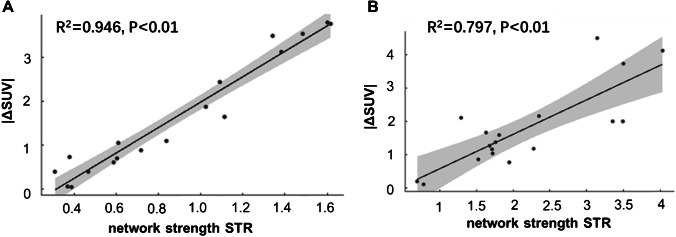
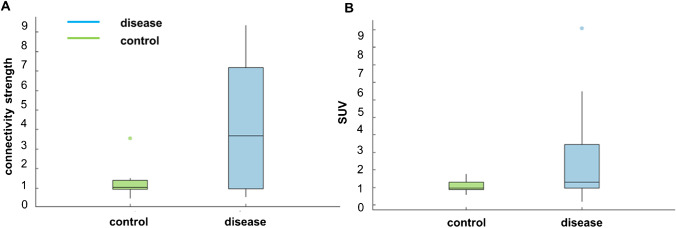
The framework could successfully capture the deviation of these patients from healthy subjects at the level of both system and organ. The strength of the altered network edges revealed the abnormal metabolic connection between organs. The overall deviation of the network nodes was observed to be highly correlated to the organ SUV measures. Therefore, the molecular connectivity of glucose metabolism was characterized at a single subject level.
The proposed framework represents a significant step toward the use of PET imaging for identifying metabolic dysfunction from a systemic perspective. A better understanding of the underlying biological mechanisms and the physiological interpretation of the interregional connections identified in the present study warrant further research.
人体各器官之间的复杂相互作用会产生不同的生理状态。正电子发射断层扫描(PET)是一种非侵入性的方法,在肿瘤学、神经病学和心脏病学等领域有许多成功的应用。然而,尽管 PET 成像已广泛应用于检测局灶性病变或疾病,但很少探索其在检测全身性异常方面的潜力,这主要是因为直到最近才有可能进行全身成像。
在这种情况下,本研究提出了一种使用受检者全身 F-FDG SUV 图像和正常对照数据库构建个体代谢异常网络的框架。该框架在肺癌患者、新冠病毒感染后出院的患者和原因不明的胃肠道出血患者中进行了评估。
该框架能够成功地捕捉到这些患者与健康受试者在系统和器官水平上的偏差。改变的网络边缘的强度揭示了器官之间异常代谢的联系。观察到网络节点的整体偏差与器官 SUV 测量高度相关。因此,在个体水平上对葡萄糖代谢的分子连通性进行了表征。
该框架代表了朝着从系统角度使用 PET 成像来识别代谢功能障碍的方向迈出了重要一步。需要进一步研究本研究中确定的区域间连接的潜在生物学机制和生理学解释。