National Tuberculosis Reference Laboratory, Eswatini National Health Services Laboratory, Ministry of Health, Mbabane, Eswatini.
Baylor College of Medicine Children's Foundation-Eswatini, Mbabane, Eswatini.
Genome Med. 2022 May 19;14(1):52. doi: 10.1186/s13073-022-01054-6.
Stool is an important diagnostic specimen for tuberculosis in populations who struggle to provide sputum, such as children or people living with HIV. However, the culture of Mycobacterium tuberculosis (M. tuberculosis) complex strains from stool perform poorly. This limits the opportunity for phenotypic drug resistance testing with this specimen. Therefore, reliable molecular methods are urgently needed for comprehensive drug resistance testing on stool specimens.
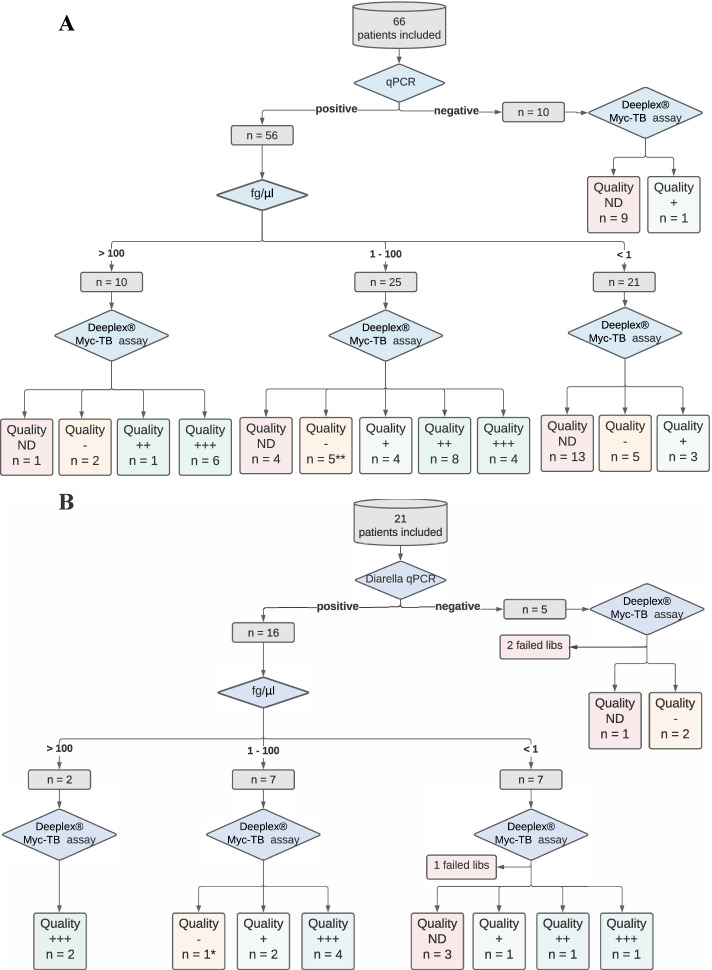
We evaluated the performance of targeted next-generation sequencing (tNGS, Deeplex® Myc-TB) for the detection of mutations associated with M. tuberculosis complex drug resistance on DNA isolated from stool specimens provided by participants from a prospective cohort of patients treated for tuberculosis in Eswatini (n = 66; 56 with and 10 participants without M. tuberculosis complex DNA detected in stool by real-time quantitative PCR), and an independent German validation cohort of participants with culture-confirmed tuberculosis (n = 21).
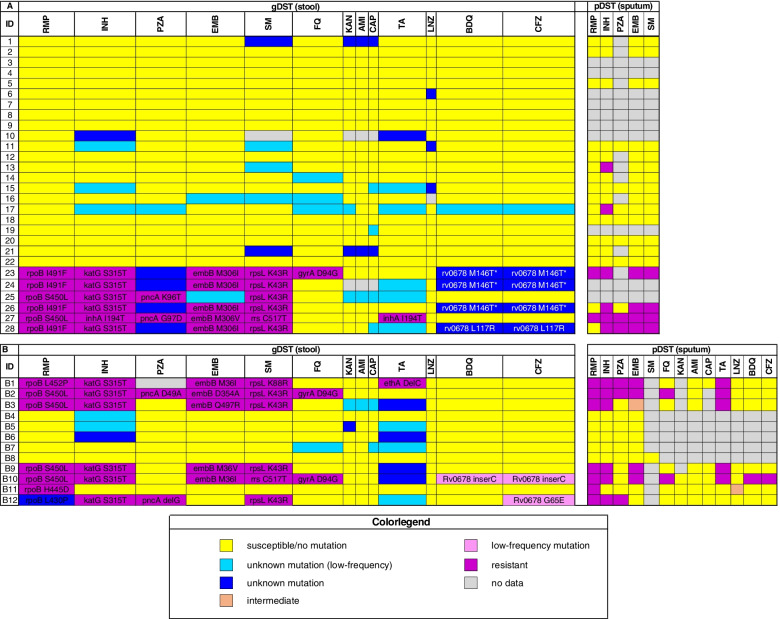
The tNGS assay detected M. tuberculosis complex DNA in 38 of 56 (68%) samples; for 28 of 38 (74%) samples, a full M. tuberculosis complex drug resistance prediction report was obtained. There was a high degree of concordance with sputum phenotypic drug susceptibility results (κ = 0.82). The ability to predict resistance was concentration-dependent and successful in 7/10 (70%), 18/25 (72%), and 3/21 (14%) of samples with stool PCR concentration thresholds of > 100 femtogram per microliter (fg/μl), 1 to 100 fg/μl, and < 1 fg/μl, respectively (p = 0.0004). The German cohort confirmed these results and demonstrated a similarly high concordance between stool tNGS and sputum phenotypic drug susceptibility results (κ = 0.84).
tNGS can identify drug resistance from stool provided by tuberculosis patients. This affords the opportunity to obtain critical diagnostic information for tuberculosis patients who struggle to provide respiratory specimens.
粪便对于难以提供痰标本的人群(如儿童或 HIV 感染者)的结核病诊断非常重要。然而,从粪便中培养结核分枝杆菌(Mycobacterium tuberculosis,M. tuberculosis)复合菌株的效果不佳。这限制了使用该标本进行表型药物耐药性检测的机会。因此,迫切需要可靠的分子方法来对粪便标本进行全面的药物耐药性检测。
我们评估了靶向下一代测序(tNGS,Deeplex® Myc-TB)在从斯威士兰前瞻性结核患者队列(n=66;56 例粪便中检测到 M. tuberculosis complex DNA,10 例未检测到)和独立的德国结核培养确诊患者验证队列(n=21)中分离的 DNA 检测与 M. tuberculosis complex 药物耐药相关的突变的性能。
tNGS 检测到 56 例粪便样本中的 38 例(68%)M. tuberculosis complex DNA;对于 38 例中的 28 例(74%),获得了完整的 M. tuberculosis complex 药物耐药预测报告。与痰表型药敏结果具有高度一致性(κ=0.82)。耐药预测能力与浓度相关,在粪便 PCR 浓度阈值分别为>100 fg/μl、1 至 100 fg/μl 和<1 fg/μl 的 10 例样本(70%)、25 例样本(72%)和 21 例样本(14%)中成功预测耐药性,p=0.0004。德国队列证实了这些结果,并显示粪便 tNGS 与痰表型药敏结果之间具有相似的高度一致性(κ=0.84)。
tNGS 可以从结核患者的粪便中识别耐药性。这为难以提供呼吸道标本的结核患者提供了获得关键诊断信息的机会。