Institute of Applied Psychology, University of the Punjab, Lahore, Pakistan.
Acta Psychol (Amst). 2022 Jul;227:103618. doi: 10.1016/j.actpsy.2022.103618. Epub 2022 May 13.
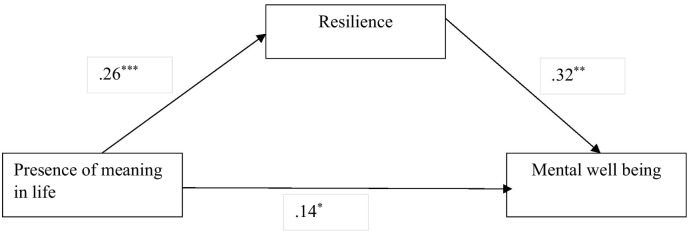
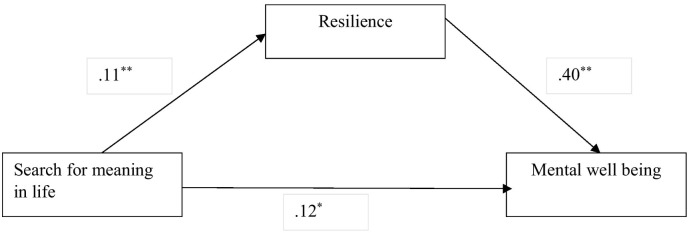
The current study aims to examine (a) the mental well-being of university students, who were taking online classes, and (b) and test whether resilience would mediate the relationship between meaning in life and mental well-being. The sample of 302 university students (M = 20.25 years; 36.1% men, 63.9% women) was taken from the universities of Punjab, Pakistan. The participants were recruited online and they completed a cross-sectional survey comprising the scales of meaning in life, resilience, and mental well-being during COVID-19. Findings from the study indicated that participants had a normal to a satisfactory level of overall mental wellbeing during COVID-19. Resilience acted as a mediator for both the presence of meaning in life, the search for meaning in life, and mental well-being. Demographic variables including family size were significantly and positively related to resilience while the availability of personal room showed a significant positive relationship with mental well-being. These findings suggest that meaning in life and resilience supports mental well-being during the COVID-19 pandemic and that effective steps should be taken to make the lives of university students more meaningful and resilient.
本研究旨在考察(a)上网课的大学生的心理健康状况,以及(b)检验韧性是否在生活意义与心理健康之间起中介作用。该研究从巴基斯坦旁遮普省的大学中抽取了 302 名大学生作为样本(M=20.25 岁;36.1%为男性,63.9%为女性)。参与者通过在线方式招募,并在 COVID-19 期间完成了包括生活意义量表、韧性量表和心理健康量表在内的横断面调查。研究结果表明,参与者在 COVID-19 期间整体心理健康水平处于正常到满意的水平。韧性在生活意义的存在、对生活意义的探索与心理健康之间起中介作用。包括家庭规模在内的人口统计学变量与韧性呈显著正相关,而个人房间的可用性与心理健康呈显著正相关。这些发现表明,生活意义和韧性在 COVID-19 大流行期间支持着大学生的心理健康,应采取有效措施使大学生的生活更有意义和更有韧性。