London Research and Development Centre, Agriculture and Agri-Food Canada, London, Ontario, Canada.
Department of Biology, The University of Western Ontario, London, Ontario, Canada.
Mol Plant Pathol. 2022 Sep;23(9):1262-1277. doi: 10.1111/mpp.13229. Epub 2022 May 22.
Tomato brown rugose fruit virus (ToBRFV) is an emerging and rapidly spreading RNA virus that infects tomato and pepper, with tomato as the primary host. The virus causes severe crop losses and threatens tomato production worldwide. ToBRFV was discovered in greenhouse tomato plants grown in Jordan in spring 2015 and its first outbreak was traced back to 2014 in Israel. To date, the virus has been reported in at least 35 countries across four continents in the world. ToBRFV is transmitted mainly via contaminated seeds and mechanical contact (such as through standard horticultural practices). Given the global nature of the seed production and distribution chain, and ToBRFV's seed transmissibility, the extent of its spread is probably more severe than has been disclosed. ToBRFV can break down genetic resistance to tobamoviruses conferred by R genes Tm-1, Tm-2, and Tm-2 in tomato and L and L alleles in pepper. Currently, no commercial ToBRFV-resistant tomato cultivars are available. Integrated pest management-based measures such as rotation, eradication of infected plants, disinfection of seeds, and chemical treatment of contaminated greenhouses have achieved very limited success. The generation and application of attenuated variants may be a fast and effective approach to protect greenhouse tomato against ToBRFV. Long-term sustainable control will rely on the development of novel genetic resistance and resistant cultivars, which represents the most effective and environment-friendly strategy for pathogen control.
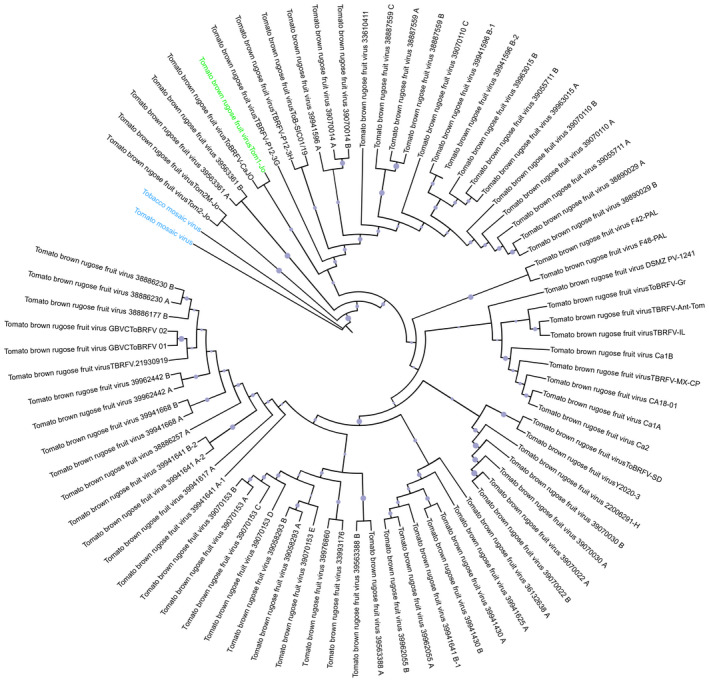
Tomato brown rugose fruit virus belongs to the genus Tobamovirus, in the family Virgaviridae. The genus also includes several economically important viruses such as Tobacco mosaic virus and Tomato mosaic virus.
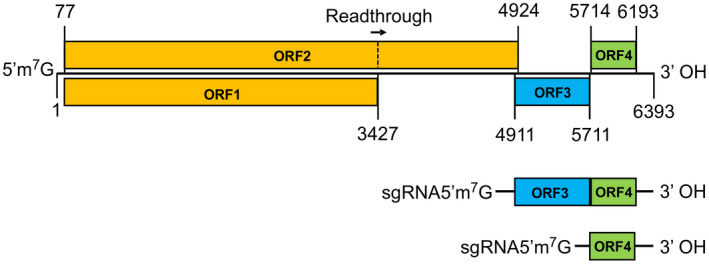
The ToBRFV genome is a single-stranded, positive-sense RNA of approximately 6.4 kb, encoding four open reading frames. The viral genomic RNA is encapsidated into virions that are rod-shaped and about 300 nm long and 18 nm in diameter. Tobamovirus virions are considered extremely stable and can survive in plant debris or on seed surfaces for long periods of time.
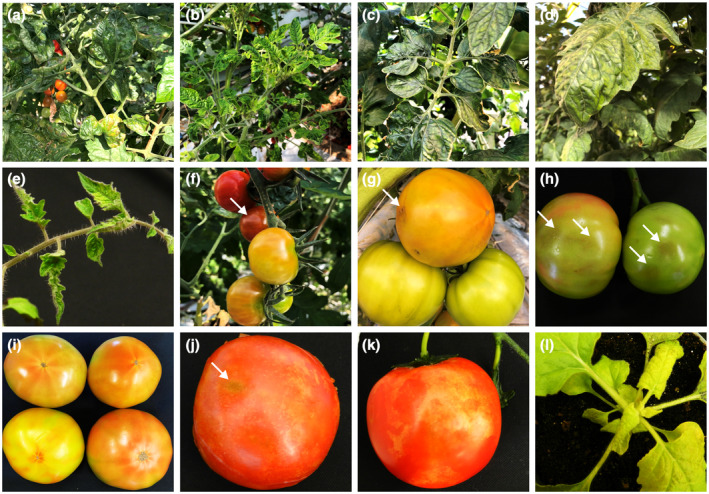
Leaves, particularly young leaves, of tomato plants infected by ToBRFV exhibit mild to severe mosaic symptoms with dark green bulges, narrowness, and deformation. The peduncles and calyces often become necrotic and fail to produce fruit. Yellow blotches, brown or black spots, and rugose wrinkles appear on tomato fruits. In pepper plants, ToBRFV infection results in puckering and yellow mottling on leaves with stunted growth of young seedlings and small yellow to brown rugose dots and necrotic blotches on fruits.
番茄褐色皱果病毒(ToBRFV)是一种新兴的、迅速传播的 RNA 病毒,感染番茄和辣椒,番茄是主要宿主。该病毒导致严重的作物损失,并威胁着全球的番茄生产。ToBRFV 于 2015 年春季在约旦温室番茄植株中首次发现,其首次爆发可追溯到 2014 年在以色列。迄今为止,该病毒已在世界四大洲至少 35 个国家报告。ToBRFV 主要通过受污染的种子和机械接触(如通过标准园艺措施)传播。鉴于种子生产和分布链的全球性以及 ToBRFV 的种子传染性,其传播范围可能比已披露的更为严重。ToBRFV 可以破坏番茄中由 R 基因 Tm-1、Tm-2 和 Tm-2 以及辣椒中的 L 和 L 等位基因赋予的对 tobamoviruses 的遗传抗性。目前,尚无商业上可利用的抗 ToBRFV 番茄品种。基于病虫害综合治理的措施,如轮作、根除感染植株、种子消毒和受污染温室的化学处理,仅取得了非常有限的成功。减毒变异体的产生和应用可能是保护温室番茄免受 ToBRFV 侵害的一种快速有效的方法。长期可持续控制将依赖于新型遗传抗性和抗性品种的开发,这是控制病原体最有效和最环保的策略。
番茄褐色皱果病毒属于烟草花叶病毒属,在弹状病毒科。该属还包括几种经济上重要的病毒,如烟草花叶病毒和番茄花叶病毒。
ToBRFV 基因组是一条约 6.4kb 的单链、正链 RNA,编码四个开放阅读框。病毒基因组 RNA 被包裹在杆状、约 300nm 长和 18nm 直径的病毒粒子中。烟草花叶病毒粒子被认为极其稳定,可以在植物残体或种子表面长时间存活。
感染 ToBRFV 的番茄植株叶片,尤其是幼叶,表现出轻度至重度花叶症状,有深绿色隆起、变窄和变形。花梗和花萼常坏死,无法结果。番茄果实出现黄色斑点、棕色或黑色斑点和皱缩皱纹。在辣椒植株中,ToBRFV 感染导致叶片卷曲和黄色斑驳,幼苗生长缓慢,幼果出现黄色至棕色皱缩斑点和坏死斑。