Ding Jiayu, Moore Talia Y, Gan Zhenyu
Dynamic Locomotion and Robotics Laboratory, Department of Mechanical and Aerospace Engineering, Syracuse University, Syracuse, NY, United States.
Evolution and Motion of Biology and Robotics Laboratory, Department of Mechanical Engineering, Robotics Institute, Ecology and Evolutionary Biology, and Museum of Zoology, University of MI, Ann Arbor, MI, United States.
Front Bioeng Biotechnol. 2022 Apr 27;10:804826. doi: 10.3389/fbioe.2022.804826. eCollection 2022.
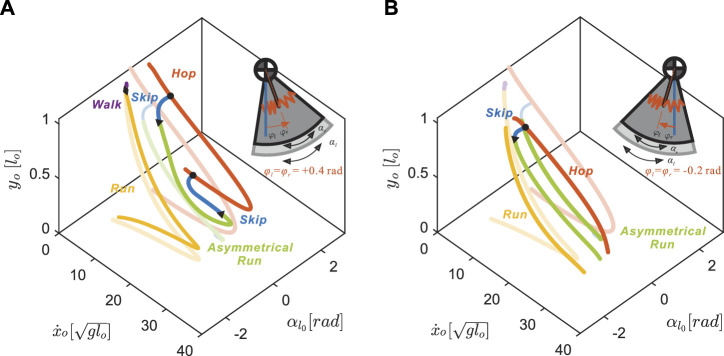
For cursorial animals that maintain high speeds for extended durations of locomotion, transitions between footfall patterns (gaits) predictably occur at distinct speed ranges. How do transitions among gaits occur for non-cursorial animals? Jerboas () are bipedal hopping rodents that frequently transition between gaits throughout their entire speed range. It has been hypothesized that these non-cursorial bipedal gait transitions are likely to enhance their maneuverability and predator evasion ability. However, it is difficult to use the underlying dynamics of these locomotion patterns to predict gait transitions due to the large number of degrees of freedom expressed by the animals. To this end, we used empirical jerboa kinematics and dynamics to develop a unified spring Loaded Inverted Pendulum model with defined passive swing leg motions. To find periodic solutions of this model, we formulated the gait search as a boundary value problem and described an asymmetrical running gait exhibited by the jerboas that emerged from the numerical search. To understand how jerboas change from one gait to another, we employed an optimization approach and used the proposed model to reproduce observed patterns of jerboa gait transitions. We then ran a detailed numerical study of the structure of gait patterns using a continuation approach in which transitions are represented by bifurcations. We found two primary mechanisms to increase the range of speeds at which gait transitions can occur. Coupled changes in the neutral leg swing angle alter leg dynamics. This mechanism generates changes in gait features (e.g., touchdown leg angle and timings of gait events) that have previously been shown to induce gait transitions. This mechanism slightly alters the speeds at which existing gait transitions occur. The model can also uncouple the left and right neutral leg swing angle, which generates asymmetries between left and right leg dynamics. New gait transitions emerge from uncoupled models across a broad range of speeds. In both the experimental observations and in the model, the majority of the gait transitions involve the skipping and asymmetrical running gaits generated by the uncoupled neutral leg swing angle mechanism. This simulated jerboa model is capable of systematically reproducing all biologically relevant gait transitions at a broad range of speeds.
对于能够长时间保持高速奔跑的 cursorial 动物而言,在不同的速度范围内,其脚步落地模式(步态)之间的转换是可预测的。那么,非 cursorial 动物的步态转换是如何发生的呢?跳鼠是双足跳跃的啮齿动物,在其整个速度范围内,它们的步态会频繁转换。据推测,这些非 cursorial 双足动物的步态转换可能会增强它们的机动性和躲避捕食者的能力。然而,由于这些动物表现出大量的自由度,很难利用这些运动模式的潜在动力学来预测步态转换。为此,我们利用跳鼠的运动学和动力学实证数据,开发了一个统一的弹簧加载倒立摆模型,该模型定义了被动摆动腿的运动。为了找到该模型的周期解,我们将步态搜索公式化为一个边值问题,并描述了通过数值搜索出现的跳鼠不对称奔跑步态。为了理解跳鼠如何从一种步态转换到另一种步态,我们采用了一种优化方法,并使用所提出的模型来重现观察到的跳鼠步态转换模式。然后,我们使用一种连续方法对步态模式的结构进行了详细的数值研究,其中转换由分岔表示。我们发现了两种增加步态转换可能发生的速度范围的主要机制。中性腿摆动角度的耦合变化会改变腿部动力学。这种机制会导致步态特征(如触地腿角度和步态事件的时间)发生变化,而这些变化先前已被证明会引发步态转换。这种机制会略微改变现有步态转换发生的速度。该模型还可以解耦左右中性腿摆动角度,从而在左右腿动力学之间产生不对称性。在很宽的速度范围内,解耦模型会出现新的步态转换。在实验观察和模型中,大多数步态转换都涉及由解耦的中性腿摆动角度机制产生的跳跃和不对称奔跑步态。这个模拟的跳鼠模型能够在很宽的速度范围内系统地重现所有生物学上相关的步态转换。