Department of Orthopedic and Trauma Surgery, Asklepios St. Georg, Hamburg, Germany.
Department of Anatomy, Christian-Albrechts-University, Kiel, Germany.
Am J Sports Med. 2022 Jul;50(8):2093-2101. doi: 10.1177/03635465221096464. Epub 2022 May 23.
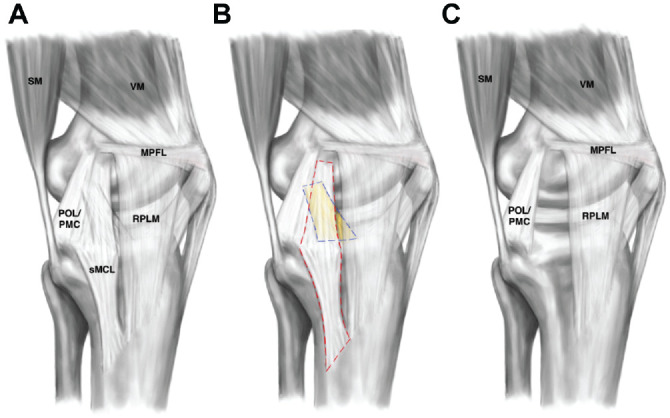
Both the superficial medial collateral ligament (sMCL) and the deep MCL (dMCL) contribute to the restraint of anteromedial (AM) rotatory instability (AMRI). Previous studies have not investigated how MCL reconstructions control AMRI.
PURPOSE/HYPOTHESIS: The purpose was to establish the optimal medial reconstruction for restoring normal knee kinematics in an sMCL- and dMCL-deficient knee. It was hypothesized that AMRI would be better controlled with the addition of an anatomically shaped (flat) sMCL reconstruction and with the addition of an AM reconstruction replicating the function of the dMCL.
Controlled laboratory study.
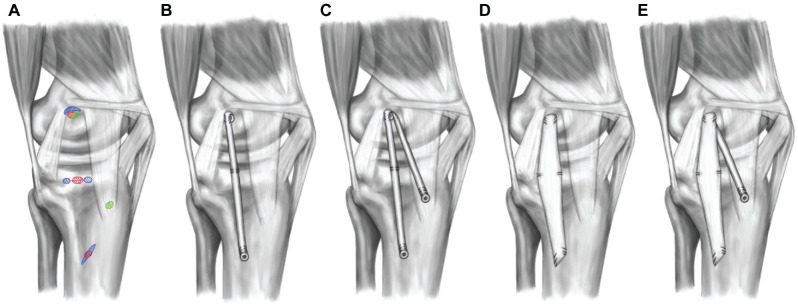
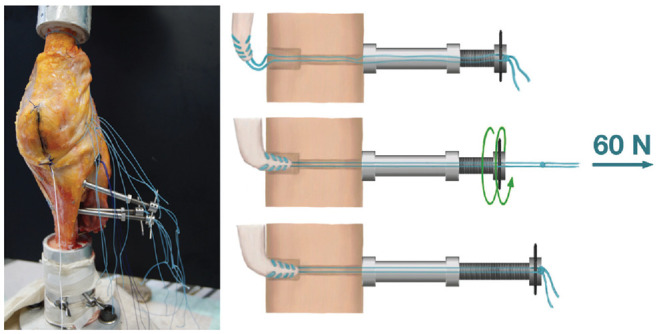
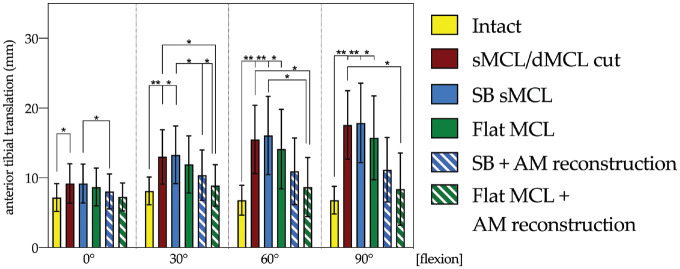
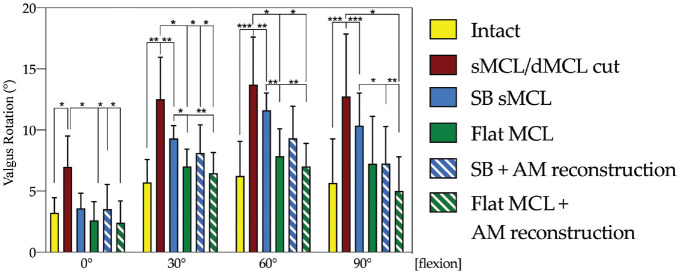
A 6 degrees of freedom robotic system equipped with a force-torque sensor was used to test 8 unpaired knees in the intact, sMCL/dMCL sectioned, and reconstructed states. Four different reconstructions were assessed. The sMCL was reconstructed with either a single-bundle (SB) or a flattened hamstring graft aimed at better replicating the appearance of the native ligament. These reconstructions were tested with and without an additional AM reconstruction. Simulated laxity tests were performed at 0°, 30°, 60°, and 90° of flexion: 10 N·m valgus rotation, 5 N·m internal and external rotation (ER), and an AM drawer test (combined 134-N anterior tibial drawer in 5 N·m ER). The primary outcome measures of this force-controlled setup were anterior tibial translation (ATT; in mm) and axial tibial rotation (in degrees).
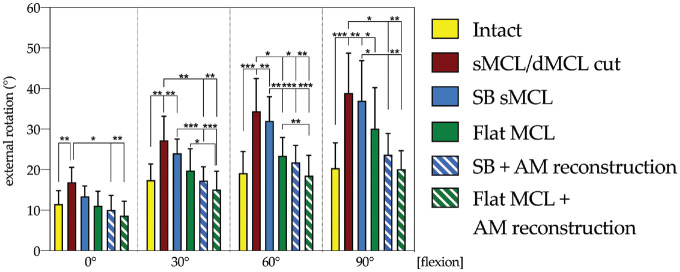
Sectioning the sMCL/dMCL increased valgus rotation, ER, and ATT with the simulated AM draw test at all flexion angles. SB sMCL reconstruction was unable to restore ATT, valgus rotation, and ER at 30°, 60°, and 90° of flexion to the intact state ( < .05). Flat MCL reconstruction restored valgus rotation at all flexion angles to the intact state ( > .05). ER was restored at all angles except at 90°, but ATT laxity in response to the AM drawer persisted. Addition of an AM reconstruction improved control of ATT relative to the intact state at all flexion angles ( > .05). Combined flat MCL and AM reconstruction restored knee kinematics closest to the intact state.
In a cadaveric model, AMRI resulting from an injured sMCL and dMCL complex could not be restored by an isolated SB sMCL reconstruction. A flat MCL reconstruction or an additional AM procedure, however, better restored medial knee stability.
In patients evaluated with a combined valgus and AM rotatory instability, a flat sMCL and an additional AM reconstruction may be superior to an isolated SB sMCL reconstruction.
浅层内侧副韧带(sMCL)和深层 MCL(dMCL)都有助于限制前内侧(AM)旋转不稳定(AMRI)。先前的研究并未探讨 MCL 重建如何控制 AMRI。
目的/假设:目的是确定内侧重建的最佳方法,以恢复 sMCL/dMCL 缺陷膝关节的正常膝关节运动学。假设通过增加解剖形状(平坦)的 sMCL 重建和增加复制 dMCL 功能的 AM 重建,可以更好地控制 AMRI。
对照实验室研究。
使用配备力-扭矩传感器的 6 自由度机器人系统测试 8 个未配对的膝关节,分别处于完整、sMCL/dMCL 切断和重建状态。评估了四种不同的重建。sMCL 采用单束(SB)或扁平腘绳肌移植物重建,旨在更好地复制固有韧带的外观。这些重建分别在有无附加 AM 重建的情况下进行了测试。在 0°、30°、60°和 90°的屈曲下进行模拟松弛测试:10 N·m 外翻旋转、5 N·m 内旋和外旋(ER)以及 AM 抽屉试验(5 N·m ER 时合并 134-N 前胫骨抽屉)。该力控制设置的主要结果测量指标为前胫骨平移(ATT;mm)和轴向胫骨旋转(度)。
切断 sMCL/dMCL 会增加在所有屈曲角度下的模拟 AM 抽屉试验中的外翻旋转、ER 和 ATT。SB sMCL 重建无法将 ATT、外翻旋转和 ER 在 30°、60°和 90°的屈曲恢复到完整状态(<0.05)。扁平 MCL 重建在所有屈曲角度下恢复到完整状态的外翻旋转(>0.05)。除 90°外,所有角度都恢复了 ER,但 AM 抽屉试验引起的 ATT 松弛仍然存在。附加 AM 重建可改善所有屈曲角度的 ATT 相对于完整状态的控制(>0.05)。联合扁平 MCL 和 AM 重建恢复膝关节运动学最接近完整状态。
在尸体模型中,受伤的 sMCL 和 dMCL 复合体引起的 AMRI 不能通过孤立的 SB sMCL 重建来恢复。然而,扁平 MCL 重建或附加的 AM 手术可以更好地恢复内侧膝关节稳定性。
在评估伴有联合外翻和 AM 旋转不稳定的患者时,扁平 sMCL 和附加 AM 重建可能优于孤立的 SB sMCL 重建。