Min Weiqing, Liu Chunlin, Xu Leyi, Jiang Shuqiang
Key Lab of Intelligent Information Processing, Institute of Computing Technology, Chinese Academy of Sciences, Beijing 100190, China.
University of Chinese Academy of Sciences, Beijing 100049, China.
Patterns (N Y). 2022 May 13;3(5):100484. doi: 10.1016/j.patter.2022.100484.
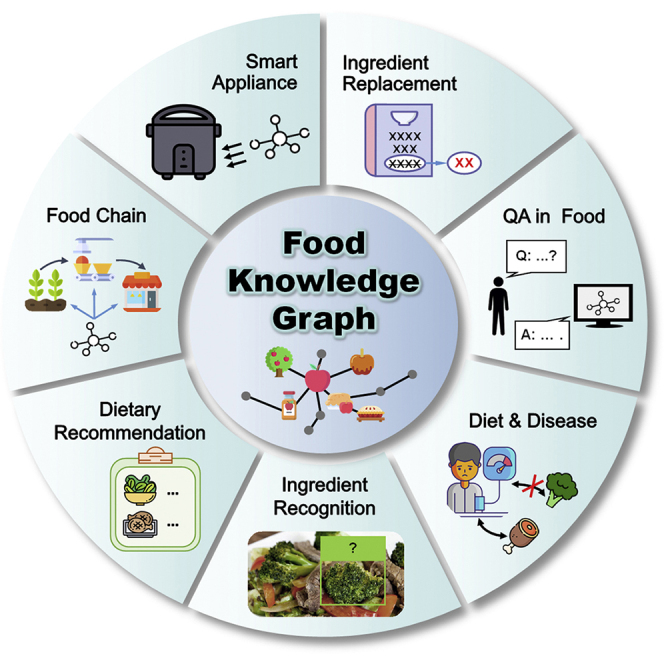
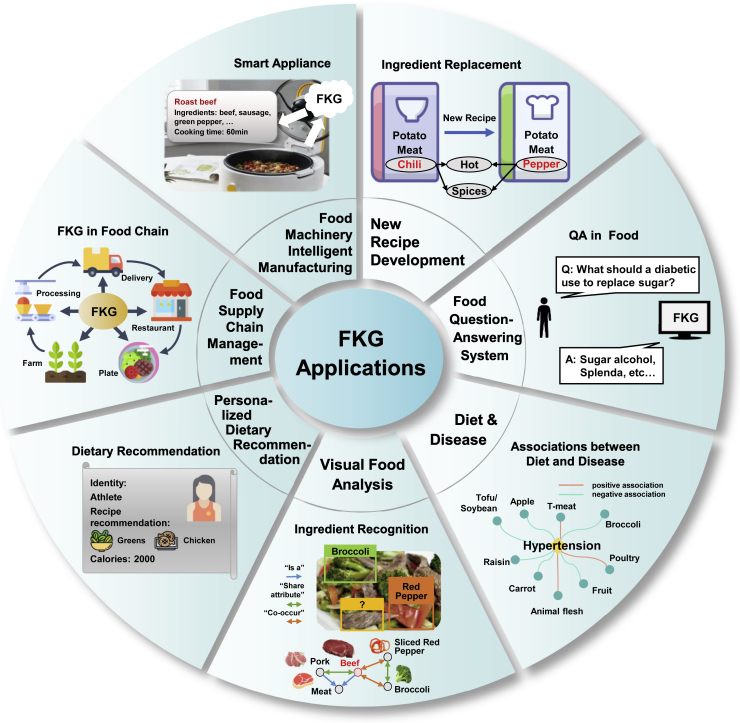
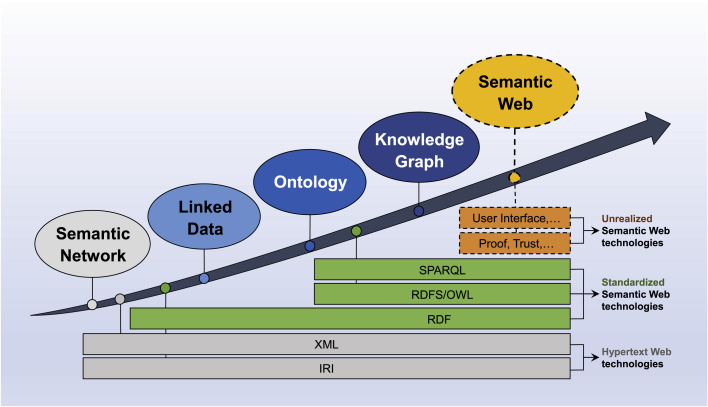
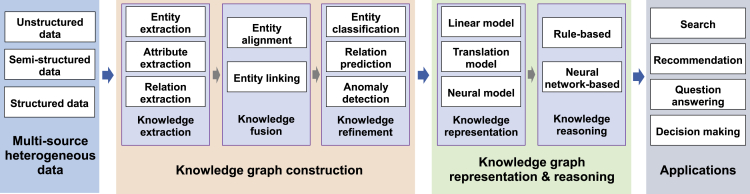
The deployment of various networks (e.g., Internet of Things [IoT] and mobile networks), databases (e.g., nutrition tables and food compositional databases), and social media (e.g., Instagram and Twitter) generates huge amounts of food data, which present researchers with an unprecedented opportunity to study various problems and applications in food science and industry via data-driven computational methods. However, these multi-source heterogeneous food data appear as information silos, leading to difficulty in fully exploiting these food data. The knowledge graph provides a unified and standardized conceptual terminology in a structured form, and thus can effectively organize these food data to benefit various applications. In this review, we provide a brief introduction to knowledge graphs and the evolution of food knowledge organization mainly from food ontology to food knowledge graphs. We then summarize seven representative applications of food knowledge graphs, such as new recipe development, diet-disease correlation discovery, and personalized dietary recommendation. We also discuss future directions in this field, such as multimodal food knowledge graph construction and food knowledge graphs for human health.
各种网络(如物联网[IoT]和移动网络)、数据库(如营养表和食物成分数据库)以及社交媒体(如Instagram和Twitter)的部署产生了大量的食品数据,这为研究人员提供了前所未有的机会,可通过数据驱动的计算方法研究食品科学与行业中的各种问题及应用。然而,这些多源异构食品数据呈现为信息孤岛,导致难以充分利用这些食品数据。知识图谱以结构化形式提供统一且标准化的概念术语,因此能够有效地组织这些食品数据,以惠及各种应用。在本综述中,我们简要介绍了知识图谱以及食品知识组织的演变,主要是从食品本体到食品知识图谱。然后,我们总结了食品知识图谱的七个代表性应用,如新食谱开发、饮食与疾病关联发现以及个性化饮食推荐。我们还讨论了该领域的未来发展方向,如多模态食品知识图谱构建以及用于人类健康的食品知识图谱。