Department of Radiology, Saitama Medical University, 38 Morohongou, Moroyama-machi, Iruma-gun, Saitama, Japan.
Department of Radiology, Tokyo Metropolitan Cancer and Infectious Diseases Center Komagome Hospital, 3-18-22 Honkomagome, Bunkyo-ku, Tokyo, Japan.
J Ovarian Res. 2022 May 25;15(1):65. doi: 10.1186/s13048-022-00989-z.
To evaluate the diagnostic utility of conventional magnetic resonance imaging (MRI)-based characteristics and a texture analysis (TA) for discriminating between ovarian thecoma-fibroma groups (OTFGs) and ovarian granulosa cell tumors (OGCTs).
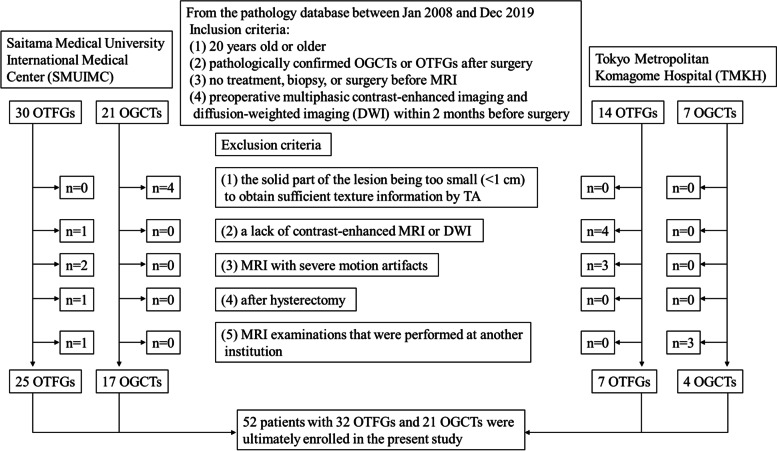
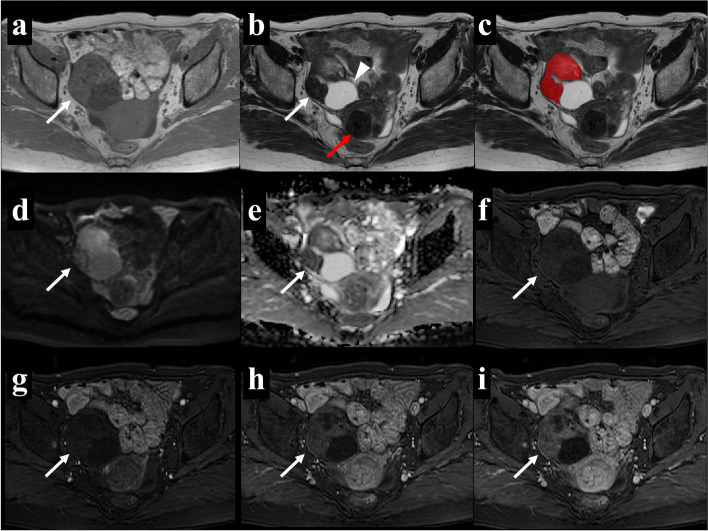
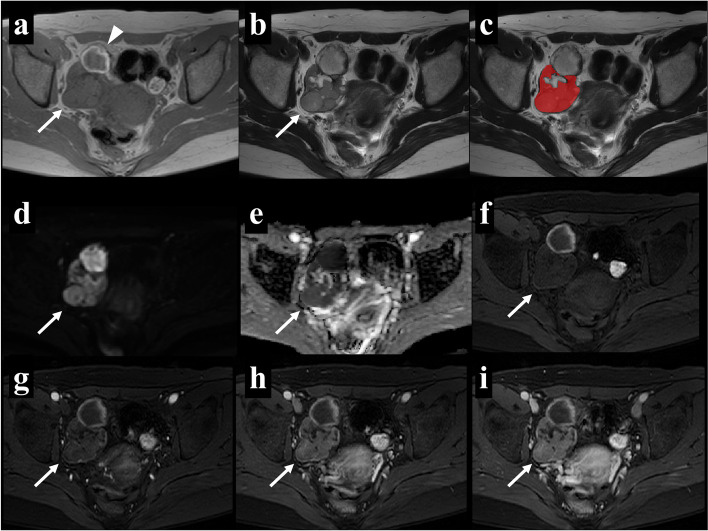
This retrospective multicenter study enrolled 52 patients with 32 OGCTs and 21 OTFGs, which were dissected and pathologically diagnosed between January 2008 and December 2019. MRI-based features (MBFs) and texture features (TFs) were evaluated and compared between OTFGs and OGCTs. A least absolute shrinkage and selection operator (LASSO) regression analysis was performed to select features and construct the discriminating model. ROC analyses were conducted on MBFs, TFs, and their combination to discriminate between the two diseases.
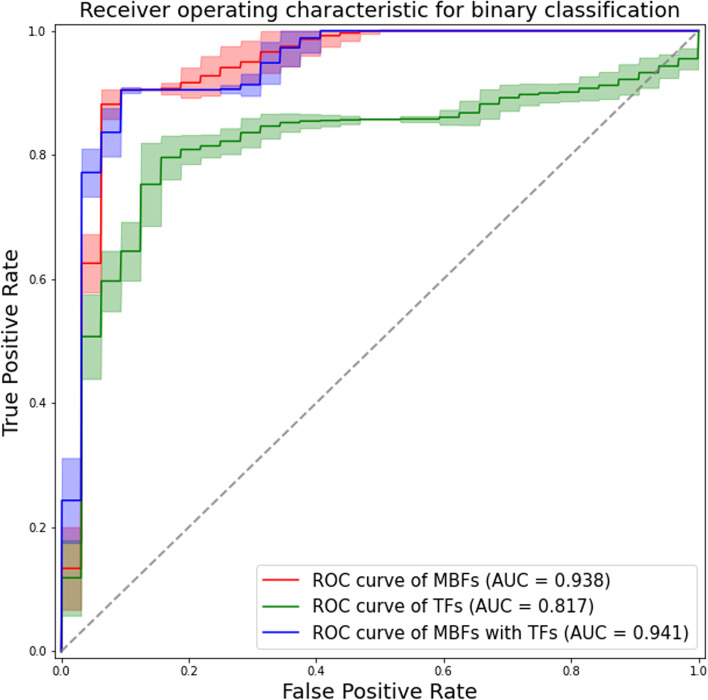
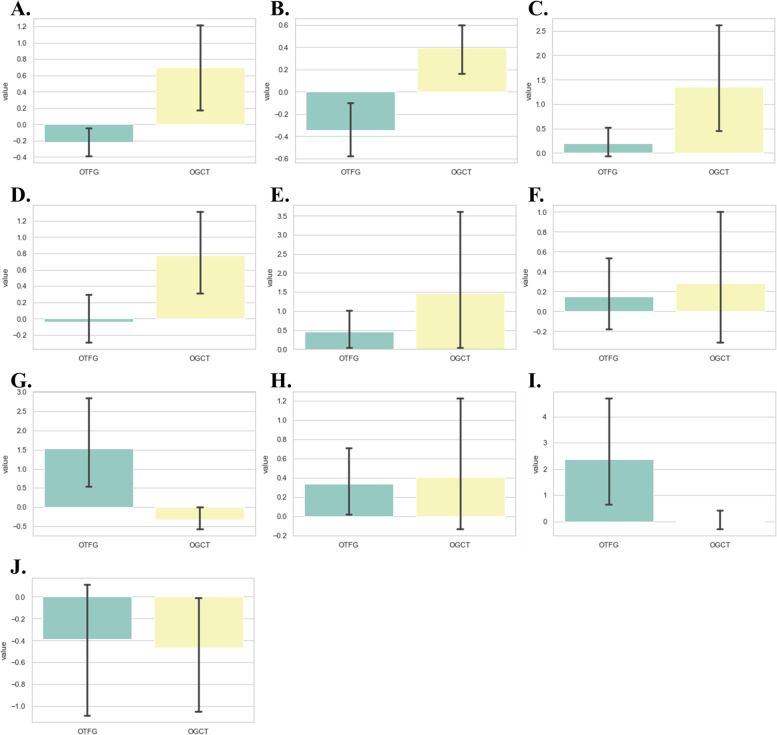
We selected 3 features with the highest absolute value of the LASSO regression coefficient for each model: the apparent diffusion coefficient (ADC), peripheral cystic area, and contrast enhancement in the venous phase (VCE) for the MRI-based model; the 10th percentile, difference variance, and maximal correlation coefficient for the TA-based model; and ADC, VCE, and the difference variance for the combination model. The areas under the curves of the constructed models were 0.938, 0.817, and 0.941, respectively. The diagnostic performance of the MRI-based and combination models was similar (p = 0.38), but significantly better than that of the TA-based model (p < 0.05).
The conventional MRI-based analysis has potential as a method to differentiate OTFGs from OGCTs. TA did not appear to be of any additional benefit. Further studies are needed on the use of these methods for a preoperative differential diagnosis of these two diseases.
评估基于常规磁共振成像(MRI)的特征和纹理分析(TA)在鉴别卵巢卵泡膜细胞瘤-纤维瘤组(OTFG)和卵巢颗粒细胞瘤(OGCT)中的诊断效用。
本回顾性多中心研究纳入了 2008 年 1 月至 2019 年 12 月期间经手术切除和病理诊断为 32 例 OGCT 和 21 例 OTFG 的 52 例患者。评估并比较了 OTFG 和 OGCT 之间的 MRI 特征(MBFs)和纹理特征(TFs)。使用最小绝对收缩和选择算子(LASSO)回归分析来选择特征并构建鉴别模型。对 MBFs、TFs 及其组合进行 ROC 分析,以鉴别这两种疾病。
我们为每个模型选择了 3 个具有最高 LASSO 回归系数绝对值的特征:基于 MRI 的模型中的表观扩散系数(ADC)、周围囊腔区和静脉期增强(VCE);基于 TA 的模型中的 10 百分位数、差异方差和最大相关系数;以及组合模型中的 ADC、VCE 和差异方差。构建模型的曲线下面积分别为 0.938、0.817 和 0.941。基于 MRI 的和组合模型的诊断性能相似(p=0.38),但明显优于基于 TA 的模型(p<0.05)。
基于常规 MRI 的分析有可能成为鉴别 OTFG 和 OGCT 的方法。TA 似乎没有任何额外的益处。需要进一步研究这些方法在这两种疾病术前鉴别诊断中的应用。