Mohammed Hussein, Eshetie Aragaw, Melese Dessie
Department of Statistics, College of Natural and Computational Science Samara University Samara Ethiopia.
Department of Statistics, College of Natural and Computational Science University of Gondar Gondar Ethiopia.
Health Sci Rep. 2022 May 22;5(3):e659. doi: 10.1002/hsr2.659. eCollection 2022 May.
Hepatitis is an inflammation of the liver that can reason a variety of health problems and can be fatal. According to the most recent estimates of the Global Burden of Disease study and WHO, viral hepatitis is accountable for around 1.34 million deaths yearly, which is comparable to the yearly number of deaths from HIV/AIDS (1.3 million), malaria (0.9 million), and tuberculosis (1.3 million). This study aimed to assess the prevalence of the Hepatitis B virus and associated risk factors among adults patients at Dessie Referral and Kemise General Hospitals.
The source for the data on Hepatitis B virus (HBV) was all adults aged≥18 years that were admitted and tested for HBV from September 2020 to February 2021 were included in the study. A total of 1283 adults were admitted out of which, 1080 adults have completed measurements and had been taken into consideration for this examination, and others had been excluded from the examination because of exclusion criteria. To meet our objective descriptive statistics, the test and multiple logistic regression statistical models were used for data analysis.
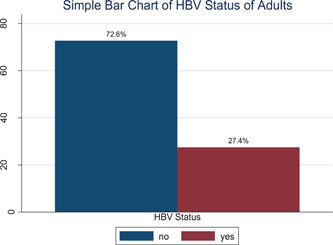
In this study, a total of 1080 adults were included out of which 631 (58.4%) female and 449 (41.6%) were male with a mean age of 34(SD ± 12.56) years. The overall prevalence of HBV among adults was 27.4% (95% confidence interval [CI];24.8-30.2). The results of this study showed that age 25-34(odds ratio [OR] = 3.6, -value = 0.005), 35-44 (OR = 6.67, -value <0.001), ≥45 (OR = 3.85, -value = 0.005), male (OR = 4.36, -value < 0.001), history of hospitalization (OR = 0.644, -value = 0.04), family history of HBV (OR = 1.96, -value = 0.005), and jaundice (OR = 2.50, -value = 0.005) were significant risk factors of HBV.
The prevalence of HBV in this study is 27.4%. The results of this study showed that age, male, history of hospitalization, family history of HBV, and jaundice were significant risk factors for Hepatitis B virus.
肝炎是肝脏的一种炎症,可引发多种健康问题,甚至可能致命。根据全球疾病负担研究和世界卫生组织的最新估计,病毒性肝炎每年导致约134万人死亡,这一数字与每年死于艾滋病毒/艾滋病(130万)、疟疾(90万)和结核病(130万)的人数相当。本研究旨在评估德西转诊医院和凯米斯综合医院成年患者中乙型肝炎病毒的流行情况及相关危险因素。
关于乙型肝炎病毒(HBV)的数据来源为2020年9月至2021年2月期间入院并接受HBV检测的所有≥18岁成年人,纳入本研究。共收治1283名成年人,其中1080名成年人完成测量并纳入本次检查,其他因排除标准被排除在检查之外。为实现我们的目标描述性统计,采用检验和多重逻辑回归统计模型进行数据分析。
本研究共纳入1080名成年人,其中女性631名(58.4%),男性449名(41.6%),平均年龄34岁(标准差±12.56)。成年人中HBV的总体流行率为27.4%(95%置信区间[CI];24.8 - 30.2)。本研究结果表明,年龄25 - 34岁(比值比[OR]=3.6,P值=0.005)、35 - 44岁(OR = 6.67,P值<0.001)、≥45岁(OR = 3.85,P值=0.005)、男性(OR = 4.36,P值<0.001)、住院史(OR = 0.644,P值=0.04)、HBV家族史(OR = 1.96,P值=0.005)和黄疸(OR = 2.50,P值=0.005)是HBV的显著危险因素。
本研究中HBV的流行率为27.4%。本研究结果表明,年龄、男性、住院史、HBV家族史和黄疸是乙型肝炎病毒的显著危险因素。