Pang Ke, Li Liang, Ouyang Wen, Liu Xing, Tang Yongzhong
Department of Anesthesiology, Third Xiangya Hospital, Central South University, Changsha 410013, China.
Department of Gastrointestinal Surgery, Third Xiangya Hospital, Central South University, Changsha 410013, China.
Diagnostics (Basel). 2022 Apr 24;12(5):1068. doi: 10.3390/diagnostics12051068.
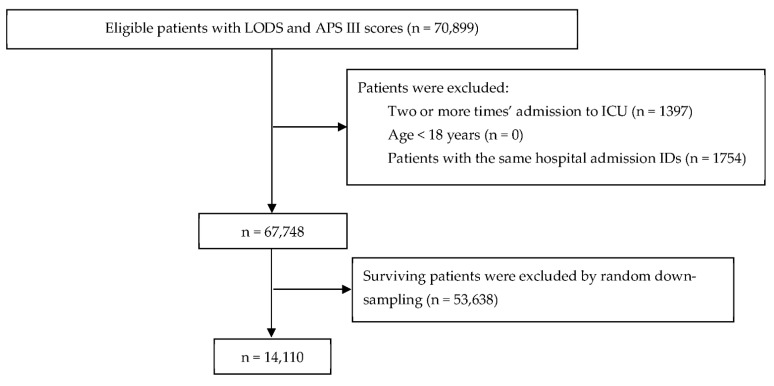
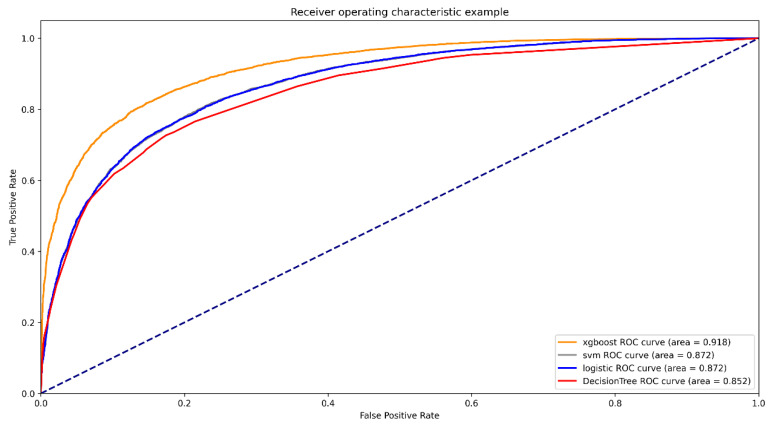
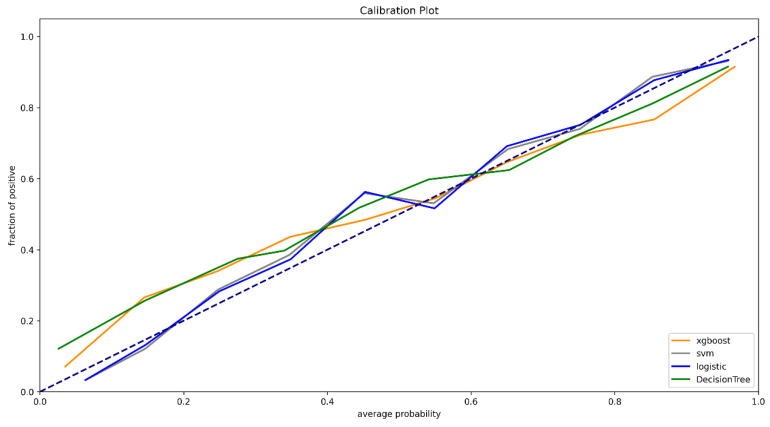
The mortality rate of critically ill patients in ICUs is relatively high. In order to evaluate patients' mortality risk, different scoring systems are used to help clinicians assess prognosis in ICUs, such as the Acute Physiology and Chronic Health Evaluation III (APACHE III) and the Logistic Organ Dysfunction Score (LODS). In this research, we aimed to establish and compare multiple machine learning models with physiology subscores of APACHE III-namely, the Acute Physiology Score III (APS III)-and LODS scoring systems in order to obtain better performance for ICU mortality prediction. A total number of 67,748 patients from the Medical Information Database for Intensive Care (MIMIC-IV) were enrolled, including 7055 deceased patients, and the same number of surviving patients were selected by the random downsampling technique, for a total of 14,110 patients included in the study. The enrolled patients were randomly divided into a training dataset (n = 9877) and a validation dataset (n = 4233). Fivefold cross-validation and grid search procedures were used to find and evaluate the best hyperparameters in different machine learning models. Taking the subscores of LODS and the physiology subscores that are part of the APACHE III scoring systems as input variables, four machine learning methods of XGBoost, logistic regression, support vector machine, and decision tree were used to establish ICU mortality prediction models, with AUCs as metrics. AUCs, specificity, sensitivity, positive predictive value, negative predictive value, and calibration curves were used to find the best model. For the prediction of mortality risk in ICU patients, the AUC of the XGBoost model was 0.918 (95%CI, 0.915-0.922), and the AUCs of logistic regression, SVM, and decision tree were 0.872 (95%CI, 0.867-0.877), 0.872 (95%CI, 0.867-0.877), and 0.852 (95%CI, 0.847-0.857), respectively. The calibration curves of logistic regression and support vector machine performed better than the other two models in the ranges 0-40% and 70%-100%, respectively, while XGBoost performed better in the range of 40-70%. The mortality risk of ICU patients can be better predicted by the characteristics of the Acute Physiology Score III and the Logistic Organ Dysfunction Score with XGBoost in terms of ROC curve, sensitivity, and specificity. The XGBoost model could assist clinicians in judging in-hospital outcome of critically ill patients, especially in patients with a more uncertain survival outcome.
重症监护病房(ICU)中危重症患者的死亡率相对较高。为了评估患者的死亡风险,人们使用不同的评分系统来帮助临床医生评估ICU患者的预后,如急性生理学与慢性健康状况评价Ⅲ(APACHEⅢ)和逻辑器官功能障碍评分(LODS)。在本研究中,我们旨在建立并比较多个机器学习模型与APACHEⅢ的生理学子评分(即急性生理学评分Ⅲ,APSⅢ)以及LODS评分系统,以便在ICU死亡率预测方面获得更好的性能。我们纳入了来自重症监护医学信息数据库(MIMIC-IV)的67748例患者,其中包括7055例死亡患者,并通过随机下采样技术选取了相同数量的存活患者,最终共有14110例患者纳入研究。将纳入的患者随机分为训练数据集(n = 9877)和验证数据集(n = 4233)。采用五折交叉验证和网格搜索程序来寻找和评估不同机器学习模型中的最佳超参数。以LODS的子评分以及作为APACHEⅢ评分系统一部分的生理学子评分为输入变量,使用XGBoost、逻辑回归、支持向量机和决策树这四种机器学习方法建立ICU死亡率预测模型,并以曲线下面积(AUC)作为指标。通过AUC、特异性、敏感性、阳性预测值、阴性预测值和校准曲线来找出最佳模型。对于ICU患者死亡风险的预测,XGBoost模型的AUC为0.918(95%置信区间,0.915 - 0.922),逻辑回归、支持向量机和决策树的AUC分别为0.872(95%置信区间,0.867 - 0.877)、0.872(95%置信区间,0.867 - 0.877)和0.852(95%置信区间,0.847 - 0.857)。逻辑回归和支持向量机的校准曲线分别在0 - 40%和70% - 100%的范围内表现优于其他两个模型;而XGBoost在40% - 70%的范围内表现更好。就ROC曲线、敏感性和特异性而言,利用急性生理学评分Ⅲ和逻辑器官功能障碍评分的特征结合XGBoost能够更好地预测ICU患者的死亡风险。XGBoost模型可以帮助临床医生判断危重症患者的院内结局,尤其是对于生存结局更不确定的患者。