Department of Analytical Chemistry, Faculty of Chemistry, Gdańsk University of Technology, 11/12 Narutowicza Str., 80-233 Gdańsk, Poland.
Functional Pharmacology, Department of Neuroscience, Uppsala University, 751 24 Uppsala, Sweden.
Molecules. 2022 May 19;27(10):3260. doi: 10.3390/molecules27103260.
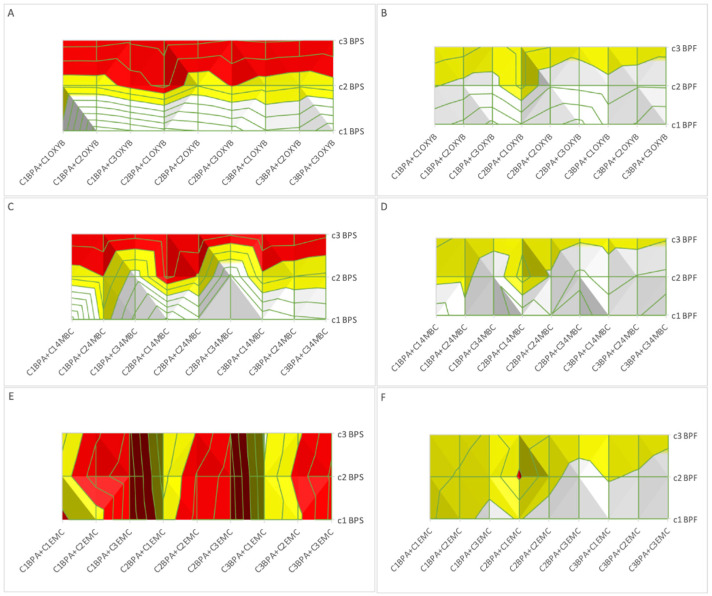
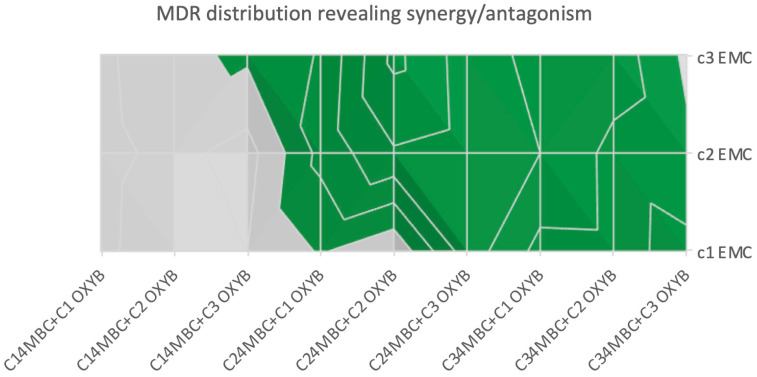
Contaminants of emerging concern (CEC) localize in the biome in variable combinations of complex mixtures that are often environmentally persistent, bioaccumulate and biomagnify, prompting a need for extensive monitoring. Many cosmetics include UV filters that are listed as CECs, such as benzophenone derivatives (oxybenzone, OXYB), cinnamates (2-ethylhexyl 4-methoxycinnamate, EMC) and camphor derivatives (4-methylbenzylidene-camphor, 4MBC). Furthermore, in numerous water sources, these UV filters have been detected together with Bisphenols (BPs), which are commonly used in plastics and can be physiologically detrimental. We utilized bioluminescent bacteria (Microtox assay) to monitor these CEC mixtures at environmentally relevant doses, and performed the first systematic study involving three sunscreen components (OXYB, 4MBC and EMC) and three BPs (BPA, BPS or BPF). Moreover, a breast cell line and cell viability assay were employed to determine the possible effect of these mixtures on human cells. Toxicity modeling, with concentration addition (CA) and independent action (IA) approaches, was performed, followed by data interpretation using Model Deviation Ratio (MDR) evaluation. The results show that UV filter sunscreen constituents and BPs interact at environmentally relevant concentrations. Of notable interest, mixtures containing any pair of three BPs (e.g., BPA + BPS, BPA + BPF and BPS + BPF), together with one sunscreen component (OXYB, 4MBC or EMC), showed strong synergy or overadditive effects. On the other hand, mixtures containing two UV filters (any pair of OXYB, 4MBC and EMC) and one BP (BPA, BPS or BPF) had a strong propensity towards concentration dependent underestimation. The three-component mixtures of UV filters (4MBC, EMC and OXYB) acted in an antagonistic manner toward each other, which was confirmed using a human cell line model. This study is one of the most comprehensive involving sunscreen constituents and BPs in complex mixtures, and provides new insights into potentially important interactions between these compounds.
新兴关注污染物(CEC)以复杂混合物的形式存在于生物群中,其组合具有变异性,这些混合物通常具有环境持久性、生物蓄积性和生物放大性,这促使人们需要进行广泛的监测。许多化妆品都包含被列为 CEC 的紫外线滤光剂,例如二苯甲酮衍生物(苯甲酮,OXYB)、肉桂酸盐(2-乙基己基 4-甲氧基肉桂酸酯,EMC)和樟脑衍生物(4-甲基亚苄基樟脑,4MBC)。此外,在许多水源中,这些紫外线滤光剂与双酚(BPs)一起被检测到,BPs 通常用于塑料制造,并且可能对生理造成损害。我们利用发光细菌(Microtox 测定法)在环境相关剂量下监测这些 CEC 混合物,并进行了首次涉及三种防晒霜成分(OXYB、4MBC 和 EMC)和三种 BPs(BPA、BPS 或 BPF)的系统研究。此外,还使用乳腺细胞系和细胞活力测定法来确定这些混合物对人类细胞的可能影响。采用浓度加和(CA)和独立作用(IA)方法进行毒性建模,然后使用模型偏差比(MDR)评估进行数据解释。结果表明,紫外线滤光剂防晒霜成分和 BPs 在环境相关浓度下相互作用。值得注意的是,含有任何三种 BPs(例如,BPA+BPS、BPA+BPF 和 BPS+BPF)的混合物,再加上一种防晒霜成分(OXYB、4MBC 或 EMC),表现出强烈的协同或超加性效应。另一方面,含有两种紫外线滤光剂(OXYB、4MBC 和 EMC 的任何两种组合)和一种 BP(BPA、BPS 或 BPF)的混合物则强烈倾向于浓度依赖性低估。三种紫外线滤光剂(4MBC、EMC 和 OXYB)的混合物相互作用呈拮抗作用,这一点在人类细胞系模型中得到了证实。这项研究是涉及复杂混合物中的防晒霜成分和 BPs 的最全面研究之一,为这些化合物之间可能存在的重要相互作用提供了新的见解。