Lambert Initiative for Cannabinoid Therapeutics, The University of Sydney, Sydney, NSW, Australia.
Brain and Mind Centre, The University of Sydney, Sydney, NSW, Australia.
J Psychopharmacol. 2022 Dec;36(12):1338-1349. doi: 10.1177/02698811221095356. Epub 2022 May 30.
Cannabidiol (CBD), a major cannabinoid of , is widely consumed in prescription and non-prescription products. While CBD is generally considered 'non-intoxicating', its effects on safety-sensitive tasks are still under scrutiny.
We investigated the effects of CBD on driving performance.
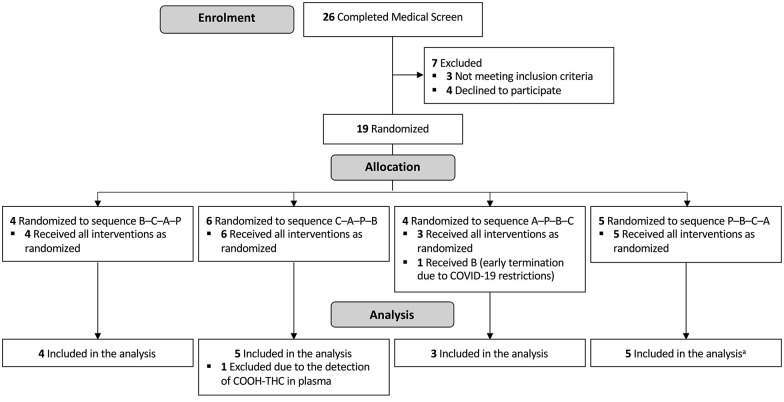
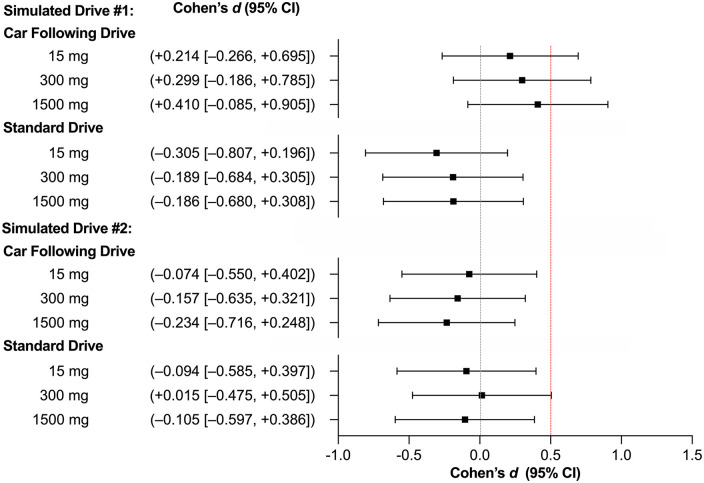
Healthy adults ( = 17) completed four treatment sessions involving the oral administration of a placebo, or 15, 300 or 1500 mg CBD in a randomised, double-blind, crossover design. Simulated driving performance was assessed between ~45-75 and ~210-240 min post-treatment (Drives 1 and 2) using a two-part scenario with 'standard' and 'car following' (CF) components. The primary outcome was standard deviation of lateral position (SDLP), a well-established measure of vehicular control. Cognitive function, subjective experiences and plasma CBD concentrations were also measured. Non-inferiority analyses tested the hypothesis that CBD would not increase SDLP by more than a margin equivalent to a 0.05% blood alcohol concentration (Cohen's = 0.50).
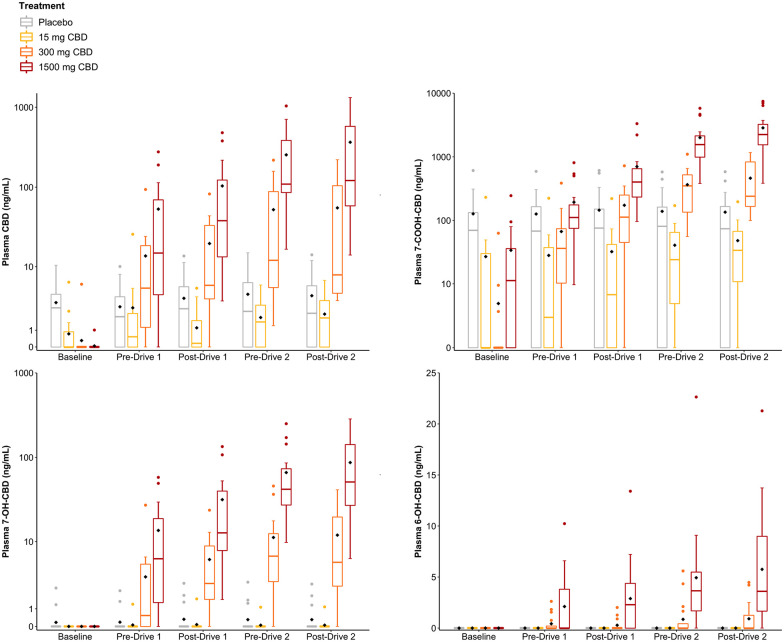
Non-inferiority was established during the standard component of Drive 1 and CF component of Drive 2 on all CBD treatments and during the standard component of Drive 2 on the 15 and 1500 mg treatments (95% CIs < 0.5). The remaining comparisons to placebo were inconclusive (the 95% CIs included 0 and 0.50). No dose of CBD impaired cognition or induced feelings of intoxication (s > 0.05). CBD was unexpectedly found to persist in plasma for prolonged periods of time (e.g. >4 weeks at 1500 mg).
Acute, oral CBD treatment does not appear to induce feelings of intoxication and is unlikely to impair cognitive function or driving performance (Registration: ACTRN12619001552178).
大麻二酚(CBD)是大麻中的主要大麻素,被广泛用于处方和非处方产品。虽然 CBD 通常被认为是“非致醉性的”,但其对安全敏感任务的影响仍在审查中。
我们研究了 CBD 对驾驶表现的影响。
健康成年人( = 17)完成了四项治疗,涉及口服安慰剂或 15、300 或 1500 mg CBD,采用随机、双盲、交叉设计。在治疗后约 45-75 和 210-240 分钟(驾驶 1 和 2)之间,使用具有“标准”和“跟车”(CF)部分的两部分场景评估模拟驾驶性能。主要结果是车辆控制的标准差(SDLP),这是一个成熟的衡量标准。还测量了认知功能、主观体验和血浆 CBD 浓度。非劣效性分析检验了 CBD 不会使 SDLP 增加超过相当于 0.05%血液酒精浓度(Cohen's = 0.50)的假设。
在所有 CBD 治疗的驾驶 1 的标准部分和驾驶 2 的 CF 部分以及在 15 和 1500 mg 治疗的驾驶 2 的标准部分,非劣效性得到确立(95%CI < 0.5)。与安慰剂的其余比较没有定论(95%CI 包括 0 和 0.50)。CBD 的任何剂量都没有损害认知或引起醉酒感(s > 0.05)。出乎意料的是,CBD 在血浆中持续存在很长时间(例如,在 1500 mg 时超过 4 周)。
急性口服 CBD 治疗似乎不会引起醉酒感,也不太可能损害认知功能或驾驶表现(注册:ACTRN12619001552178)。