The Royal Melbourne Hospital, Melbourne, VIC.
The University of Melbourne, Melbourne, VIC.
Med J Aust. 2022 Jul 18;217(2):88-93. doi: 10.5694/mja2.51585. Epub 2022 May 29.
To compare the performance of four N95 respirator types with respect to quantitative fit test pass rate and health care worker-rated usability and comfort.
DESIGN, SETTING, PARTICIPANTS: Health care workers who participated in the respiratory protection program at the Royal Melbourne Hospital, 1 October 2020 - 31 May 2021. Participants underwent quantitative N95 respirator fit testing (at least three of four types: semi-rigid cup, flat-fold cup, duckbill, and three-panel flat-fold types), and were invited to complete an online usability and comfort assessment for respirators for which their fit test results were passes.
Fit test pass rate, and user-rated overall comfort and assessment ratings (five-point Likert scales), by N95 respirator type.
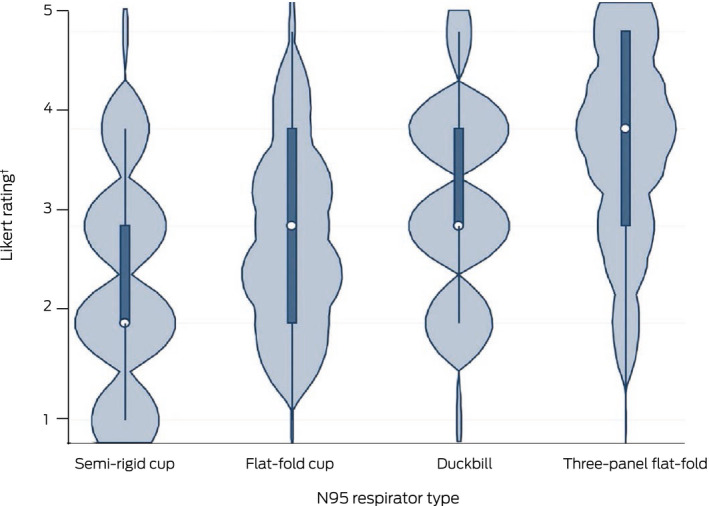
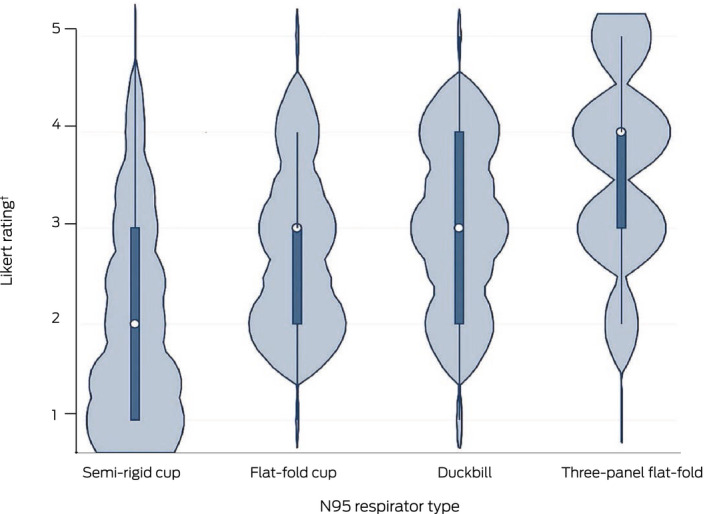
A total of 2161 health care workers underwent quantitative fit testing (women, 1586 [73.4%]; nurses, 1271 [58.8%]). The overall fit test pass rates were 65.0% for the semi-rigid cup respirators (1029/1583 tests), 32.4% for the flat-fold respirator (660/2035 tests), 59.2% for the duckbill respirators (2005/3387 tests), and 96.4% for the three-panel flat-fold respirator (1876/1946 tests). 378 health care workers completed the comfort and usability survey. Overall comfort and assessment ratings each differed by respirator group (P < 0.001); the median overall comfort (4; IQR, 3-4) and overall assessment values (4; IQR, 3-5) were highest for the three-panel flat-fold respirator and lowest for the semi-rigid cup respirators (comfort: 2 [IQR, 1-3]; assessment: 2 [IQR, 2-3]).
The three-panel flat-fold N95 respirator outperformed the three alternative types with regard to fit test pass rate and user-rated comfort and usability. To maximise respiratory protection for health care workers, these factors should be considered when making respirator procurement decisions.
比较四种 N95 呼吸器类型在定量 fit 测试通过率以及医护人员评定的可用性和舒适度方面的性能。
设计、设置、参与者:2020 年 10 月 1 日至 2021 年 5 月 31 日期间,参加墨尔本皇家医院呼吸保护计划的医护人员。参与者接受了定量 N95 呼吸器 fit 测试(至少包括四种类型中的三种:半刚性杯、扁平折叠杯、鸭嘴阀和三面板扁平折叠类型),并被邀请在线完成对其 fit 测试结果为通过的呼吸器的可用性和舒适度评估。
根据 N95 呼吸器类型,fit 测试通过率和用户评定的总体舒适度和评估等级(五分李克特量表)。
共有 2161 名医护人员接受了定量 fit 测试(女性 1586 人[73.4%];护士 1271 人[58.8%])。半刚性杯呼吸器的总体 fit 测试通过率为 65.0%(1029/1583 次测试),扁平折叠呼吸器为 32.4%(660/2035 次测试),鸭嘴阀呼吸器为 59.2%(2005/3387 次测试),三面板扁平折叠呼吸器为 96.4%(1876/1946 次测试)。378 名医护人员完成了舒适度和可用性调查。每个呼吸器组的总体舒适度和评估评分均存在差异(P<0.001);三面板扁平折叠呼吸器的总体舒适度(中位数 4;IQR,3-4)和总体评估值(中位数 4;IQR,3-5)最高,半刚性杯呼吸器最低(舒适度:2 [IQR,1-3];评估:2 [IQR,2-3])。
在 fit 测试通过率以及用户评定的舒适度和可用性方面,三面板扁平折叠 N95 呼吸器优于其他三种类型。为了最大限度地为医护人员提供呼吸保护,在做出呼吸器采购决策时应考虑这些因素。