Bhat Deepa V, Awchat Kiran L, Singh Pooja, Jha Manish, Arora Kashika, Mitra Malay
Department of Pedodontics and Preventive Dentistry, Awadh Dental College and Hospital, Jamshedpur, Jharkhand, India.
Department of Prosthodontics, Military Dental Centre, Nasirabad, Rajasthan, India.
Int J Clin Pediatr Dent. 2022;15(Suppl 2):S221-S225. doi: 10.5005/jp-journals-10005-2161.
The change in understanding of dental caries which is now believed to be a reversible lesion has led to the change in its management.
To evaluate the remineralizing potential of three remineralizing agents [casein phosphopeptide (CPP)-amorphous calcium phosphate (ACP), CPP-ACP + F, and beta-tricalcium phosphate (β TCP) + F] and their effect on microhardness of enamel using Vickers microhardness test.
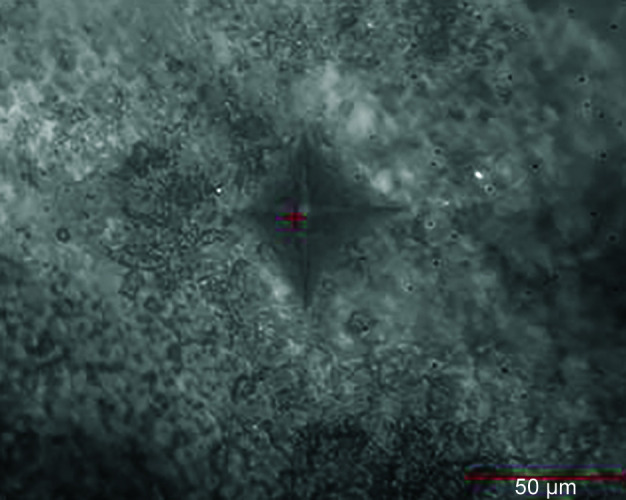
Forty freshly extracted premolars, extracted for orthodontic purpose were collected and specimen prepared. The specimens were equally divided into four groups. Baseline surface microhardness measurement was taken for the specimens. Demineralization of enamel was carried out by keeping the specimens in 20 mL of demineralizing solution for 72 hours, and microhardness was evaluated. Remineralizing agents CPP-ACP, CPP-ACP + F, and β TCP + F was applied to Group A, Group B, and Group C, respectively for 28 days and microhardness was evaluated again. Group D was kept as control group. Statistical analysis was done by One-way ANOVA test. Percentage microhardness recovery was calculated to evaluate the regain in microhardness after remineralization and thus assess the remineralizing efficacy of the agents.
After demineralization surface microhardness of enamel decreased to the range of Vickers hardness number (VHN) 155-167 but after application of remineralizing agents surface microhardness for Group B was found to be highest, in other words, VHN 240.78 followed by Group C, in other words, VHN 214.29 and Group A the least VHN 197.90.
The result of this study concludes that surface microhardness of enamel decreased after demineralization procedure and increased after application of all the remineralizing agents. The highest increase was seen in group tested with CPP-ACP + F followed by β TCP and least for CPP-ACP. The values for all the three groups were higher than the control so we can conclude that all the agents can be used as remineralizing agent with CPP-ACP + F being the best among the three.
Bhat DV, Awchat KL, Singh P, Evaluation of Remineralizing Potential of CPP-ACP, CPP-ACP + F and β TCP + F and Their Effect on Microhardness of Enamel Using Vickers Microhardness Test: An In Vitro Study. Int J Clin Pediatr Dent 2022;15(S-2):S221-S225.
对龋齿的认识已发生改变,现在认为它是一种可逆性病变,这导致了其治疗方法的改变。
使用维氏显微硬度测试评估三种再矿化剂[酪蛋白磷酸肽(CPP)-无定形磷酸钙(ACP)、CPP-ACP+氟、β-磷酸三钙(β TCP)+氟]的再矿化潜力及其对牙釉质显微硬度的影响。
收集40颗因正畸拔除的新鲜前磨牙并制备标本。将标本平均分为四组。对标本进行基线表面显微硬度测量。通过将标本置于20 mL脱矿溶液中72小时进行牙釉质脱矿,并评估显微硬度。分别将再矿化剂CPP-ACP、CPP-ACP+氟和β TCP+氟应用于A组、B组和C组28天,然后再次评估显微硬度。D组作为对照组。采用单因素方差分析进行统计分析。计算显微硬度恢复百分比以评估再矿化后显微硬度的恢复情况,从而评估这些药剂的再矿化效果。
脱矿后牙釉质表面显微硬度降至维氏硬度值(VHN)155-167范围内,但应用再矿化剂后,发现B组的表面显微硬度最高,即VHN为240.78,其次是C组,即VHN为214.29,A组最低,VHN为197.90。
本研究结果表明,脱矿程序后牙釉质表面显微硬度降低,应用所有再矿化剂后硬度增加。在使用CPP-ACP+氟测试的组中增加幅度最大,其次是β TCP,CPP-ACP最小。三组的值均高于对照组,因此我们可以得出结论,所有药剂都可作为再矿化剂使用,其中CPP-ACP+氟是三者中最好的。
Bhat DV, Awchat KL, Singh P, 使用维氏显微硬度测试评估CPP-ACP、CPP-ACP+氟和β TCP+氟的再矿化潜力及其对牙釉质显微硬度的影响:一项体外研究。《国际临床儿科牙科学杂志》2022年;15(S-2):S221-S225。