Kim Ko Woon, Choi Jongdoo, Chin Juhee, Lee Byung Hwa, Na Duk L
Department of Neurology, Jeonbuk National University Medical School and Hospital, Jeonju, South Korea.
Research Institute of Clinical Medicine of Jeonbuk National University, Jeonju, South Korea.
Front Neurol. 2022 May 16;13:844341. doi: 10.3389/fneur.2022.844341. eCollection 2022.
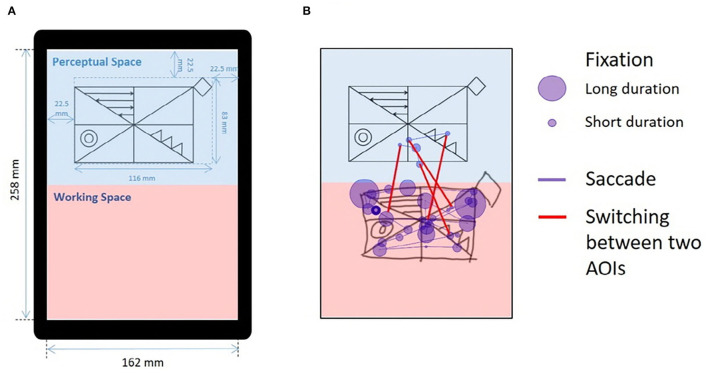
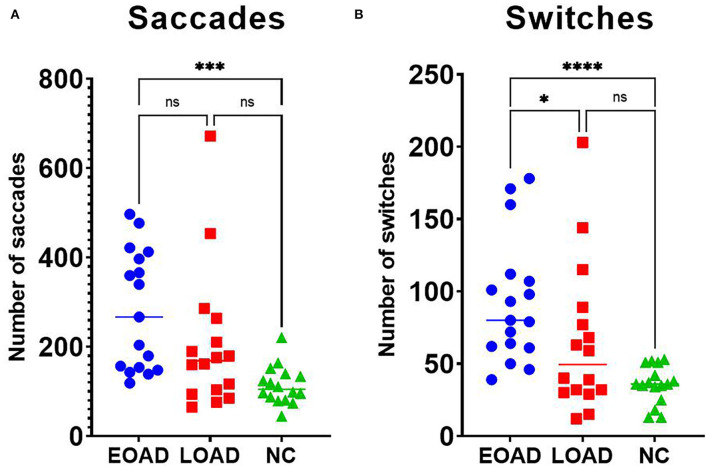
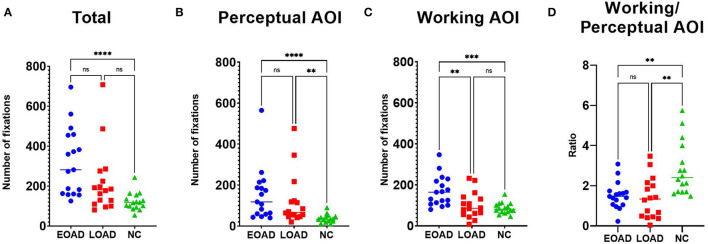
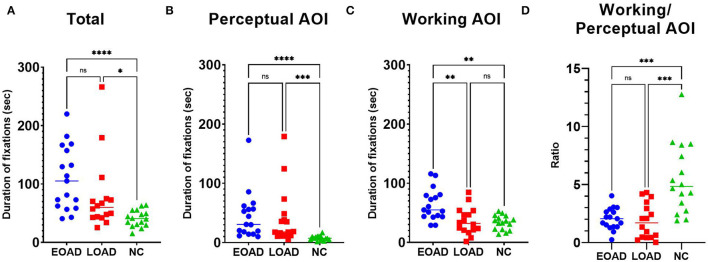
Visuospatial dysfunction is a common symptom in patients with Alzheimer's disease (AD). To more focus on copying processes rather than on finally completed figures, we conceptually split the copying processes into three stages: visuoperceptual function, visuoconstructional function, and working memory function. We constructed perceptual and working spaces to investigate the different stages of copying, and then, we compared the number and duration of fixations and saccades and the number of switches across the two spaces. We used eye-tracking glasses to assess eye-tracking metrics in patients with early-onset AD (EOAD), patients with late-onset AD (LOAD), and normal control (NC) participants while they copied the simplified Rey-Osterrieth complex figure test (RCFT). Regarding eye metrics on the perceptual space, the number and duration of fixations were greater in both groups of patients with AD than in the NC participants group (number: EOAD vs. NC: < 0.001, LOAD vs. NC: = 0. 003/ duration: EOAD vs. NC: < 0.001, LOAD vs. NC: < 0.001). On the working space, the number and duration of fixations were greater in the patients with EOAD than in the patients with LOAD and NC participants (number: EOAD vs. LOAD: = 0. 007, EOAD vs. NC: = 0. 001/duration: EOAD vs. LOAD: = 0. 008, EOAD vs. NC: = 0. 002). The number of saccades and switching was higher in patients with EOAD than in NC participants ( < 0.001). The eye-tracking metrics from the simplified RCFT correlated with the neuropsychological test scores. Patients with EOAD and LOAD achieved the same level of performance at the simplified and original RCFT scores. However, patients with EOAD than LOAD showed a greater number and duration of fixations on the working space and more frequent switching between the perceptual and working spaces, which may reflect more cognitive efforts to achieve the same level of performance.
视觉空间功能障碍是阿尔茨海默病(AD)患者的常见症状。为了更专注于复制过程而非最终完成的图形,我们从概念上将复制过程分为三个阶段:视觉感知功能、视觉构建功能和工作记忆功能。我们构建了感知空间和工作空间来研究复制的不同阶段,然后,我们比较了注视和扫视的次数与持续时间以及在两个空间之间切换的次数。我们使用眼动追踪眼镜评估早发型AD(EOAD)患者、晚发型AD(LOAD)患者和正常对照(NC)参与者在复制简化版雷-奥斯特里思复杂图形测验(RCFT)时的眼动指标。关于感知空间的眼动指标,两组AD患者的注视次数和持续时间均多于NC参与者组(次数:EOAD与NC比较:<0.001,LOAD与NC比较:=0.003/持续时间:EOAD与NC比较:<0.001,LOAD与NC比较:<0.001)。在工作空间中,EOAD患者的注视次数和持续时间多于LOAD患者和NC参与者(次数:EOAD与LOAD比较:=0.007,EOAD与NC比较:=0.001/持续时间:EOAD与LOAD比较:=0.008,EOAD与NC比较:=0.002)。EOAD患者的扫视次数和切换次数高于NC参与者(<0.001)。简化版RCFT的眼动指标与神经心理学测试分数相关。EOAD和LOAD患者在简化版和原版RCFT分数上达到了相同的表现水平。然而,与LOAD患者相比,EOAD患者在工作空间上的注视次数和持续时间更多,并且在感知空间和工作空间之间的切换更频繁,这可能反映了在达到相同表现水平时需要更多的认知努力。