Department of Breast Surgery, Fudan University Shanghai Cancer Center, 270 Dongan Road, Xuhui District, Shanghai, People's Republic of China.
Department of Oncology, Shanghai Medical College, Fudan University, Shanghai, People's Republic of China.
J Transl Med. 2022 Jun 7;20(1):256. doi: 10.1186/s12967-022-03452-1.
We established a radiogenomic model to predict pathological complete response (pCR) in triple-negative breast cancer (TNBC) and explored the association between high-frequency mutations and drug resistance.
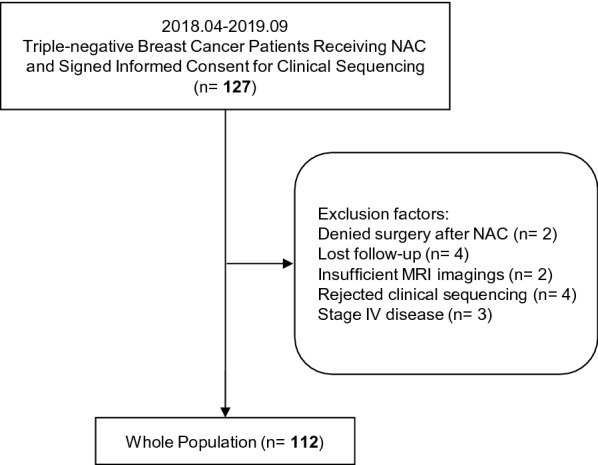
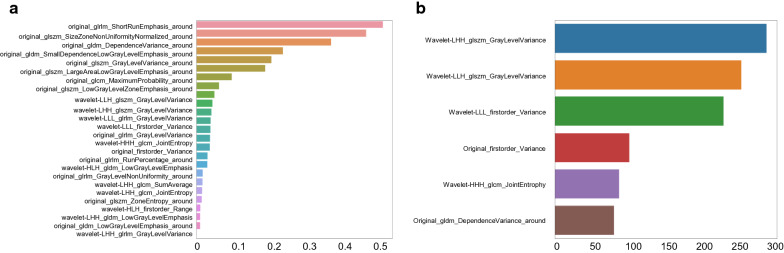
From April 2018 to September 2019, 112 patients who had received neoadjuvant chemotherapy were included. We randomly split the study population into training and validation sets (2:1 ratio). Contrast-enhanced magnetic resonance imaging scans were obtained at baseline and after two cycles of treatment and were used to extract quantitative radiomic features and to construct two radiomics-only models using a light gradient boosting machine. By incorporating the variant allele frequency features obtained from baseline core tissues, a radiogenomic model was constructed to predict pCR. Additionally, we explored the association between recurrent mutations and drug resistance.
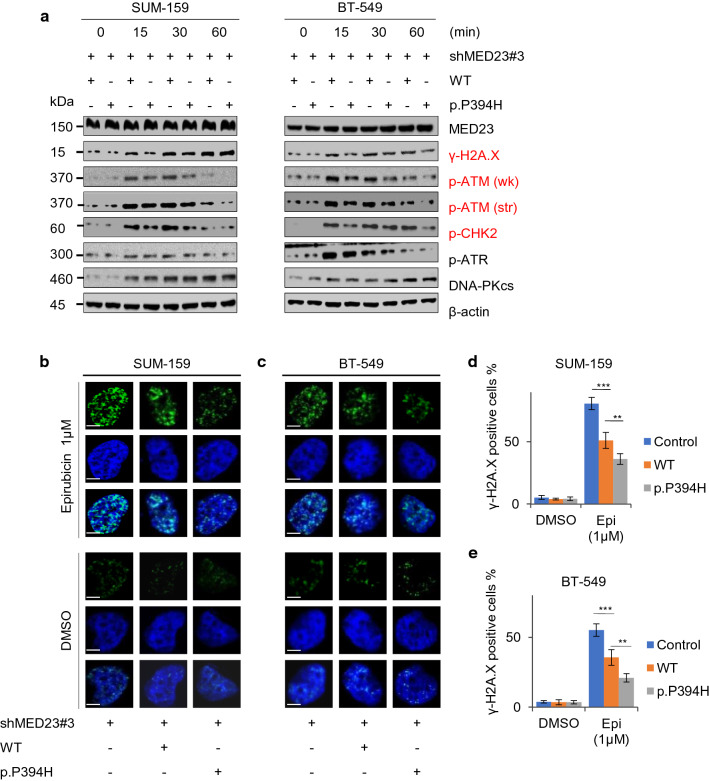
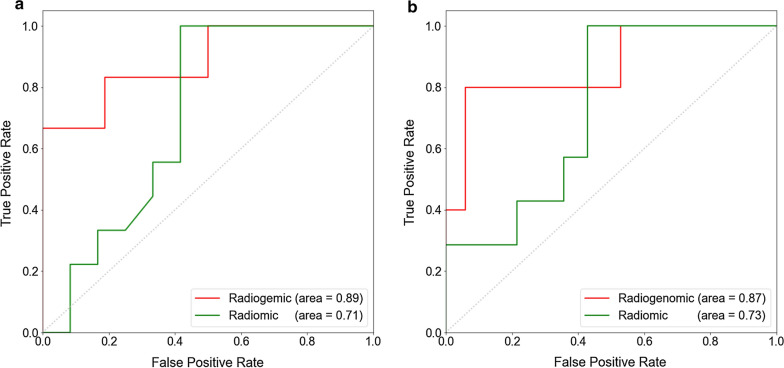
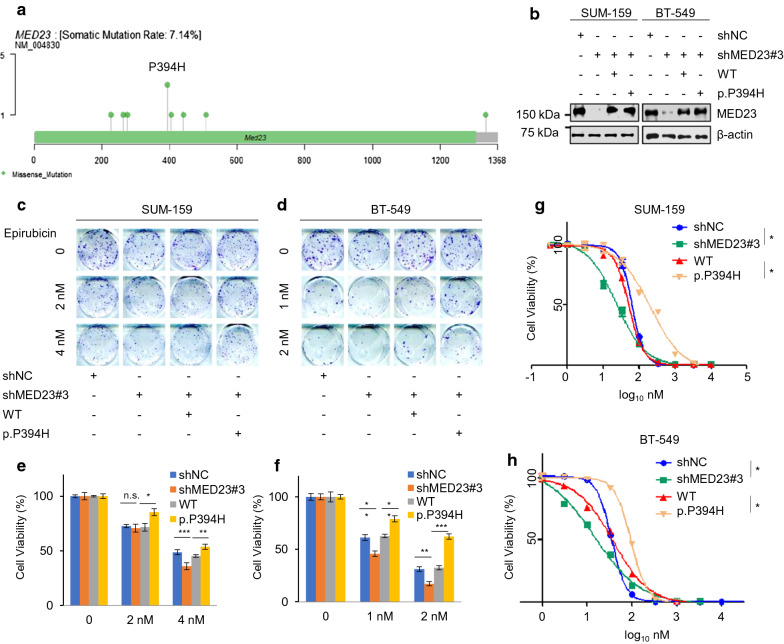
The two radiomics-only models showed similar performance with AUCs of 0.71 and 0.73 (p = 0.55). The radiogenomic model had a higher predictive ability than the radiomics-only model in the validation set (p = 0.04), with a corresponding AUC of 0.87 (0.73-0.91). Two highly frequent mutations were selected after comparing the mutation sites of pCR and non-pCR populations. The MED23 mutation p.P394H caused epirubicin resistance in vitro (p < 0.01). The expression levels of γ-H2A.X, p-ATM and p-CHK2 in MED23 p.P394H cells were significantly lower than those in wild type cells (p < 0.01). In the HR repair system, the GFP positivity rate of MED23 p.P394H cells was higher than that in wild-type cells (p < 0.01).
The proposed radiogenomic model has the potential to accurately predict pCR in TNBC patients. Epirubicin resistance after MED23 p.P394H mutation might be affected by HR repair through regulation of the p-ATM-γ-H2A.X-p-CHK2 pathway.
我们建立了一个放射基因组模型,以预测三阴性乳腺癌(TNBC)的病理完全缓解(pCR),并探讨了高频突变与耐药性之间的关系。
本研究纳入了 2018 年 4 月至 2019 年 9 月期间接受新辅助化疗的 112 例患者。我们将研究人群随机分为训练集和验证集(比例为 2:1)。基线和治疗两个周期后均进行对比增强磁共振成像扫描,以提取定量放射组学特征,并使用轻梯度提升机构建两个仅基于放射组学的模型。通过整合基线核心组织中获得的变异等位基因频率特征,构建放射基因组模型以预测 pCR。此外,我们还探讨了复发突变与耐药性之间的关系。
两个仅基于放射组学的模型的表现相似,AUC 值分别为 0.71 和 0.73(p=0.55)。验证集中,放射基因组模型的预测能力高于仅基于放射组学的模型(p=0.04),AUC 值为 0.87(0.73-0.91)。比较 pCR 和非 pCR 人群的突变位点后,筛选出两个高频突变。体外实验表明,MED23 突变 p.P394H 导致表阿霉素耐药(p<0.01)。MED23 p.P394H 细胞中 γ-H2A.X、p-ATM 和 p-CHK2 的表达水平明显低于野生型细胞(p<0.01)。在 HR 修复系统中,MED23 p.P394H 细胞的 GFP 阳性率高于野生型细胞(p<0.01)。
所提出的放射基因组模型有可能准确预测 TNBC 患者的 pCR。MED23 p.P394H 突变后表阿霉素耐药可能通过 HR 修复,通过调节 p-ATM-γ-H2A.X-p-CHK2 通路来影响。