Criado-Gonzalez Miryam, Dominguez-Alfaro Antonio, Lopez-Larrea Naroa, Alegret Nuria, Mecerreyes David
POLYMAT University of the Basque Country UPV/EHU, Avenida de Tolosa 72, 20018 Donostia-San Sebastián, Spain.
Instituto de Ciencia y Tecnología de Polímeros CSIC, Juan de la Cierva 3, 28006 Madrid, Spain.
ACS Appl Polym Mater. 2021 Jun 11;3(6):2865-2883. doi: 10.1021/acsapm.1c00252. Epub 2021 Jun 1.
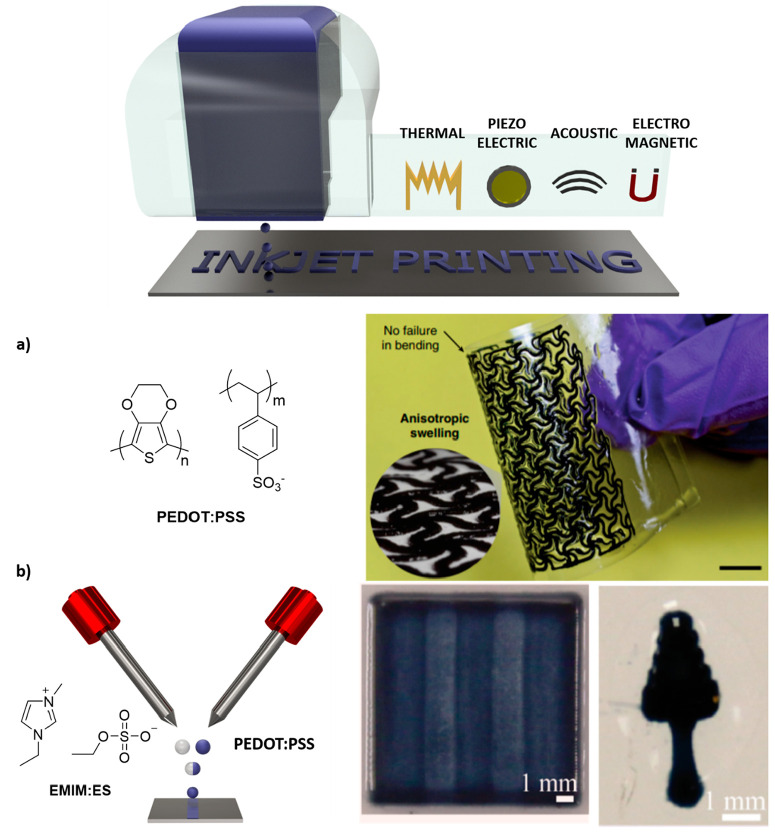
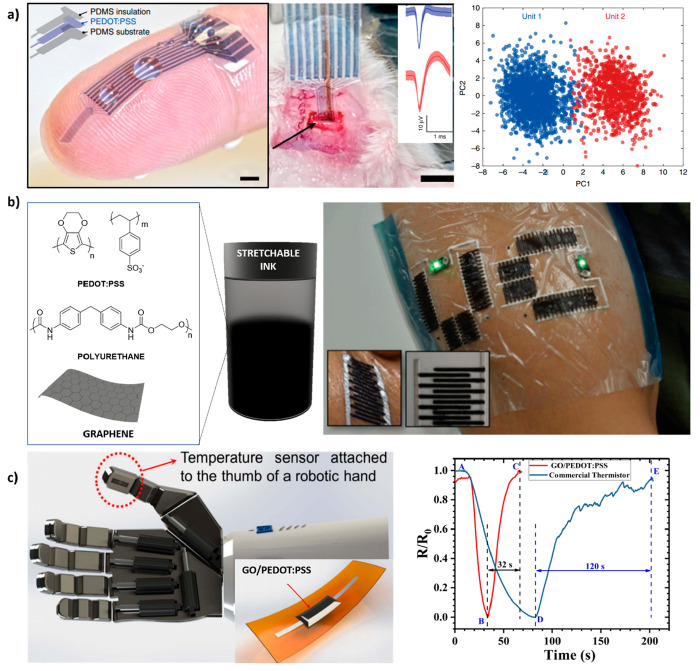
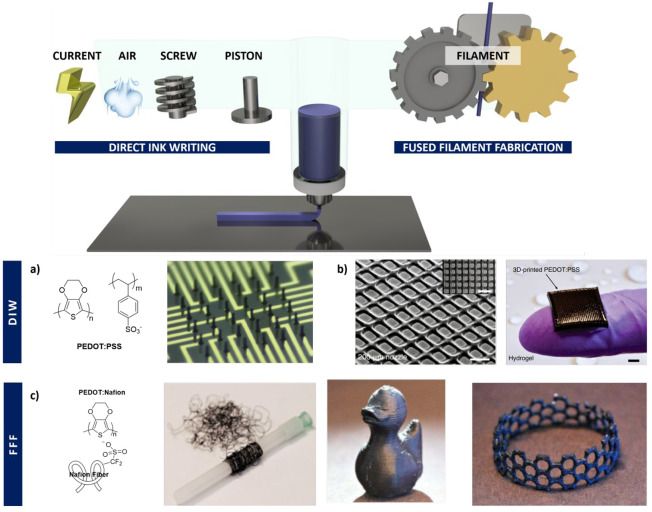
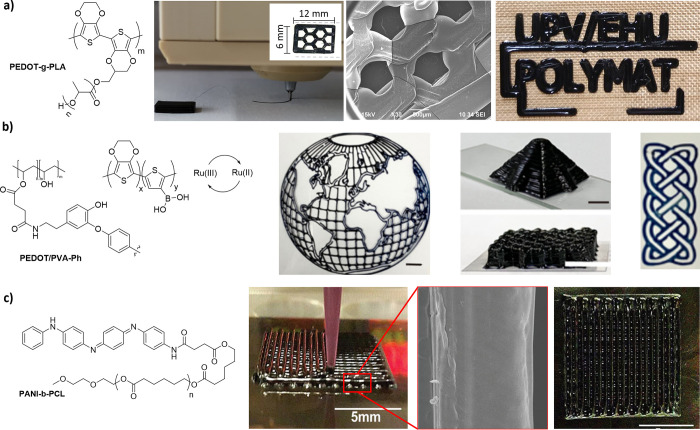
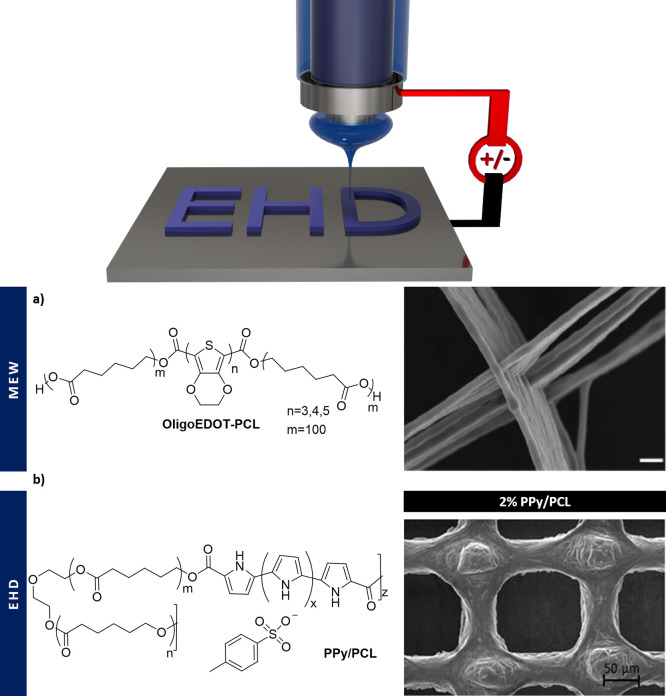
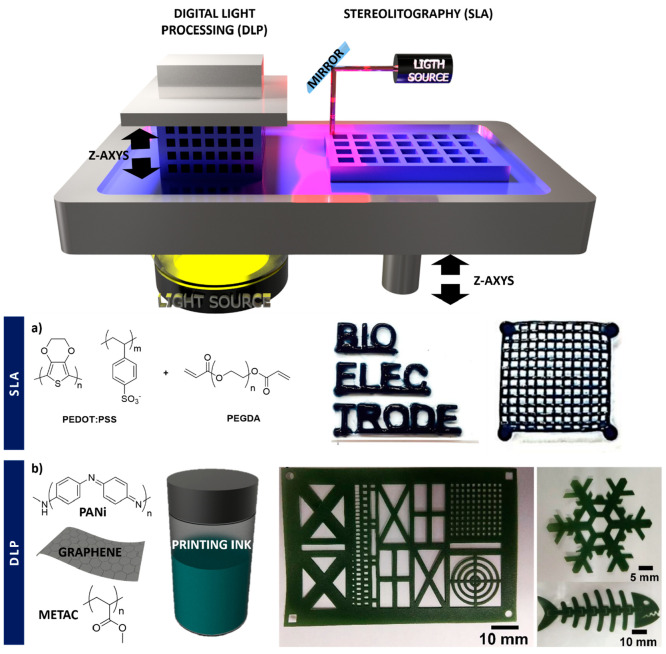
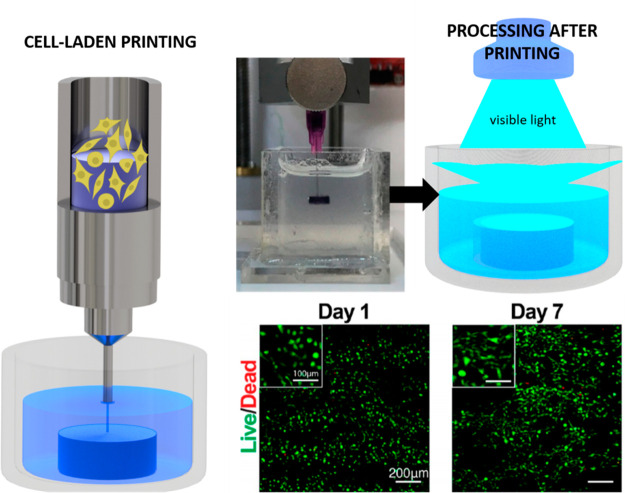
Conducting polymers (CPs) have been attracting great attention in the development of (bio)electronic devices. Most of the current devices are rigid two-dimensional systems and possess uncontrollable geometries and architectures that lead to poor mechanical properties presenting ion/electronic diffusion limitations. The goal of the article is to provide an overview about the additive manufacturing (AM) of conducting polymers, which is of paramount importance for the design of future wearable three-dimensional (3D) (bio)electronic devices. Among different 3D printing AM techniques, inkjet, extrusion, electrohydrodynamic, and light-based printing have been mainly used. This review article collects examples of 3D printing of conducting polymers such as poly(3,4-ethylene-dioxythiophene), polypyrrole, and polyaniline. It also shows examples of AM of these polymers combined with other polymers and/or conducting fillers such as carbon nanotubes, graphene, and silver nanowires. Afterward, the foremost applications of CPs processed by 3D printing techniques in the biomedical and energy fields, that is, wearable electronics, sensors, soft robotics for human motion, or health monitoring devices, among others, will be discussed.
导电聚合物(CPs)在(生物)电子器件的发展中一直备受关注。当前的大多数器件都是刚性二维系统,具有不可控的几何形状和结构,导致机械性能较差,并存在离子/电子扩散限制。本文的目的是对导电聚合物的增材制造(AM)进行概述,这对于未来可穿戴三维(3D)(生物)电子器件的设计至关重要。在不同的3D打印增材制造技术中,主要使用了喷墨、挤出、电流体动力学和基于光的打印技术。这篇综述文章收集了导电聚合物如聚(3,4-亚乙基二氧噻吩)、聚吡咯和聚苯胺的3D打印实例。它还展示了这些聚合物与其他聚合物和/或导电填料(如碳纳米管、石墨烯和银纳米线)结合的增材制造实例。之后,将讨论通过3D打印技术加工的导电聚合物在生物医学和能源领域的最重要应用,即可穿戴电子设备、传感器、用于人体运动的软机器人或健康监测设备等。