
促进用户参与数字心理健康干预的技术支持策略:一项系统综述。
Technology-supported strategies for promoting user engagement with digital mental health interventions: A systematic review.
作者信息
Gan Daniel Z Q, McGillivray Lauren, Larsen Mark E, Christensen Helen, Torok Michelle
机构信息
Black Dog Institute, University of New South Wales, Australia.
出版信息
Digit Health. 2022 Jun 1;8:20552076221098268. doi: 10.1177/20552076221098268. eCollection 2022 Jan-Dec.
BACKGROUND
Although digital mental health interventions (DMHIs) offer a potential solution for increasing access to mental health treatment, their integration into real-world settings has been slow. A key reason for this is poor user engagement. A growing number of studies evaluating strategies for promoting engagement with DMHIs means that a review of the literature is now warranted. This systematic review is the first to synthesise evidence on technology-supported strategies for promoting engagement with DMHIs.
METHODS
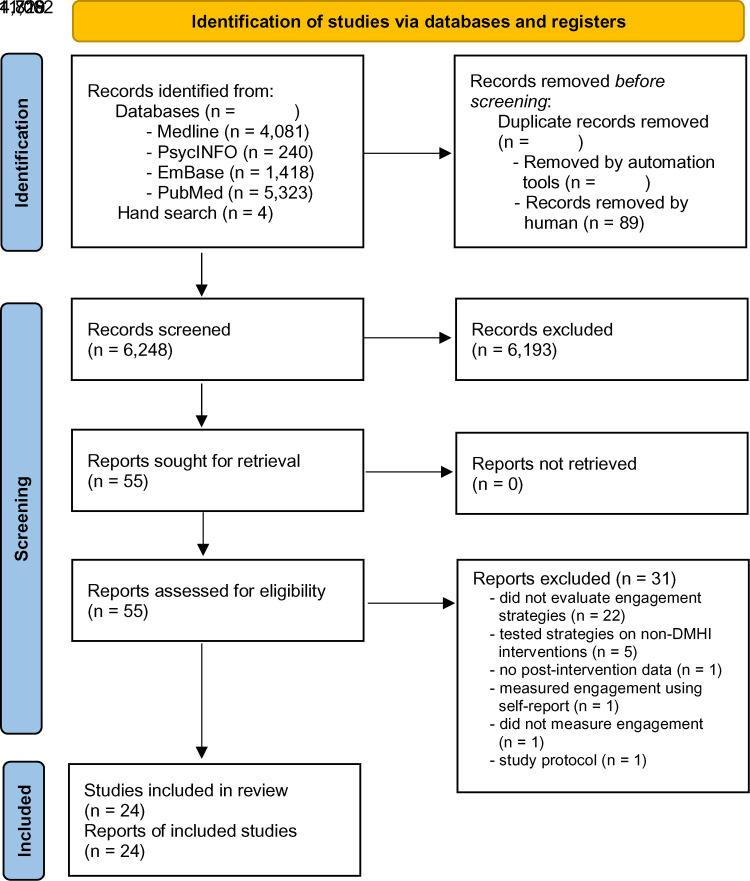
MEDLINE, EmbASE, PsycINFO and PubMed databases were searched from 1 January 1995 to 1 October 2021. Experimental or quasi-experimental studies examining the effect of technology-supported engagement strategies deployed alongside DMHIs were included, as were secondary analyses of such studies. Title and abstract screening, full-text coding and quality assessment were performed independently by two authors. Narrative synthesis was used to summarise findings from the included studies.
RESULTS
24 studies (10,266 participants) were included. Engagement strategies ranged from reminders, coaching, personalised information and peer support. Most strategies were disseminated once a week, usually via email or telephone. There was some empirical support for the efficacy of technology-based strategies towards promoting engagement. However, findings were mixed regardless of strategy type or study aim.
CONCLUSIONS
Technology-supported strategies appear to increase engagement with DMHIs; however, their efficacy varies widely by strategy type. Future research should involve end-users in the development and evaluation of these strategies to develop a more cohesive set of strategies that are acceptable and effective for target audiences, and explore the mechanism(s) through which such strategies promote engagement.
背景
尽管数字心理健康干预措施(DMHIs)为增加心理健康治疗的可及性提供了一种潜在解决方案,但它们在现实环境中的整合进展缓慢。造成这种情况的一个关键原因是用户参与度低。越来越多的研究评估促进与数字心理健康干预措施互动的策略,这意味着现在有必要对相关文献进行综述。本系统综述首次综合了关于促进与数字心理健康干预措施互动的技术支持策略的证据。
方法
检索了1995年1月1日至2021年10月1日期间的MEDLINE、EmbASE、PsycINFO和PubMed数据库。纳入了检验与数字心理健康干预措施同时部署的技术支持参与策略效果的实验性或准实验性研究,以及此类研究的二次分析。由两位作者独立进行标题和摘要筛选、全文编码及质量评估。采用叙述性综合法总结纳入研究的结果。
结果
纳入24项研究(10266名参与者)。参与策略包括提醒、指导、个性化信息和同伴支持。大多数策略每周传播一次,通常通过电子邮件或电话。有一些实证支持基于技术的策略在促进参与方面的有效性。然而,无论策略类型或研究目的如何,结果都参差不齐。
结论
技术支持的策略似乎能提高与数字心理健康干预措施的互动;然而,其效果因策略类型而异。未来的研究应让最终用户参与这些策略的开发和评估,以制定一套更具凝聚力、对目标受众可接受且有效的策略,并探索这些策略促进参与的机制。
 Zotero 插件