Department of Food Science and Nutrition, Gwangju University, Gwangju 61743, Korea.
Department of Food and Nutrition, Inha University, Incheon 22212, Korea.
Int J Environ Res Public Health. 2020 May 8;17(9):3287. doi: 10.3390/ijerph17093287.
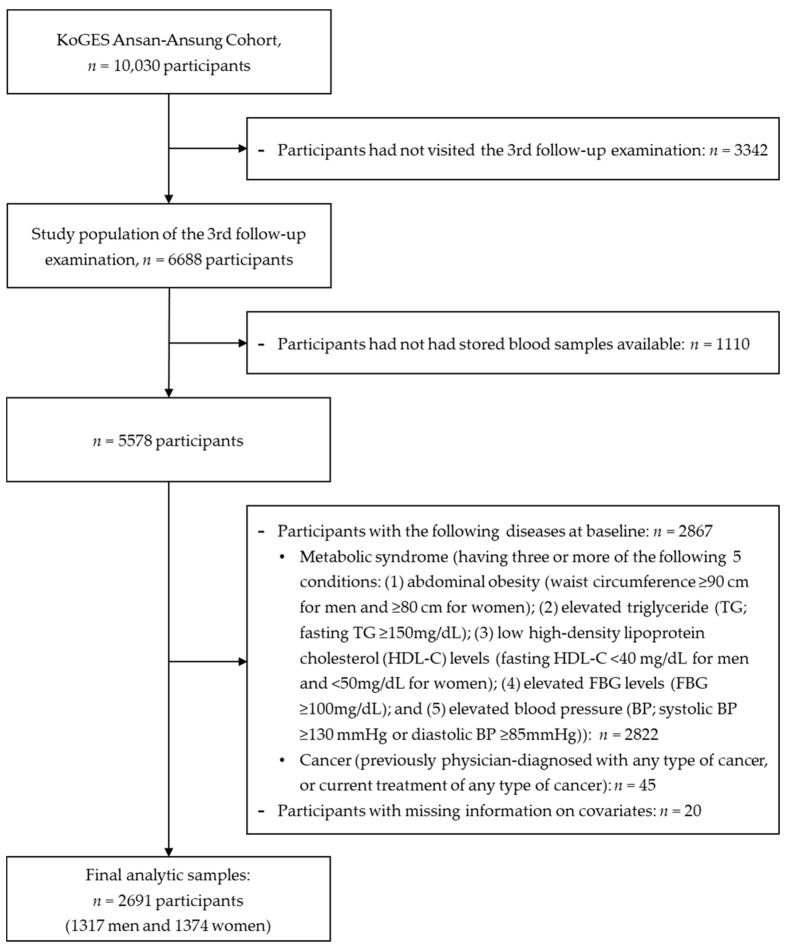
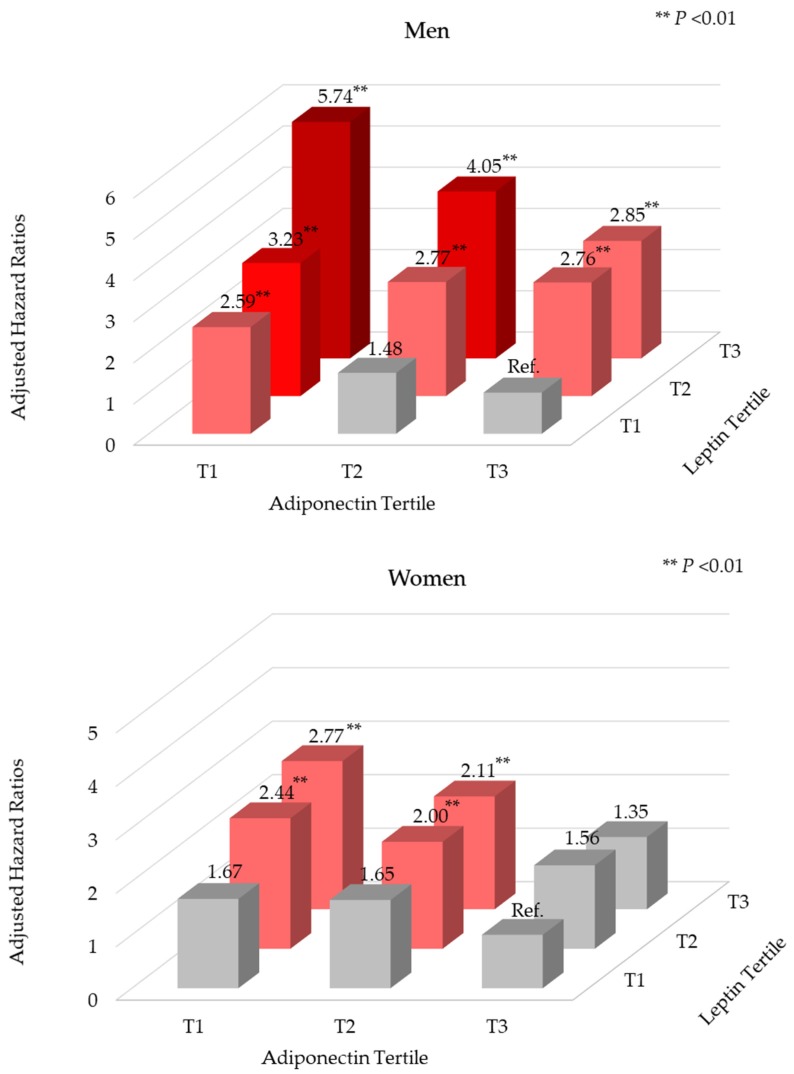
Although the role of adiponectin and leptin in the etiology of metabolic syndrome (MetS) has been explored in various populations, limited knowledge is available on the prospective association of adiponectin and leptin with the risk of MetS development. The present study aimed to evaluate the associations of adiponectin, leptin, and the leptin-adiponectin (LA) ratio with the future risk of MetS in middle-aged and older Korean adults. Using a prospective, population-based Ansan-Ansung cohort of the Korean Genome and Epidemiology Study (KoGES), 2691 Korean adults (1317 men and 1374 women) were included in the present study. Serum adiponectin and leptin concentrations were measured using commonly available enzyme-linked immunosorbent assay kits. Multivariable Cox proportional hazard models were used to investigate the relationships of the different adiponectin and leptin concentrations and LA ratio with the incident MetS. During a mean follow-up of 6.75 years, a total of 359 (27.26%) men and 385 (28.02%) women were identified as developing new-onset MetS. After controlling for covariates, higher adiponectin levels were associated with lower incidence of MetS (hazard ratio (HR) for third vs. first tertile: 0.53, 95% confidence interval (CI): 0.40-0.70 for men and HR: 0.54, 95% CI: 0.42-0.71 for women), while higher leptin levels (HR for third vs. first tertile: 2.88, 95% CI: 2.01-4.13 for men and HR: 1.55, 95% CI: 1.13-2.13 for women) and LA ratio (HR for third vs. first tertile: 3.07, 95% CI: 2.13-4.44 for men and HR: 1.94, 95% CI: 1.41-2.66 for women) were associated with an increased incidence of MetS. Among men, in the fully adjusted models an increase by one standard deviation (SD) in adiponectin levels was associated with a 10% decrease in MetS risk (HR per SD: 0.90, 95% CI: 0.85-0.95) while leptin and LA ratio was associated with a 5% (HR per SD: 1.05, 95% CI: 1.01-1.08) and 40% (HR per SD: 1.40, 95% CI: 1.22-1.62) increase in MetS risk, respectively. Among women, a significant association with MetS risk was observed only in adiponectin levels (HR per SD: 0.91, 95% CI: 0.88-0.95). We found that higher adiponectin level was associated with a lower risk of MetS, while higher leptin level and LA ratio were associated with elevated MetS incidence, irrespective of body mass index at baseline in both Korean men and women. Adiponectin and leptin levels and LA ratio could play a role as a useful biomarker in the prediction of future MetS development among middle-aged and older Koreans.
虽然脂联素和瘦素在代谢综合征(MetS)病因中的作用已在各种人群中进行了探讨,但关于脂联素和瘦素与 MetS 发展风险的前瞻性关联的知识有限。本研究旨在评估脂联素、瘦素和瘦素-脂联素(LA)比值与中年和老年韩国成年人未来发生 MetS 的风险的关系。本研究使用了韩国基因组和流行病学研究(KoGES)中基于人群的安山-安城队列的前瞻性研究,纳入了 2691 名韩国成年人(1317 名男性和 1374 名女性)。使用常用的酶联免疫吸附测定试剂盒测量血清脂联素和瘦素浓度。多变量 Cox 比例风险模型用于研究不同的脂联素和瘦素浓度和 LA 比值与新发 MetS 的关系。在平均 6.75 年的随访期间,共有 359 名(27.26%)男性和 385 名(28.02%)女性被确定为新发 MetS。在控制了混杂因素后,较高的脂联素水平与较低的 MetS 发生率相关(第三与第一三分位数的 HR:0.53,95%CI:0.40-0.70 男性和 HR:0.54,95%CI:0.42-0.71 女性),而较高的瘦素水平(第三与第一三分位数的 HR:2.88,95%CI:2.01-4.13 男性和 HR:1.55,95%CI:1.13-2.13 女性)和 LA 比值(第三与第一三分位数的 HR:3.07,95%CI:2.13-4.44 男性和 HR:1.94,95%CI:1.41-2.66 女性)与 MetS 发生率增加相关。在男性中,在完全调整的模型中,脂联素水平增加一个标准差(SD)与 MetS 风险降低 10%相关(每 SD 的 HR:0.90,95%CI:0.85-0.95),而瘦素和 LA 比值与 MetS 风险分别增加 5%(每 SD 的 HR:1.05,95%CI:1.01-1.08)和 40%(每 SD 的 HR:1.40,95%CI:1.22-1.62)相关。在女性中,仅观察到脂联素水平与 MetS 风险之间存在显著相关性(每 SD 的 HR:0.91,95%CI:0.88-0.95)。我们发现,较高的脂联素水平与较低的 MetS 风险相关,而较高的瘦素水平和 LA 比值与 MetS 发生率升高相关,无论基线时的体重指数如何,在韩国男性和女性中均如此。脂联素和瘦素水平以及 LA 比值可能在预测中年和老年韩国人未来发生 MetS 方面发挥有用的生物标志物作用。