Hashem Nesrein M, El-Sherbiny Hossam R, Fathi Mohamed, Abdelnaby Elshymaa A
Department of Animal and Fish Production, Faculty of Agriculture (El-Shatby), Alexandria University, Alexandria 21545, Egypt.
Theriogenology Department, Faculty of Veterinary Medicine, Cairo University, Giza 12211, Egypt.
Animals (Basel). 2022 Jun 3;12(11):1442. doi: 10.3390/ani12111442.
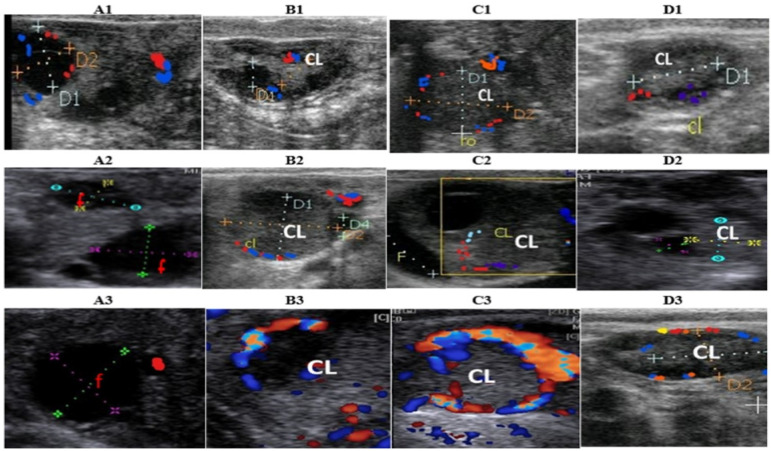
Fifteen cyclic, multiparous goats were equally stratified and received the common Ovsynch protocol (GPG: intramuscular, IM, injection of 50 mg gonadorelin, followed by an IM injection of 125 µg cloprostenol 7 days later, and a further IM injection of 50 mg gonadorelin 2 days later) or the Ovsynch protocol using nanofabricated hormones with the same dosages (NGPG) or half dosages (HNGPG) of each hormone. The ovarian structures and ovarian and luteal artery hemodynamic indices after each injection of the Ovsynch protocol using B-mode, color, and spectral Doppler scanning were monitored. Levels of blood serum progesterone (P4), estradiol (E2), and nitric oxide (NO) were determined. After the first gonadotrophin-releasing hormone (GnRH) injection, the number of large follicles decreased (p = 0.02) in NGPG and HNGPG, compared with GPG. HNGPG resulted in larger corpus luteum (CL) diameters (p = 0.001), and improved ovarian and luteal blood flow, compared with GPG and NGPG. Both NGPG and HNGPG significantly increased E2 and NO levels compared with GPG. HNGPG increased (p < 0.001) P4 levels compared with GPG, whereas NGPG resulted in an intermediate value. After prostaglandin F2α (PGF2α) injection, HNGPG had the largest diameter of CLs (p = 0.001) and significantly improved ovarian blood flow compared with GPG and NGPG. Both NGPG and HNGPG increased (p = 0.007) NO levels, compared with GPG. E2 level was increased (p = 0.028) in HNGPG, compared with GPG, whereas NGPG resulted in an intermediate value. During the follicular phase, HNGPG increased (p = 0.043) the number of medium follicles, shortened (p = 0.04) the interval to ovulation, and increased (p < 0.001) ovarian artery blood flow and levels (p < 0.001) of blood serum P4, E2, and NO, compared with GPG and NGPG. During the luteal phase, the numbers of CLs were similar among different experimental groups, whereas the diameter of CLs, luteal blood flow, and levels of blood serum P4 and NO increased (p < 0.001) in HNGPG, compared with GPG and NGPG. Conclusively, the nanodelivery system for the Ovsynch protocol could be recommended as a new strategy for improving estrous synchronization outcomes of goats while enabling lower hormone dose administration.
15只经产周期山羊被平均分层,分别接受普通Ovsynch方案(GPG:肌肉注射50mg促性腺激素释放激素,7天后肌肉注射125μg氯前列醇,再过2天肌肉注射50mg促性腺激素释放激素)或使用纳米制造激素且各激素剂量相同(NGPG)或各激素剂量减半(HNGPG)的Ovsynch方案。使用B超、彩色和频谱多普勒扫描监测Ovsynch方案每次注射后卵巢结构以及卵巢和黄体动脉血流动力学指标。测定血清孕酮(P4)、雌二醇(E2)和一氧化氮(NO)水平。首次注射促性腺激素释放激素(GnRH)后,与GPG相比,NGPG和HNGPG组的大卵泡数量减少(p = 0.02)。与GPG和NGPG相比,HNGPG导致黄体(CL)直径更大(p = 0.001),并改善了卵巢和黄体血流。与GPG相比,NGPG和HNGPG均显著提高了E2和NO水平。与GPG相比,HNGPG使P4水平升高(p < 0.001),而NGPG导致中间值。注射前列腺素F2α(PGF2α)后,与GPG和NGPG相比,HNGPG的CL直径最大(p = 0.001),并显著改善了卵巢血流。与GPG相比,NGPG和HNGPG均使NO水平升高(p = 0.007)。与GPG相比,HNGPG的E2水平升高(p = 0.028),而NGPG导致中间值。在卵泡期,与GPG和NGPG相比,HNGPG增加了中等卵泡数量(p = 0.043),缩短了排卵间隔(p = 0.04),并增加了卵巢动脉血流以及血清P4、E2和NO水平(p < 0.001)。在黄体期,不同实验组的CL数量相似,而与GPG和NGPG相比,HNGPG的CL直径、黄体血流以及血清P4和NO水平升高(p < 0.001)。总之,Ovsynch方案的纳米递送系统可作为一种新策略推荐,以改善山羊的发情同步效果,同时能够降低激素剂量的使用。