Graduate School of Hebei Medical University, Shijiazhuang 050017, China.
Endocrinology Department, Harrison International Peace Hospital, Hengshui 053000, China.
Int J Clin Pract. 2022 Jan 31;2022:9734738. doi: 10.1155/2022/9734738. eCollection 2022.
Previous studies on the effects of resveratrol on metabolic indicators reported contradictory findings, and these indicators have not been frequently studied in patients with type 2 diabetes. In this study, we aimed to examine the effects of resveratrol on metabolic indicators in a specific group of people with type 2 diabetes using the most recent literature.
We used RevMan 5.4 and Stata 14.0 software to identify randomized controlled studies on the impact of resveratrol on metabolic indicators in patients with type 2 diabetes using relevant search terms and keywords such as "resveratrol" and "type 2 diabetes" in the China National Knowledge Infrastructure, PubMed, Cochrane, and Embase. Data were expressed as the weighted mean difference (WMD) and 95% confidence interval (CI).
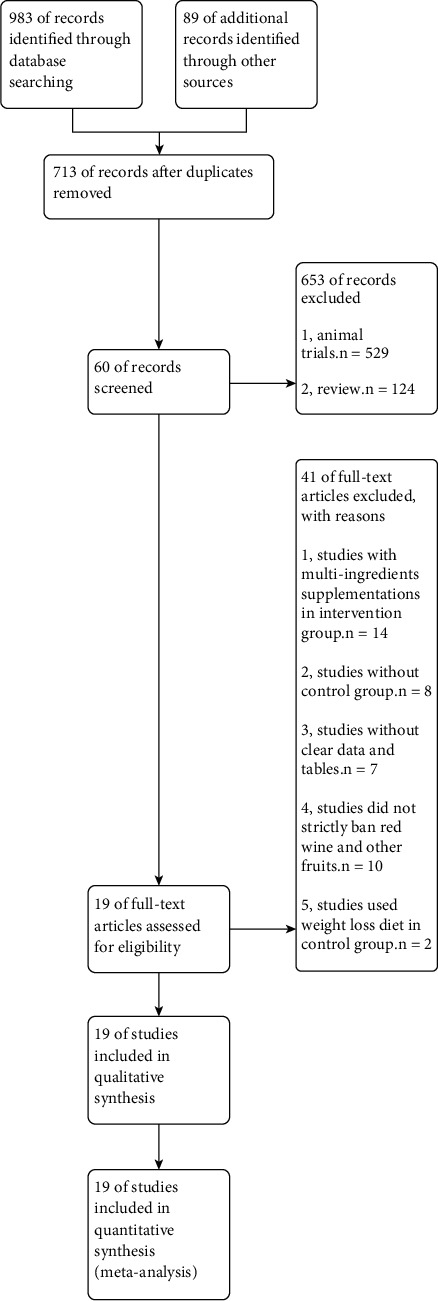
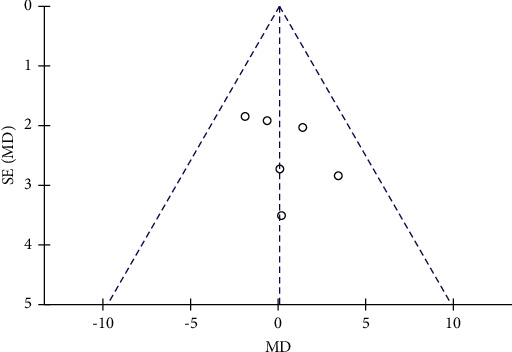
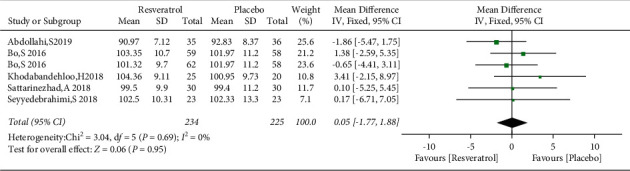
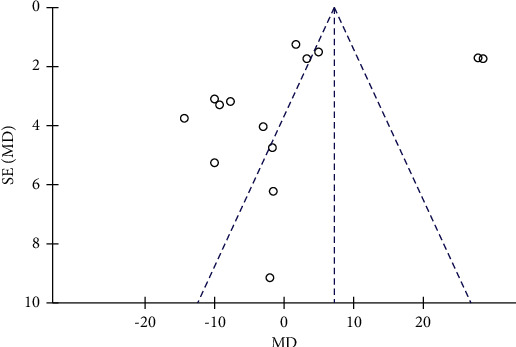
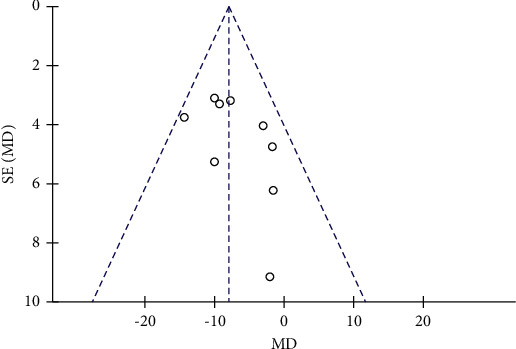
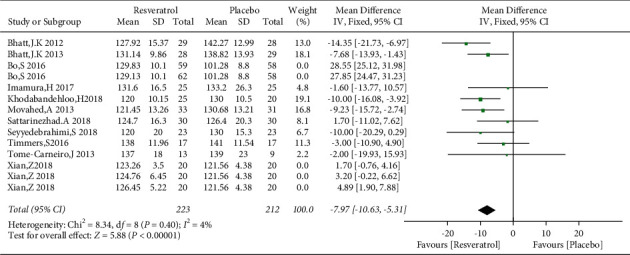
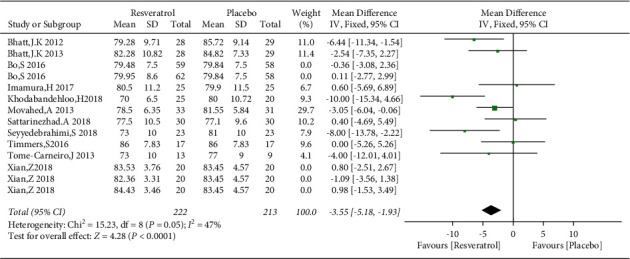
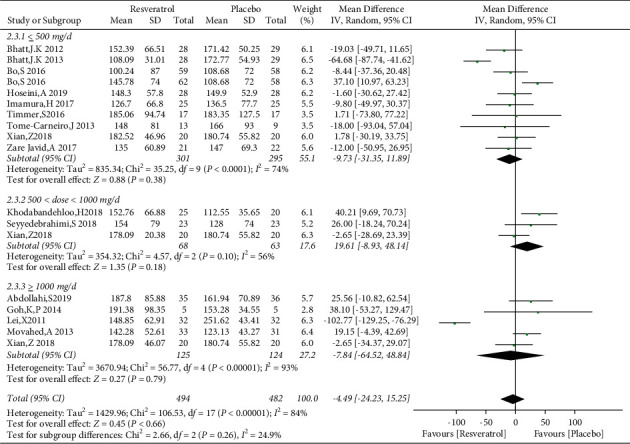
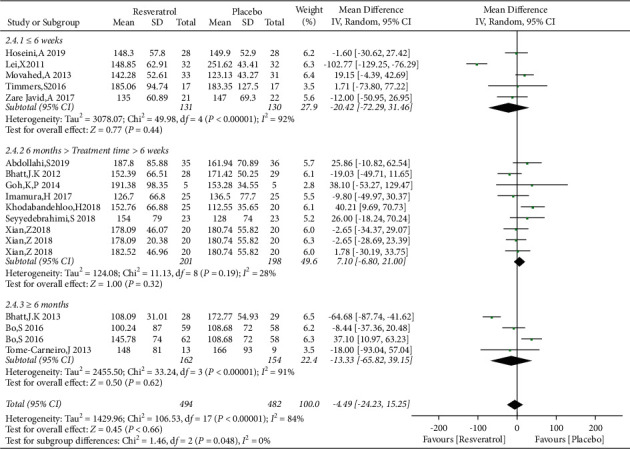
This meta-analysis included 19 studies involving 1151 patients with type 2 diabetes, including 584 patients treated with resveratrol and 567 patients who received placebo. Compared with the control data, large doses of resveratrol (≥1000 mg) reduced fasting blood glucose levels (WMD: -18.76 mg/dL, 95% CI: -23.43, -14.09; < 0.00001). Additionally, resveratrol reduced systolic blood pressure (WMD: -7.97 mmHg, 95% CI: -10.63, -5.31; < 0.00001) and diastolic blood pressure (WMD: -3.55 mmHg, 95% CI: -5.18, -1.93; < 0.00001) in patients with type 2 diabetes but did not improve waist circumference (WMD: 0.05 cm, 95% CI: -1.77, 1.88; =0.95), triglyceride levels (WMD: -4.49 mg/dL, 95% CI: -24.23, 15.25; =0.66), or high-density lipoprotein cholesterol levels (WMD: -1.05 mg/dL, 95% CI: -2.44, 0.33; =0.14) in patients with type 2 diabetes.
This systematic review and meta-analysis updated the most recent literature and provided new evidence, proving that resveratrol treatment can reduce systolic blood pressure and diastolic blood pressure. High-dose resveratrol can reduce fasting blood glucose in patients with type 2 diabetes, although it has no effect on waist circumference, triglyceride, and high-density lipoprotein cholesterol.
先前关于白藜芦醇对代谢指标影响的研究结果相互矛盾,且这些指标在 2 型糖尿病患者中并未得到广泛研究。本研究旨在使用最新文献,针对特定 2 型糖尿病患者群体,检验白藜芦醇对代谢指标的影响。
我们使用 RevMan 5.4 和 Stata 14.0 软件,通过相关检索词和关键词(如“白藜芦醇”和“2 型糖尿病”)在中国知网、PubMed、Cochrane 和 Embase 中检索了白藜芦醇对 2 型糖尿病患者代谢指标影响的随机对照研究。数据以加权均数差(WMD)和 95%置信区间(CI)表示。
该荟萃分析纳入了 19 项研究,共涉及 1151 例 2 型糖尿病患者,其中 584 例接受白藜芦醇治疗,567 例接受安慰剂治疗。与对照组相比,大剂量白藜芦醇(≥1000mg)可降低空腹血糖水平(WMD:-18.76mg/dL,95%CI:-23.43,-14.09;<0.00001)。此外,白藜芦醇还可降低 2 型糖尿病患者的收缩压(WMD:-7.97mmHg,95%CI:-10.63,-5.31;<0.00001)和舒张压(WMD:-3.55mmHg,95%CI:-5.18,-1.93;<0.00001),但对腰围(WMD:0.05cm,95%CI:-1.77,1.88;=0.95)、三酰甘油水平(WMD:-4.49mg/dL,95%CI:-24.23,15.25;=0.66)或高密度脂蛋白胆固醇水平(WMD:-1.05mg/dL,95%CI:-2.44,0.33;=0.14)无改善作用。
本系统评价和荟萃分析更新了最新文献,提供了新的证据,证明白藜芦醇治疗可降低收缩压和舒张压。高剂量白藜芦醇可降低 2 型糖尿病患者的空腹血糖水平,尽管它对腰围、三酰甘油和高密度脂蛋白胆固醇没有影响。