Centre for Environmental Biotechnology, School of Natural Sciences, Bangor University, Bangor, Gwynedd LL57 2UW, UK.
Centre for Environmental Biotechnology, School of Natural Sciences, Bangor University, Bangor, Gwynedd LL57 2UW, UK.
Sci Total Environ. 2022 Sep 10;838(Pt 4):156580. doi: 10.1016/j.scitotenv.2022.156580. Epub 2022 Jun 9.
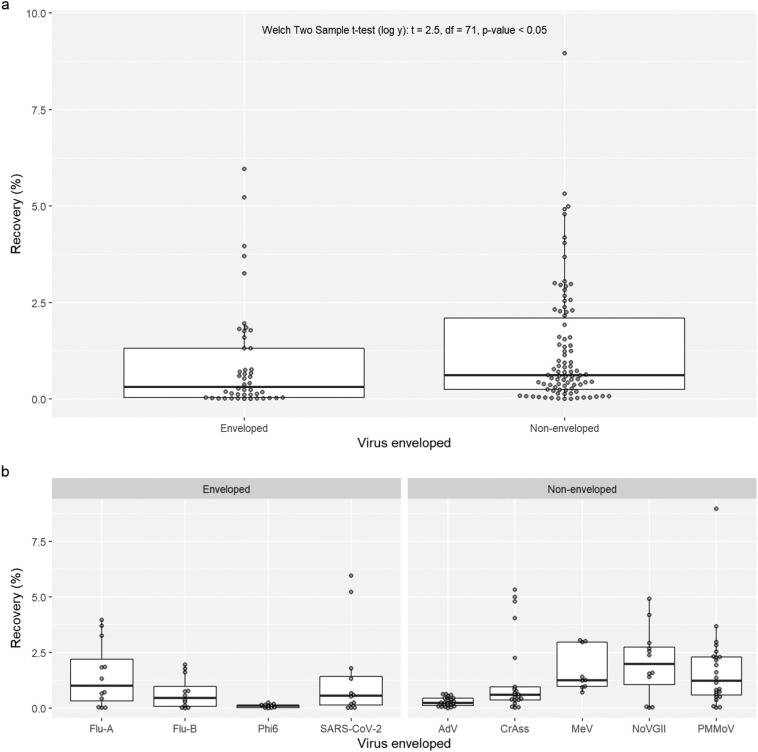
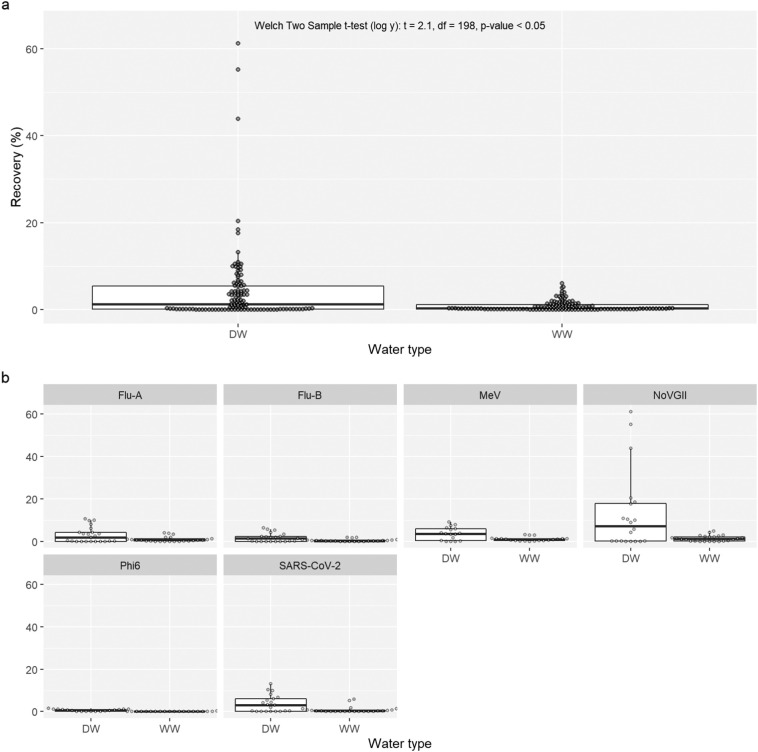
Wastewater-based epidemiology (WBE) has proven to be a useful surveillance tool during the ongoing SARS-CoV-2 pandemic, and has driven research into evaluating the most reliable and cost-effective techniques for obtaining a representative sample of wastewater. When liquid samples cannot be taken efficiently, passive sampling approaches have been used, however, insufficient data exists on their usefulness for multi-virus capture and recovery. In this study, we compared the virus-binding capacity of two passive samplers (cotton-based tampons and ion exchange filter papers) in two different water types (deionised water and wastewater). Here we focused on the capture of wastewater-associated viruses including Influenza A and B (Flu-A & B), SARS-CoV-2, human adenovirus (AdV), norovirus GII (NoVGII), measles virus (MeV), pepper mild mottle virus (PMMoV), the faecal marker crAssphage and the process control virus Pseudomonas virus phi6. After deployment, we evaluated four different methods to recover viruses from the passive samplers namely, (i) phosphate buffered saline (PBS) elution followed by polyethylene glycol (PEG) precipitation, (ii) beef extract (BE) elution followed by PEG precipitation, (iii) no-elution into PEG precipitation, and (iv) direct extraction. We found that the tampon-based passive samplers had higher viral recoveries in comparison to the filter paper. Overall, the preferred viral recovery method from the tampon passive samplers was the no-elution/PEG precipitation method. Furthermore, we evidenced that non-enveloped viruses had higher percent recoveries from the passive samplers than enveloped viruses. This is the first study of its kind to assess passive sampler and viral recovery methods amongst a plethora of viruses commonly found in wastewater or used as a viral surrogate in wastewater studies.
基于污水的流行病学(WBE)已被证明是在当前 SARS-CoV-2 大流行期间进行监测的有用工具,并推动了评估获得污水有代表性样本的最可靠和最具成本效益的技术的研究。当无法有效地采集液体样本时,已经使用了被动采样方法,但是,关于它们在多病毒捕获和回收方面的有用性的数据还不够充分。在这项研究中,我们比较了两种被动采样器(基于棉花的棉塞和离子交换滤纸)在两种不同水类型(去离子水和污水)中的病毒结合能力。在这里,我们重点关注捕获与污水相关的病毒,包括流感 A 和 B(Flu-A&B)、SARS-CoV-2、人类腺病毒(AdV)、诺如病毒 GII(NoVGII)、麻疹病毒(MeV)、辣椒斑驳病毒(PMMoV)、粪便标志物 crAssphage 和过程控制病毒假单胞菌病毒 phi6。部署后,我们评估了从被动采样器中回收病毒的四种不同方法,即(i)磷酸盐缓冲盐水(PBS)洗脱后聚乙二醇(PEG)沉淀,(ii)牛肉提取物(BE)洗脱后 PEG 沉淀,(iii)不洗脱到 PEG 沉淀中,以及(iv)直接提取。我们发现,与滤纸相比,基于棉塞的被动采样器具有更高的病毒回收率。总体而言,从棉塞被动采样器中回收病毒的首选方法是不洗脱/PEG 沉淀方法。此外,我们证明了无包膜病毒从被动采样器中的回收率高于包膜病毒。这是首次评估常用于污水或用作污水研究中病毒替代物的多种病毒的被动采样器和病毒回收方法的研究。