College of Life Sciences, Zhejiang University, Hangzhou, China.
Key Laboratory of Growth Regulation and Translational Research of Zhejiang Province, School of Life Sciences, Westlake University, 18 Shilongshan Rd, Cloud Town, Hangzhou, China.
BMC Med. 2022 Jun 15;20(1):204. doi: 10.1186/s12916-022-02402-4.
The interplay among the plant-based dietary pattern, gut microbiota, and cardiometabolic health is still unclear, and evidence from large prospective cohorts is rare. We aimed to examine the association of long-term and short-term plant-based dietary patterns with gut microbiota and to assess the prospective association of the identified microbial features with cardiometabolic biomarkers.
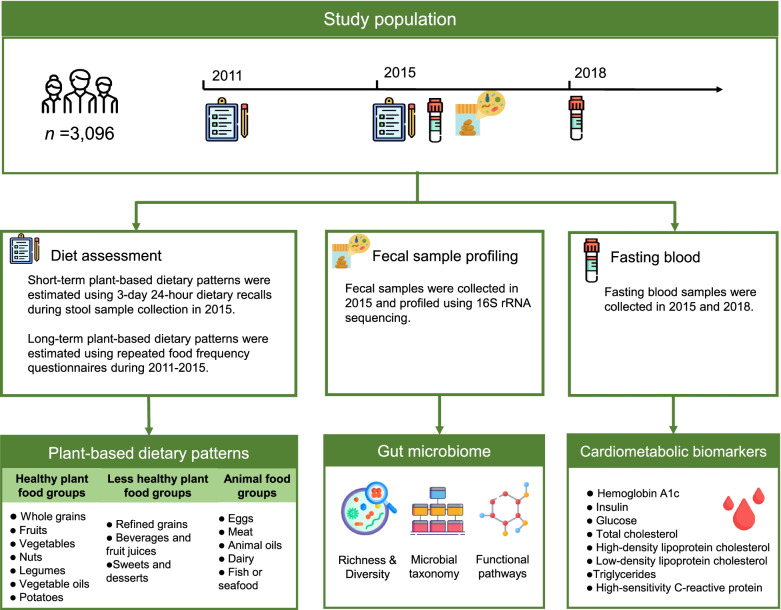
Using a population-based prospective cohort study: the China Health and Nutrition Survey, we included 3096 participants from 15 provinces/megacities across China. We created an overall plant-based diet index (PDI), a healthful plant-based diet index (hPDI), and an unhealthful plant-based diet index (uPDI). The average PDIs were calculated using repeat food frequency questionnaires collected in 2011 and 2015 to represent a long-term dietary pattern. Short-term dietary pattern was estimated using 3-day 24-h dietary recalls collected in 2015. Fecal samples were collected in 2015 and measured using 16S rRNA sequencing. We investigated the association of long-term and short-term plant-based dietary patterns with gut microbial diversity, taxonomies, and functional pathways using linear mixed models. Furthermore, we assessed the prospective associations between the identified gut microbiome signatures and cardiometabolic biomarkers (measured in 2018) using linear regression.
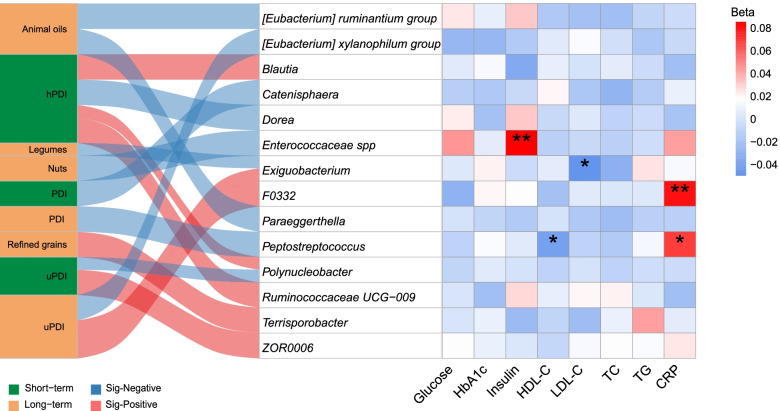
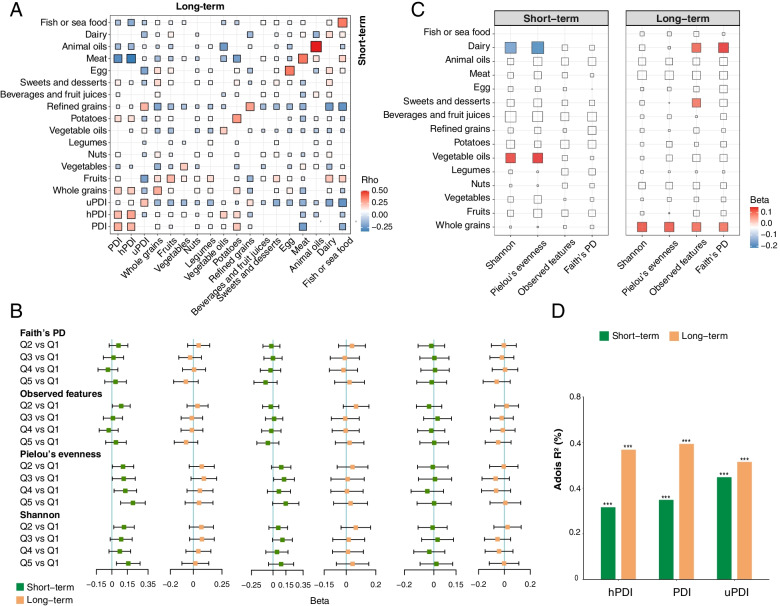
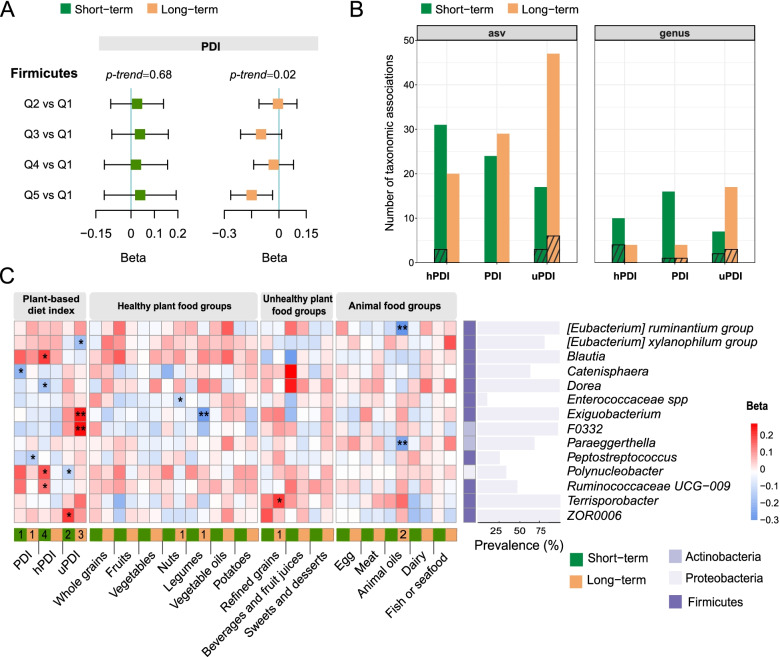
We found a significant association of short-term hPDI with microbial alpha-diversity. Both long-term and short-term plant-based diet indices were correlated with microbial overall structure, whereas long-term estimates explained more variance. Long-term and short-term PDIs were differently associated with microbial taxonomic composition, yet only microbes related to long-term estimates showed association with future cardiometabolic biomarkers. Higher long-term PDI was associated with the lower relative abundance of Peptostreptococcus, while this microbe was positively correlated with the high-sensitivity C-reactive protein and inversely associated with high-density lipoprotein cholesterol.
We found shared and distinct gut microbial signatures of long-term and short-term plant-based dietary patterns. The identified microbial genera may provide insights into the protective role of long-term plant-based dietary pattern for cardiometabolic health, and replication in large independent cohorts is needed.
植物性饮食模式、肠道微生物群和心脏代谢健康之间的相互作用仍不清楚,而且来自大型前瞻性队列的证据很少。我们旨在研究长期和短期植物性饮食模式与肠道微生物群的关系,并评估所确定的微生物特征与心脏代谢生物标志物的前瞻性关联。
使用基于人群的前瞻性队列研究:中国健康与营养调查,我们纳入了来自中国 15 个省份/特大城市的 3096 名参与者。我们创建了一个整体植物性饮食指数(PDI)、健康植物性饮食指数(hPDI)和不健康植物性饮食指数(uPDI)。使用 2011 年和 2015 年重复的食物频率问卷计算平均 PDI,以代表长期饮食模式。短期饮食模式使用 2015 年 3 天 24 小时膳食记录来估计。2015 年收集粪便样本并进行 16S rRNA 测序。我们使用线性混合模型研究长期和短期植物性饮食模式与肠道微生物多样性、分类群和功能途径的关系。此外,我们使用线性回归评估了所确定的肠道微生物组特征与 2018 年测量的心脏代谢生物标志物之间的前瞻性关联。
我们发现短期 hPDI 与微生物 alpha 多样性有显著关联。长期和短期植物性饮食指数与微生物整体结构相关,而长期估计解释了更多的差异。长期和短期 PDIs 与微生物分类组成有不同的关联,但只有与长期估计相关的微生物与未来的心脏代谢生物标志物相关。较高的长期 PDI 与 Peptostreptococcus 的相对丰度降低相关,而这种微生物与高敏 C 反应蛋白呈正相关,与高密度脂蛋白胆固醇呈负相关。
我们发现长期和短期植物性饮食模式的肠道微生物特征既有共同之处,也有不同之处。所确定的微生物属可能为长期植物性饮食模式对心脏代谢健康的保护作用提供了新的见解,需要在大型独立队列中进行复制。