Exercise Science & Neuroscience Unit, Department Sports & Health, 26578Paderborn University, Paderborn, Germany.
Percept Mot Skills. 2022 Aug;129(4):1074-1088. doi: 10.1177/00315125221108698. Epub 2022 Jun 15.
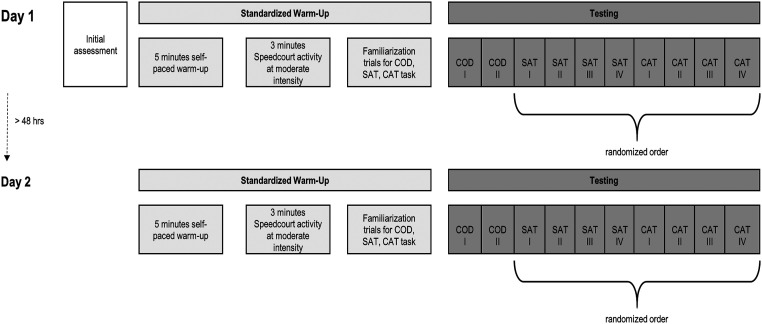
Agility, a key component of team ball sports, describes an athlete´s ability to move fast in response to changing environments. While agility requires basic cognitive functions like processing speed, it also requires more complex cognitive processes like working memory and inhibition. Yet, most agility tests restrict an assessment of cognitive processes to simple reactive times that lack ecological validity. Our aim in this study was to assess agility performance by means of total time on two agility tests with matched motor demands but with both low and high cognitive demands. We tested 22 female team athletes on SpeedCourt, using a simple agility test (SAT) that measured only processing speed and a complex agility test (CAT) that required working memory and inhibition. We found excellent to good reliability for both our SAT (ICC = .79) and CAT (ICC =.70). Lower agility performance on the CAT was associated with increased agility total time and split times ( < .05). These results demonstrated that agility performance depends on the complexity of cognitive demands. There may be interference-effects between motor and cognitive performances, reducing speed when environmental information becomes more complex. Future studies should consider agility training models that implement complex cognitive stimuli to challenge athletes according to competitive demands. This will also allow scientists and practitioners to tailor tests to talent identification, performance development and injury rehabilitation.
敏捷性是团队球类运动的关键组成部分,它描述了运动员快速应对环境变化的能力。虽然敏捷性需要像处理速度这样的基本认知功能,但它也需要更复杂的认知过程,如工作记忆和抑制。然而,大多数敏捷性测试将认知过程的评估限制在缺乏生态有效性的简单反应时间上。我们在这项研究中的目的是通过两项具有匹配运动要求但具有低和高认知要求的敏捷性测试来评估敏捷性表现。我们在 SpeedCourt 上测试了 22 名女性团队运动员,使用了一项仅测量处理速度的简单敏捷性测试(SAT)和一项需要工作记忆和抑制的复杂敏捷性测试(CAT)。我们发现我们的 SAT(ICC =.79)和 CAT(ICC =.70)都具有极好到良好的可靠性。在 CAT 上表现出较低的敏捷性与增加的敏捷性总时间和分割时间(<.05)有关。这些结果表明,敏捷性表现取决于认知需求的复杂性。在环境信息变得更加复杂时,运动和认知表现之间可能存在干扰效应,从而降低速度。未来的研究应该考虑实施复杂认知刺激的敏捷性训练模型,根据竞争需求挑战运动员。这也将使科学家和从业者能够根据人才识别、绩效发展和伤害康复来定制测试。