Oxford Centre for Clinical MR Research (OCMR), RDM Cardiovascular Medicine, University of Oxford, Oxford, United Kingdom.
Institute of Measurement Science, Slovak Academy of Sciences, Bratislava, SVK.
PLoS One. 2022 Jun 16;17(6):e0269957. doi: 10.1371/journal.pone.0269957. eCollection 2022.
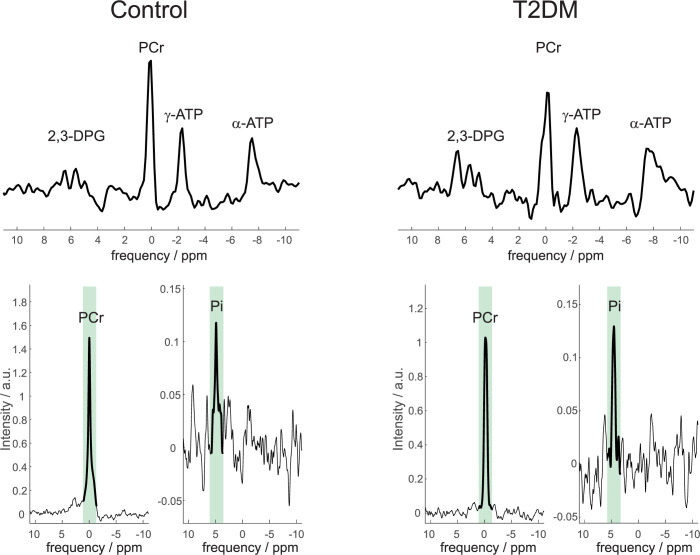
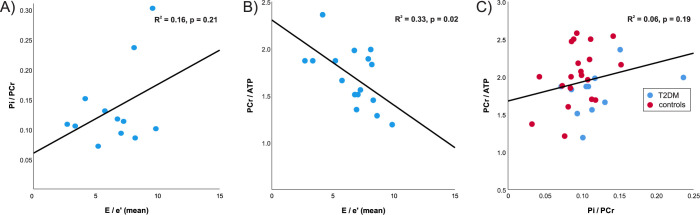
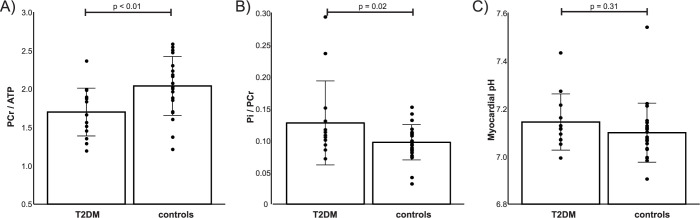
Phosphorus magnetic resonance spectroscopy (31P-MRS) has previously demonstrated decreased energy reserves in the form of phosphocreatine to adenosine-tri-phosphate ratio (PCr/ATP) in the hearts of patients with type 2 diabetes (T2DM). Recent 31P-MRS techniques using 7T systems, e.g. long mixing time stimulated echo acquisition mode (STEAM), allow deeper insight into cardiac metabolism through assessment of inorganic phosphate (Pi) content and myocardial pH, which play pivotal roles in energy production in the heart. Therefore, we aimed to further explore the cardiac metabolic phenotype in T2DM using STEAM at 7T. Seventeen patients with T2DM and twenty-three healthy controls were recruited and their cardiac PCr/ATP, Pi/PCr and pH were assessed at 7T. Diastolic function of all patients with T2DM was assessed using echocardiography to investigate the relationship between diastolic dysfunction and cardiac metabolism. Mirroring the decreased PCr/ATP (1.70±0.31 vs. 2.07±0.39; p<0.01), the cardiac Pi/PCr was increased (0.13±0.07 vs. 0.10±0.03; p = 0.02) in T2DM patients in comparison to healthy controls. Myocardial pH was not significantly different between the groups (7.14±0.12 vs. 7.10±0.12; p = 0.31). There was a negative correlation between PCr/ATP and diastolic function (R2 = 0.33; p = 0.02) in T2DM. No correlation was observed between diastolic function and Pi/PCr and (R2 = 0.16; p = 0.21). In addition, we did not observe any correlation between cardiac PCr/ATP and Pi/PCr (p = 0.19). Using STEAM 31P-MRS at 7T we have for the first time explored Pi/PCr in the diabetic human heart and found it increased when compared to healthy controls. The lack of correlation between measured PCr/ATP and Pi/PCr suggests that independent mechanisms might contribute to these perturbations.
磷磁共振波谱(31P-MRS)先前已经证明,2 型糖尿病(T2DM)患者的心脏中以磷酸肌酸与三磷酸腺苷的比率(PCr/ATP)形式存在的能量储备减少。最近使用 7T 系统的 31P-MRS 技术,例如长混合时间刺激回波采集模式(STEAM),通过评估无机磷(Pi)含量和心肌 pH 值,使人们能够更深入地了解心脏代谢,这在心脏能量产生中起着关键作用。因此,我们旨在使用 7T 上的 STEAM 进一步探索 T2DM 的心脏代谢表型。招募了 17 名 T2DM 患者和 23 名健康对照者,并在 7T 下评估他们的心脏 PCr/ATP、Pi/PCr 和 pH 值。使用超声心动图评估所有 T2DM 患者的舒张功能,以研究舒张功能障碍与心脏代谢之间的关系。与健康对照组相比,T2DM 患者的心脏 PCr/ATP(1.70±0.31 比 2.07±0.39;p<0.01)降低,而心脏 Pi/PCr 增加(0.13±0.07 比 0.10±0.03;p = 0.02)。两组之间心肌 pH 值无显著差异(7.14±0.12 比 7.10±0.12;p = 0.31)。在 T2DM 中,PCr/ATP 与舒张功能之间存在负相关(R2 = 0.33;p = 0.02)。在 T2DM 中,舒张功能与 Pi/PCr 之间未观察到相关性(R2 = 0.16;p = 0.21)。此外,我们没有观察到心脏 PCr/ATP 和 Pi/PCr 之间存在任何相关性(p = 0.19)。使用 7T 上的 STEAM 31P-MRS,我们首次在糖尿病患者的心脏中探索了 Pi/PCr,并发现与健康对照组相比,Pi/PCr 增加。测量的 PCr/ATP 和 Pi/PCr 之间缺乏相关性表明,可能有独立的机制导致这些波动。