Yang Bijing, Liu Chunyan, Huang Yanna, Wu Qiwen, Xiong Yunxia, Yang Xuefen, Hu Shenglan, Jiang Zongyong, Wang Li, Yi Hongbo
State Key Laboratory of Livestock and Poultry Breeding, Ministry of Agriculture Key Laboratory of Animal Nutrition and Feed Science in South China, Guangdong Key Laboratory of Animal Breeding and Nutrition, Guangdong Laboratory for Lingnan Modern Agriculture, Institute of Animal Science, Guangdong Academy of Agricultural Sciences, Guangzhou, China.
College of Veterinary Medicine, South China Agricultural University, Guangzhou, China.
Front Microbiol. 2022 Jun 2;13:877297. doi: 10.3389/fmicb.2022.877297. eCollection 2022.
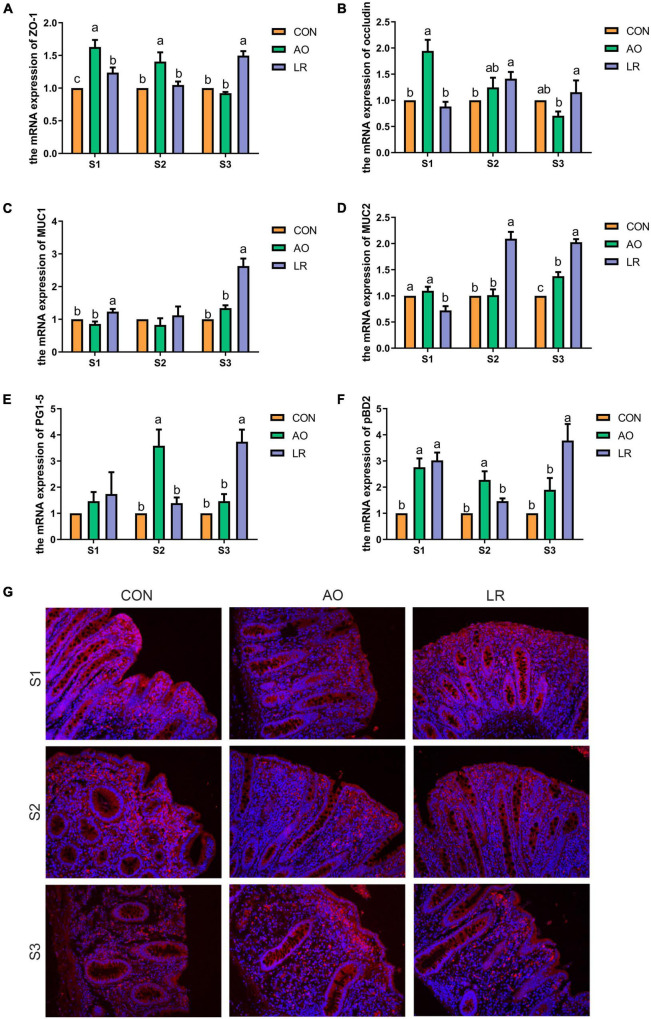
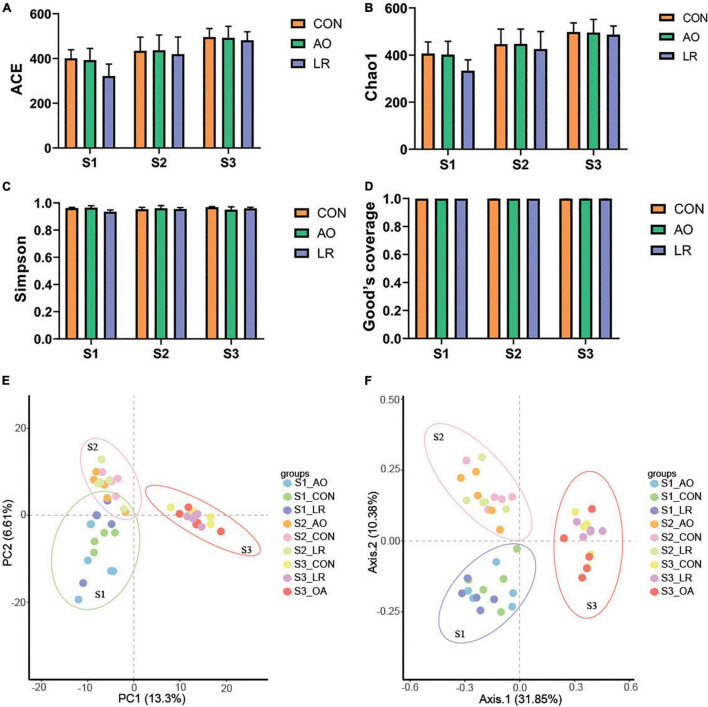
This study aimed to investigate responses of the or an antibiotic on cecal microbiota and intestinal barrier function in different stages of pigs. A total of 144 weaned pigs ( × × , 21 days of age) were randomly assigned to the control group (CON, fed with a basal diet), the antibiotic group (AO, fed with basal diet plus 100 mg/kg olaquindox and 75 mg/kg aureomycin), and the group (LR, fed with the basal diet + 5 × 10 CFU/kg LR1) throughout the 164-d experiment. A total of 45 cecal content samples (5 samples per group) from different periods (14th, 42th, and 164th days) were collected for 16S rRNA gene amplification. The results revealed that although LR and AO did not change the diversity of cecal microbiota in pigs, the abundance of some bacteria at the genus level was changed with age. The proportion of was increased by LR in early life, whereas it was decreased by AO compared with the control group. The relative abundance of was increased along with age. In addition, the gas chromatography results showed that age, not AO or LR, has significant effects on the concentrations of SCFAs in the cecum of pigs ( < 0.05). However, the mRNA expression of tight junction proteins () and were increased by AO in the cecum of pigs on day 14, while LR increased the mRNA expression of intestinal barrier-related proteins , , , , , and in the cecum of pigs on days 14 and 164 ( < 0.05). In conclusion, LR and AO have different effects on the intestinal barrier function of the cecum, and neither LR nor AO damaged the intestinal barrier function of pig cecum. In addition, LR and AO have little effects on cecal microflora in different stages of the pigs. The microflora and their metabolite SCFAs were significantly changed along with age. These findings provide important information to understand the homeostasis of the cecum of pigs after antibiotic or probiotic treatment.
本研究旨在调查抗生素或益生菌对不同生长阶段猪的盲肠微生物群和肠道屏障功能的影响。在为期164天的实验中,将总共144头断奶仔猪(××,21日龄)随机分为对照组(CON,饲喂基础日粮)、抗生素组(AO,饲喂基础日粮加100 mg/kg喹乙醇和75 mg/kg金霉素)和益生菌组(LR,饲喂基础日粮 + 5×10 CFU/kg LR1)。在不同时期(第14天、第42天和第164天)共收集45份盲肠内容物样本(每组5份)用于16S rRNA基因扩增。结果显示,虽然LR和AO未改变猪盲肠微生物群的多样性,但某些属水平细菌的丰度随年龄变化。LR在猪早期生活中增加了[具体菌属]的比例,而与对照组相比,AO使其降低。[具体菌属]的相对丰度随年龄增加。此外,气相色谱结果表明,对猪盲肠中短链脂肪酸浓度有显著影响的是年龄,而非AO或LR(P < 0.05)。然而,AO在第14天增加了猪盲肠中紧密连接蛋白[具体蛋白名称]和[具体蛋白名称]的mRNA表达,而LR在第14天和第164天增加了猪盲肠中肠道屏障相关蛋白[具体蛋白名称]、[具体蛋白名称]、[具体蛋白名称]、[具体蛋白名称]、[具体蛋白名称]和[具体蛋白名称]的mRNA表达(P < 0.05)。总之,LR和AO对盲肠的肠道屏障功能有不同影响,且LR和AO均未损害猪盲肠的肠道屏障功能。此外,LR和AO对猪不同阶段的盲肠微生物群影响较小。微生物群及其代谢产物短链脂肪酸随年龄显著变化。这些发现为理解抗生素或益生菌处理后猪盲肠的稳态提供了重要信息。