Hung Pei-Shan, Lin Pei-Ru, Hsu Hsin-Hui, Huang Yi-Chen, Wu Shin-Hwar, Kor Chew-Teng
Division of Critical Care Internal Medicine, Department of Emergency Medicine and Critical Care, Changhua Christian Hospital, Changhua 500, Taiwan.
Big Data Center, Changhua Christian Hospital, Changhua 500, Taiwan.
Diagnostics (Basel). 2022 Jun 19;12(6):1496. doi: 10.3390/diagnostics12061496.
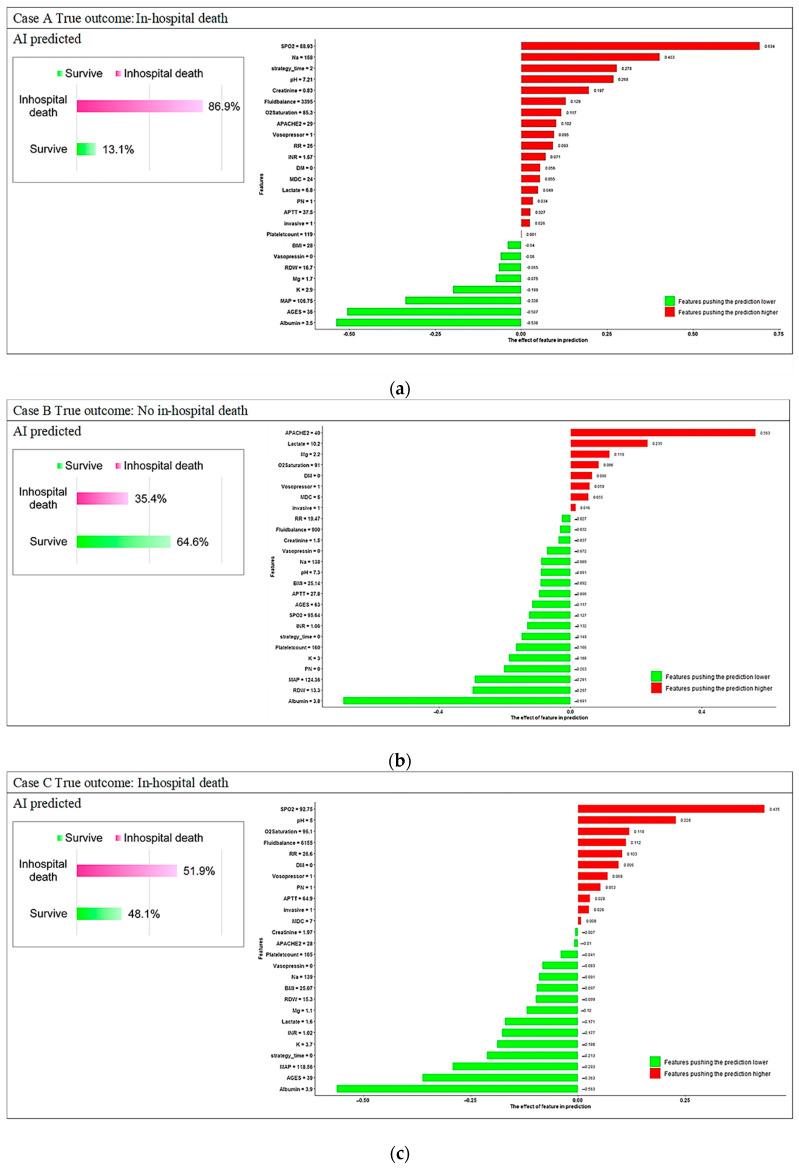
In this study, we established an explainable and personalized risk prediction model for in-hospital mortality after continuous renal replacement therapy (CRRT) initiation. This retrospective cohort study was conducted at Changhua Christian Hospital (CCH). A total of 2932 consecutive intensive care unit patients receiving CRRT between 1 January 2010, and 30 April 2021, were identified from the CCH Clinical Research Database and were included in this study. The recursive feature elimination method with 10-fold cross-validation was used and repeated five times to select the optimal subset of features for the development of machine learning (ML) models to predict in-hospital mortality after CRRT initiation. An explainable approach based on ML and the SHapley Additive exPlanation (SHAP) and a local explanation method were used to evaluate the risk of in-hospital mortality and help clinicians understand the results of ML models. The extreme gradient boosting and gradient boosting machine models exhibited a higher discrimination ability (area under curve [AUC] = 0.806, 95% CI = 0.770-0.843 and AUC = 0.823, 95% CI = 0.788-0.858, respectively). The SHAP model revealed that the Acute Physiology and Chronic Health Evaluation II score, albumin level, and the timing of CRRT initiation were the most crucial features, followed by age, potassium and creatinine levels, SPO2, mean arterial pressure, international normalized ratio, and vasopressor support use. ML models combined with SHAP and local interpretation can provide the visual interpretation of individual risk predictions, which can help clinicians understand the effect of critical features and make informed decisions for preventing in-hospital deaths.
在本研究中,我们建立了一个可解释的个性化风险预测模型,用于预测连续肾脏替代疗法(CRRT)开始后患者的院内死亡率。这项回顾性队列研究在彰化基督教医院(CCH)进行。从CCH临床研究数据库中确定了2010年1月1日至2021年4月30日期间连续接受CRRT的2932例重症监护病房患者,并纳入本研究。采用具有10折交叉验证的递归特征消除方法,并重复5次,以选择最佳特征子集,用于开发机器学习(ML)模型,以预测CRRT开始后的院内死亡率。基于ML以及SHapley加性解释(SHAP)的可解释方法和局部解释方法用于评估院内死亡风险,并帮助临床医生理解ML模型的结果。极端梯度提升模型和梯度提升机模型表现出更高的辨别能力(曲线下面积[AUC]分别为0.806,95%可信区间[CI]=0.770-0.843和AUC=0.823,95%CI=0.788-0.858)。SHAP模型显示,急性生理与慢性健康状况评估II评分、白蛋白水平和CRRT开始时间是最关键的特征,其次是年龄、钾和肌酐水平、血氧饱和度(SPO2)、平均动脉压、国际标准化比值以及血管升压药支持的使用情况。结合SHAP和局部解释的ML模型可以提供个体风险预测的可视化解释,这有助于临床医生了解关键特征的影响,并为预防院内死亡做出明智决策。