Canzi Gabriele, Aseni Paolo, De Ponti Elena, Cimbanassi Stefania, Sammartano Fabrizio, Novelli Giorgio, Sozzi Davide
Maxillofacial Surgery Unit, Department of Emergency, ASST-GOM Niguarda, Niguarda Hospital, Piazza Ospedale Maggiore 3, 20162 Milan, Italy.
Department of Emergency, ASST-GOM Niguarda, Niguarda Hospital, Piazza Ospedale Maggiore 3, 20162 Milan, Italy.
J Clin Med. 2022 Jun 8;11(12):3281. doi: 10.3390/jcm11123281.
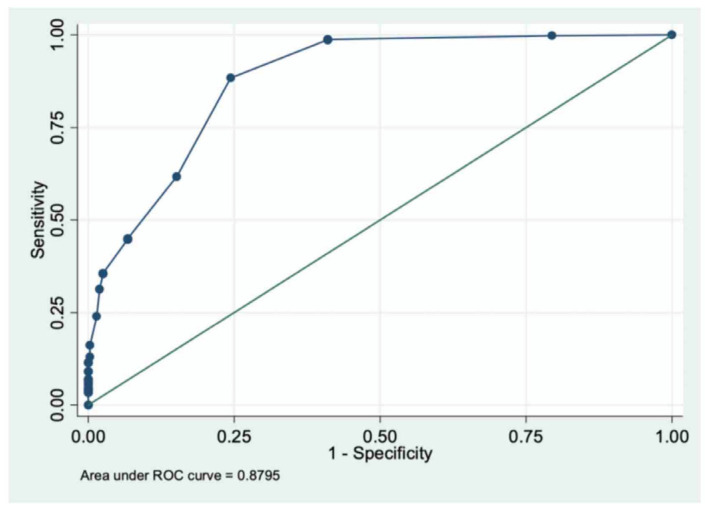
Identifying groups of patients with homogeneous characteristics and comparable outcomes improves clinical activity, patients' management, and scientific research. This study aims to define mild, moderate, and severe facial trauma by validating two cut-off values of the Comprehensive Facial Injury (CFI) score and describing their foreseeable clinical needs to create a useful guide in patient management, starting from the first evaluation. The individual CFI score, overall surgical time, and length of hospitalization are calculated for a sample of 1400 facial-injured patients. Receiver Operating Characteristic (ROC) analysis and the corresponding Area Under the Curve (AUC) is tested, and a CFI score ≥4 is selected to discriminate patients undergoing surgical management under general anesthesia (Positive Predictive Value, PPV of 91.4%), while a CFI score ≥10 is selected to identify patients undergoing major surgical procedures (Negative Predictive Value, NPV of 91.7%). These results are enhanced by the consensual trend of Length of Stay outcome. The use of the CFI score allows us to distinguish between the "Mild facial trauma" with a low risk of hospitalization for surgical treatment, the "Moderate facial trauma" with a high probability of surgical treatment, and the "Severe facial trauma" that requires long-lasting surgery and hospital stay, with an increased incidence of Intensive Care Unit admission.
识别具有同质特征和可比结果的患者群体可改善临床活动、患者管理和科学研究。本研究旨在通过验证综合面部损伤(CFI)评分的两个临界值来定义轻度、中度和重度面部创伤,并描述其可预见的临床需求,以便从首次评估开始,为患者管理创建一个有用的指南。计算了1400例面部受伤患者样本的个体CFI评分、总体手术时间和住院时间。进行了受试者操作特征(ROC)分析并测试了相应的曲线下面积(AUC),选择CFI评分≥4来区分接受全身麻醉手术治疗的患者(阳性预测值,PPV为91.4%),而选择CFI评分≥10来识别接受大型外科手术的患者(阴性预测值,NPV为91.7%)。住院时间结果的一致趋势进一步强化了这些结果。CFI评分的使用使我们能够区分手术治疗住院风险低的“轻度面部创伤”、手术治疗可能性高的“中度面部创伤”以及需要长期手术和住院、重症监护病房入院率增加的“重度面部创伤”。