Hotos George N, Antoniadis Theodoros I
Plankton Culture Laboratory, Department of Animal Production, Fisheries and Aquaculture, University of Patras, 30200 Messolonghi, Greece.
Life (Basel). 2022 Jun 4;12(6):837. doi: 10.3390/life12060837.
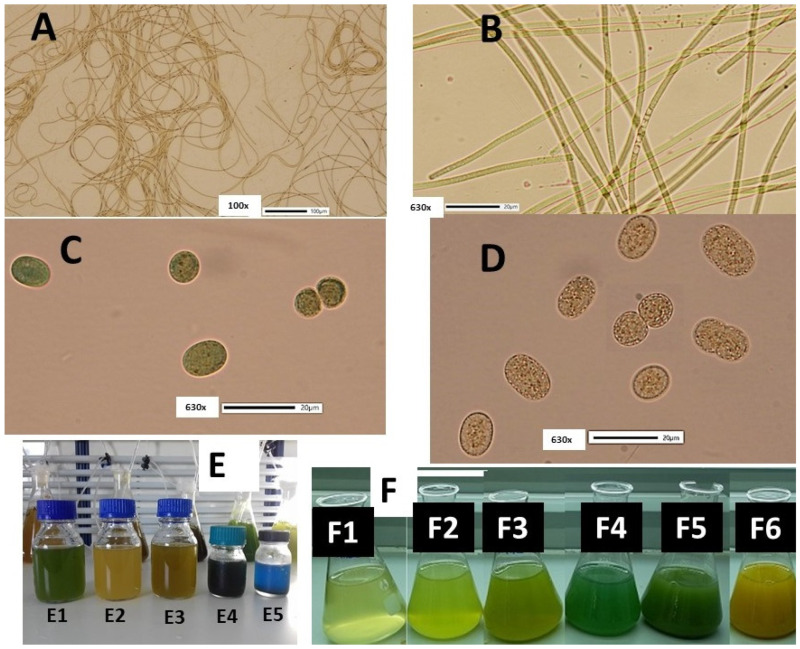
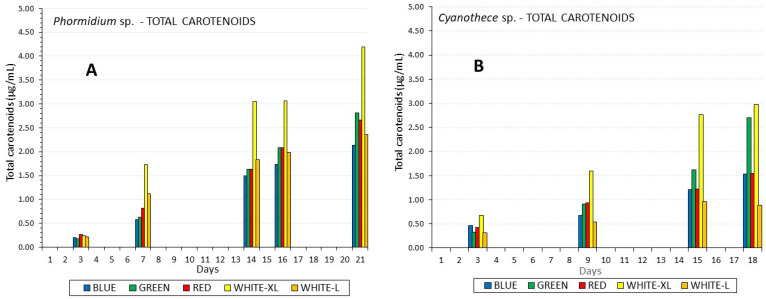
Two local marine cyanobacteria, sp. and sp., were batch-cultured under 18-19.5 °C, at 40 ppt salinity, using white LED light of low (40 μmol photons/m/s) and high (160 μmol/m/s) intensity and, additionally, blue, green and red LED light. Yield was highest in high white light in both species (2.15 g dw/L in 1.47 g/L in ), followed by green light (1.25 g/L) in and low white and green (1.26-1.33 g/L) in . Green light maximized phycocyanin in (0.45 mg/mL), while phycoerythrin was enhanced (0.17 mg/mL) by blue light and allophycocyanin by all colors (0.80 mg/mL). All colors maximized phycocyanin in (0.32 mg/mL), while phycoerythrin and allophycocyanin peaked under green light (0.138 and 0.38 mg/mL, respectively). In , maximization of chlorophyll-a (9.3 μg/mL) was induced by green light, while total carotenoids and b-carotene (3.05 and 0.89 μg/mL, respectively) by high white light. In , both white light intensities along with green maximized chlorophyll-a (9 μg/mL) while high white light and green maximized total carotenoids (2.6-3.0 μg/mL). This study strongly indicates that these cyanobacteria can be cultured at the first stage under white light to accumulate sufficient biomass and, subsequently, under colored light for enhancing phycobiliproteins.
两种本地海洋蓝细菌,[具体菌种1]和[具体菌种2],在18 - 19.5°C、盐度40 ppt的条件下进行分批培养,使用低强度(40 μmol光子/平方米/秒)和高强度(160 μmol/平方米/秒)的白色LED光,此外还使用了蓝色、绿色和红色LED光。两种蓝细菌在高强度白光下产量最高([菌种1]为2.15克干重/升,[菌种2]为1.47克/升),其次是[菌种1]的绿光(1.25克/升)以及[菌种2]的低强度白光和绿光(1.26 - 1.33克/升)。绿光使[菌种1]中的藻蓝蛋白含量最大化(0.45毫克/毫升),而蓝光使藻红蛋白含量增加(0.17毫克/毫升),所有颜色的光使别藻蓝蛋白含量增加(约0.80毫克/毫升)。所有颜色的光使[菌种2]中的藻蓝蛋白含量最大化(约0.32毫克/毫升),而藻红蛋白和别藻蓝蛋白在绿光下达到峰值(分别约为0.138毫克/毫升和0.38毫克/毫升)。在[菌种1]中,绿光诱导叶绿素a含量最大化(9.3微克/毫升),而高强度白光使总类胡萝卜素和β - 胡萝卜素含量最大化(分别为3.05微克/毫升和0.89微克/毫升)。在[菌种2]中,两种强度的白光以及绿光使叶绿素a含量最大化(约9微克/毫升),而高强度白光和绿光使总类胡萝卜素含量最大化(2.6 - 3.0微克/毫升)。这项研究有力地表明,这些蓝细菌可以在第一阶段在白光下培养以积累足够的生物量,随后在有色光下培养以提高藻胆蛋白含量。