Graduate School of Integrated Pharmaceutical and Nutritional Sciences, University of Shizuoka, Shizuoka 422-8526, Japan.
Institute of Microbial Chemistry (BIKAKEN), Numazu, Microbial Chemistry Research Foundation, Numazu-shi 410-0301, Japan.
Molecules. 2022 Jun 14;27(12):3816. doi: 10.3390/molecules27123816.
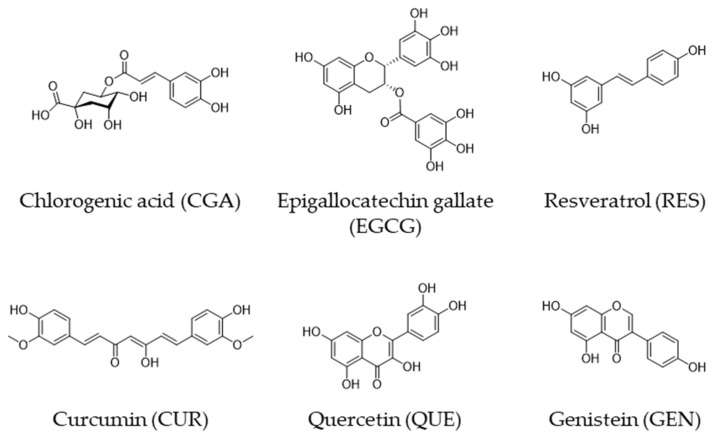
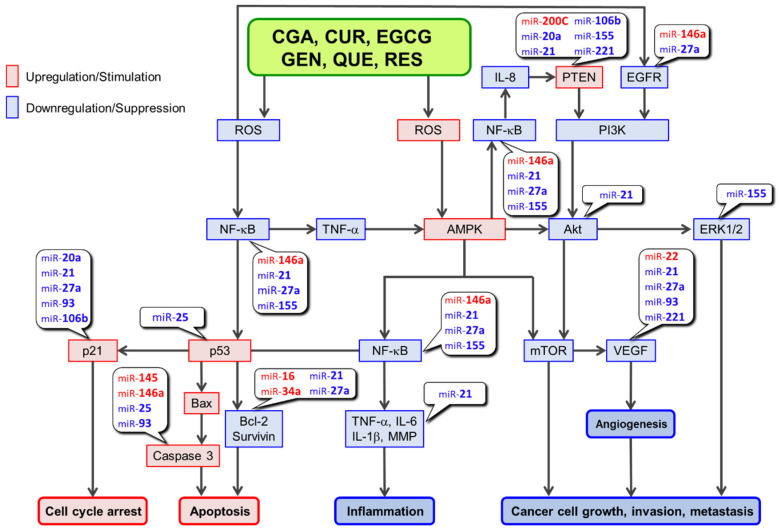
Consumption of coffee, tea, wine, curry, and soybeans has been linked to a lower risk of cancer in epidemiological studies. Several cell-based and animal studies have shown that dietary polyphenols like chlorogenic acid, curcumin, epigallocatechin-3--gallate, genistein, quercetin and resveratrol play a major role in these anticancer effects. Several mechanisms have been proposed to explain the anticancer effects of polyphenols. Depending on the cellular microenvironment, these polyphenols can exert double-faced actions as either an antioxidant or a prooxidant, and one of the representative anticancer mechanisms is a reactive oxygen species (ROS)-mediated mechanism. These polyphenols can also influence microRNA (miR) expression. In general, they can modulate the expression/activity of the constituent molecules in ROS-mediated anticancer pathways by increasing the expression of tumor-suppressive miRs and decreasing the expression of oncogenic miRs. Thus, miR modulation may enhance the anticancer effects of polyphenols through the ROS-mediated pathways in an additive or synergistic manner. More precise human clinical studies on the effects of dietary polyphenols on miR expression will provide convincing evidence of the preventive roles of dietary polyphenols in cancer and other diseases.
在流行病学研究中,咖啡、茶、酒、咖喱和大豆的消费与癌症风险降低有关。一些基于细胞和动物的研究表明,膳食多酚如绿原酸、姜黄素、表没食子儿茶素-3-没食子酸酯、染料木黄酮、槲皮素和白藜芦醇在这些抗癌作用中起着重要作用。已经提出了几种机制来解释多酚的抗癌作用。根据细胞的微环境,这些多酚可以作为抗氧化剂或促氧化剂发挥双重作用,代表性的抗癌机制之一是活性氧(ROS)介导的机制。这些多酚还可以影响 microRNA(miR)的表达。一般来说,它们可以通过增加肿瘤抑制性 miR 的表达和降低致癌性 miR 的表达来调节 ROS 介导的抗癌途径中组成分子的表达/活性。因此,miR 调节可能通过 ROS 介导的途径以累加或协同的方式增强多酚的抗癌作用。关于膳食多酚对 miR 表达影响的更精确的人类临床研究将为膳食多酚在癌症和其他疾病中的预防作用提供令人信服的证据。