Department of Cell and Molecular Biology, Fluminense Federal University, Niterói, Brazil.
Laboratory of Immunopharmacology, Federal University of the State of Rio de Janeiro, Rio de Janeiro, Brazil.
Front Endocrinol (Lausanne). 2022 Jun 17;13:879066. doi: 10.3389/fendo.2022.879066. eCollection 2022.
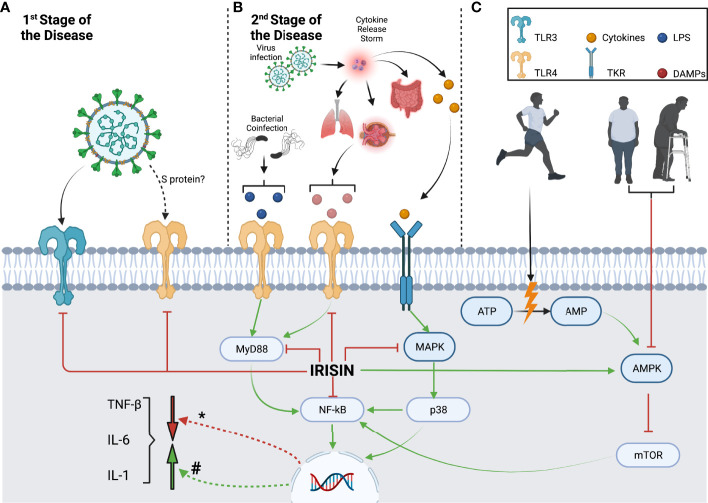
Muscle and adipose tissue produce irisin during exercise. Irisin is thermogenic adipomyokine, improves glucose and lipid metabolism, and ameliorates the effects of obesity-driven inflammation, metabolic syndrome, and diabetes. In addition, exercise-induced irisin activates anti-inflammatory pathways and may play an essential role in improving the outcomes of inflammatory conditions, such as coronavirus disease (COVID-19). COVID-19 infection can activate different intracellular receptors and modulate various pathways during the course of the disease. The cytokine release storm (CRS) produced is significant because it promotes the context for systemic inflammation, which increases the risk of mortality in patients with severe acute respiratory syndrome coronavirus 2 (SARS-CoV2). In addition, viral infection and the resulting organ damage may stimulate the mitogen-activated protein kinase(MAPK) and toll-like receptor 4 (TLR4)/toll interleukin receptor (TIR)-domain-containing adaptor (MyD88) pathways while negatively modulating the AMP-activated protein kinase (AMPK) pathway, leading to increased inflammatory cytokine production. Exercise-induced irisin may counteract this inflammatory modulation by decreasing cytokine production. Consequently, increased irisin levels, as found in healthy patients, may favor a better prognosis in patients with SARS-CoV2. This review aims to explore the molecular mechanisms underlying the anti-inflammatory properties of irisin in mitigating CRS and preventing severe outcomes due to infection with SARS-CoV2.
肌肉和脂肪组织在运动过程中会产生鸢尾素。鸢尾素是一种产热脂肪因子,可改善葡萄糖和脂质代谢,并改善肥胖引起的炎症、代谢综合征和糖尿病的影响。此外,运动诱导的鸢尾素可激活抗炎途径,并可能在改善炎症性疾病的结局方面发挥重要作用,如冠状病毒病 (COVID-19)。COVID-19 感染可在疾病过程中激活不同的细胞内受体并调节多种途径。细胞因子释放风暴 (CRS) 非常重要,因为它促进了全身炎症的发生,增加了严重急性呼吸综合征冠状病毒 2 (SARS-CoV2) 患者的死亡率。此外,病毒感染和由此产生的器官损伤可能会刺激丝裂原激活蛋白激酶 (MAPK) 和 Toll 样受体 4 (TLR4)/Toll 白细胞介素受体 (TIR)-域包含衔接子 (MyD88) 途径,同时负调节 AMP 激活的蛋白激酶 (AMPK) 途径,导致炎症细胞因子的产生增加。运动诱导的鸢尾素可能通过减少细胞因子的产生来对抗这种炎症调节。因此,在健康患者中发现的鸢尾素水平升高可能有利于 SARS-CoV2 患者的预后改善。本综述旨在探讨鸢尾素的抗炎特性的分子机制,以减轻 CRS 并预防因 SARS-CoV2 感染而导致的严重后果。