Department of Environment Science and Engineering, Fudan University, Shanghai, China.
School of Public Health, Boston University, Boston, MA, USA.
Nat Commun. 2022 Jul 6;13(1):3847. doi: 10.1038/s41467-022-31145-2.
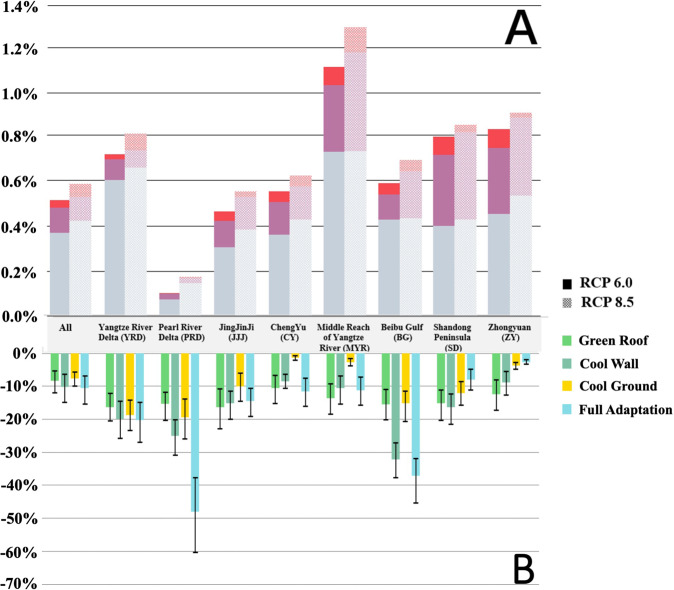
Heat-induced labor loss is a major economic cost related to climate change. Here, we use hourly heat stress data modeled with a regional climate model to investigate the heat-induced labor loss in 231 Chinese cities. Results indicate that future urban heat stress is projected to cause an increase in labor losses exceeding 0.20% of the total account gross domestic product (GDP) per year by the 2050s relative to the 2010s. In this process, certain lower-paid sectors could be disproportionately impacted. The implementation of various urban adaptation strategies could offset 10% of the additional economic loss per year and help reduce the inequality-related impact on lower-paid sectors. So future urban warming can not only damage cities as a whole but can also contribute to income inequality. The implication of adaptation strategies should be considered in regard to not only cooling requirements but also environmental justice.
热应激导致的劳动力损失是与气候变化相关的主要经济成本。在这里,我们使用区域气候模型模拟的每小时热应激数据,研究了 231 个中国城市的热应激导致的劳动力损失。结果表明,未来城市热应激预计将导致劳动力损失增加,与 2010 年代相比,到 2050 年代每年将超过国内生产总值(GDP)总额的 0.20%。在这个过程中,某些低薪行业可能会受到不成比例的影响。实施各种城市适应策略可以抵消每年额外经济损失的 10%,并有助于减少对低薪行业的不平等相关影响。因此,未来城市变暖不仅会对整个城市造成损害,还会导致收入不平等。在考虑适应策略时,不仅要考虑降温需求,还要考虑环境正义。