Department of Urology, West China School of Medicine/West China Hospital, Sichuan University, Chengdu, China.
Cochrane China Center, Chinese Evidence-Based Medicine Center, West China Hospital, Sichuan University, Chengdu, China.
Front Public Health. 2022 Jun 20;10:832881. doi: 10.3389/fpubh.2022.832881. eCollection 2022.
Evidence is scarce about the effect of noise exposure on the risk of dementia. We conducted a systematic review and dose-response meta-analysis, aiming to explore the association between noise exposure and the risk of dementia.
We searched PubMed, EMBASE and the Cochrane Library to collect studies on chronic noise exposure and the risk of dementia from database inception to September 18, 2021 without language limitations. Two authors independently screened the literature, extracted data and assessed the risk of bias of the included studies. A dose-response meta-analysis and subgroup analysis were then conducted to detect the association between noise exposure and the risk of dementia by using Stata 14.0 software. This study is registered on PROSPERO (CRD42021249243).
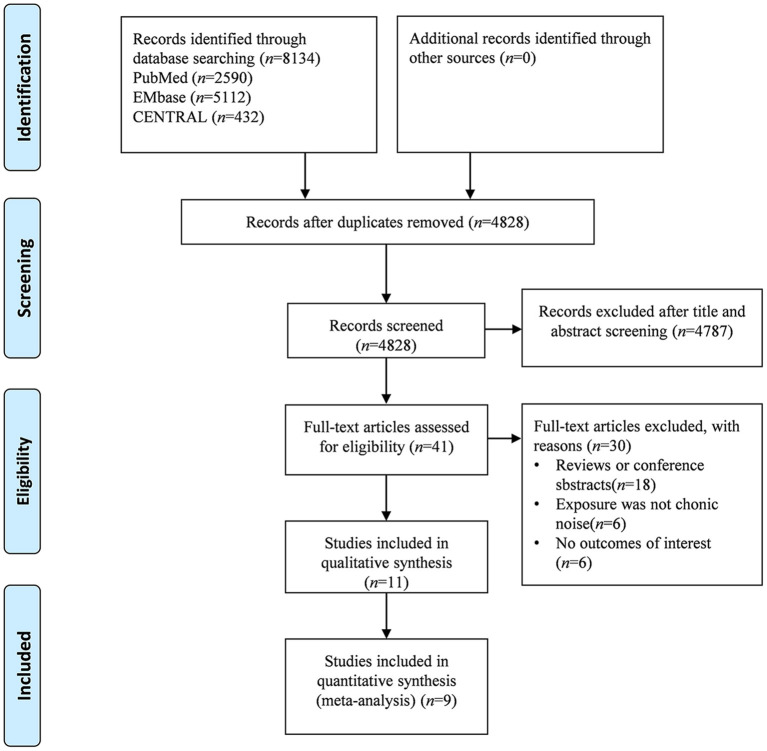
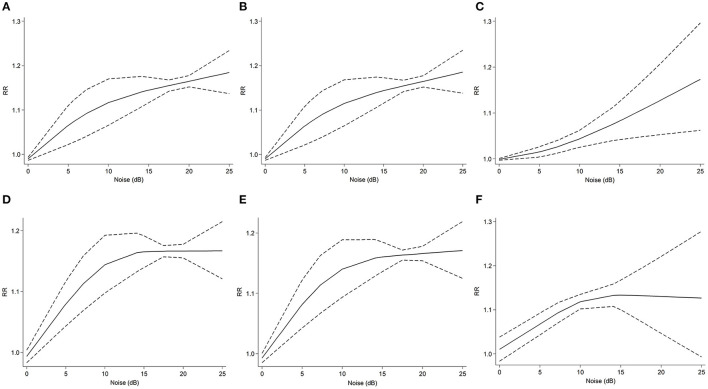
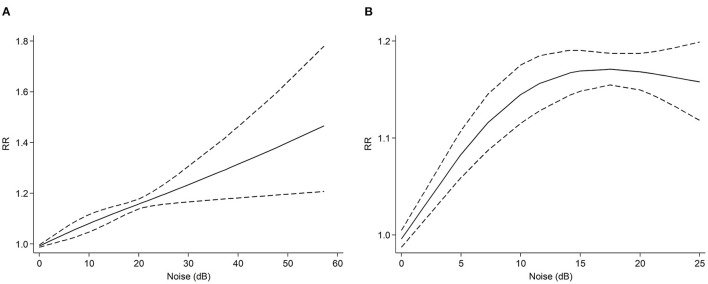
A total of 11 studies were eligible for qualitative synthesis, and nine were eligible for quantitative data synthesis. All of them showed moderate to high quality scores in the assessment of risk of bias. We found a positive linear association between the noise increment and dementia risk ( = 0.58). When noise exposure increased 57 dB, the RR of dementia was 1.47 (95% CI: 1.21-1.78). From the outcome subgroup of AD, AD and dementia, VaD and NAD, we also found a positive association ( = 0.68, 0.68, 0.58, respectively). When noise exposure increased by 25 dB, the RRs were 1.18 (95% CI: 1.14-1.23), 1.19 (95% CI: 1.14-1.23) and 1.17 (95% CI: 1.06-1.30), respectively. We found a nonlinear association between the noise increment and dementia risk when only cohort studies were included ( = 0.58). When noise exposure increased by 25 dB, the RR of dementia was 1.16 (95% CI: 1.12-1.20). From the subgroup of AD, AD and dementia, VaD and NAD of cohort studies, the regression curve showed a nonlinear positive association ( = 0.74, 0.71, 0.43, respectively). When noise exposure increased by 25 dB, the RRs were 1.17 (95% CI: 1.12-1.21), 1.17 (95% CI: 1.12-1.22) and 1.13 (95% CI: 0.99-1.28), respectively.
Based on the current evidence, exposure to noise may be a specific risk factor for dementia. To better prevent dementia, more rigorously designed studies are needed to explore the etiological mechanism of noise and dementia.
关于噪声暴露对痴呆风险的影响,证据有限。我们进行了一项系统评价和剂量-反应荟萃分析,旨在探讨噪声暴露与痴呆风险之间的关系。
我们检索了 PubMed、EMBASE 和 Cochrane 图书馆,以收集自数据库建立至 2021 年 9 月 18 日关于慢性噪声暴露与痴呆风险的研究,无语言限制。两位作者独立筛选文献、提取数据并评估纳入研究的偏倚风险。然后使用 Stata 14.0 软件进行剂量-反应荟萃分析和亚组分析,以检测噪声暴露与痴呆风险之间的关联。本研究已在 PROSPERO(CRD42021249243)上注册。
共有 11 项研究符合定性综合分析的条件,9 项研究符合定量数据分析的条件。所有研究在偏倚风险评估方面的评分均为中高度。我们发现噪声增量与痴呆风险之间存在正线性关联( = 0.58)。当噪声暴露增加 57 dB 时,痴呆的 RR 为 1.47(95%CI:1.21-1.78)。从 AD、AD 和痴呆、VaD 和 NAD 的结果亚组中,我们也发现了正相关( = 0.68、0.68、0.58,分别)。当噪声暴露增加 25 dB 时,RR 分别为 1.18(95%CI:1.14-1.23)、1.19(95%CI:1.14-1.23)和 1.17(95%CI:1.06-1.30)。当仅包括队列研究时,我们发现噪声增量与痴呆风险之间存在非线性关联( = 0.58)。当噪声暴露增加 25 dB 时,痴呆的 RR 为 1.16(95%CI:1.12-1.20)。从队列研究的 AD、AD 和痴呆、VaD 和 NAD 的亚组中,回归曲线显示出非线性正相关( = 0.74、0.71、0.43,分别)。当噪声暴露增加 25 dB 时,RR 分别为 1.17(95%CI:1.12-1.21)、1.17(95%CI:1.12-1.22)和 1.13(95%CI:0.99-1.28)。
基于目前的证据,噪声暴露可能是痴呆的一个特定危险因素。为了更好地预防痴呆,需要设计更严格的研究来探讨噪声与痴呆的病因机制。