Akselsson Anna, Westholm Lena, Small Rhonda, Ternström Elin
Department of Health Promoting Science, Sophiahemmet University, Stockholm, Sweden.
Department of Women's and Children's Health, Karolinska Institutet, Stockholm, Sweden.
Eur J Midwifery. 2022 Jun 16;6:38. doi: 10.18332/ejm/148159. eCollection 2022.
The European Union faces challenges related to migration, cultural diversity and health. Immigration to Sweden has increased and a third of all women giving birth were born outside Sweden. A higher risk for negative pregnancy outcomes is seen among foreign-born women and one of the explanations given is inadequate communication. Midwives in Sweden have responsibility for normal birth. This study aimed to investigate labor ward midwives' experiences of caring for and communicating with women who do not speak and understand the Swedish language.
A questionnaire based on the Migrant Friendly Hospital questionnaire was distributed to all 46 midwives working on the Södertälje Hospital labor and postpartum ward in 2018 and 32 completed it (70%).
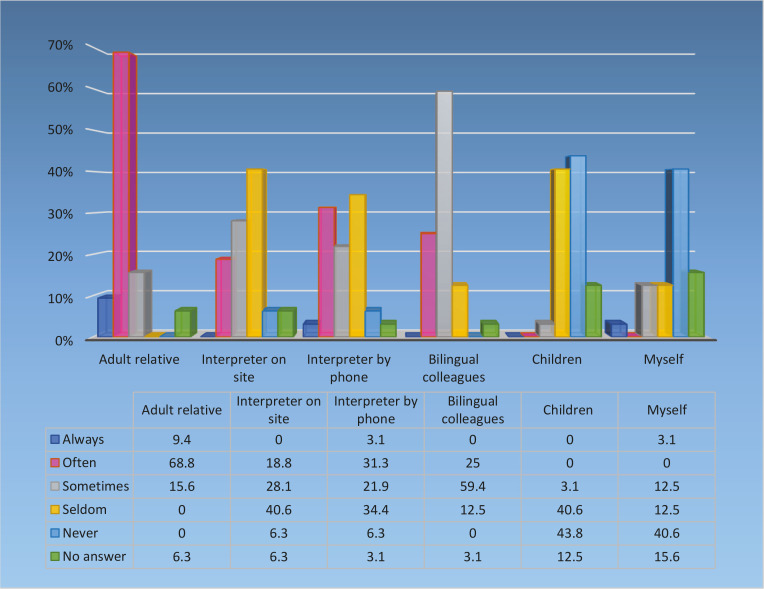
Most of the midwives thought communication and giving support to non-Swedish speaking women during birth was difficult or very difficult (n=31; 97%). The quality of the professional interpreters' work was reported as good or very good by most of the midwives (n=31; 97%). However, the most common resource for facilitating communication during labor was an adult relative (always/often: n=25; 83%). Increased availability was the most common response for improving the interpreter service (n=22; 69%), as well as increasing the number of languages available for interpreter services (n=8; 25%).
When women are giving birth, it is of the highest priority to improve communication between midwives and non-Swedish-speaking women. Better strategies for improving communication must be implemented in order to comply adequately with Swedish law and achieve equitable care of high quality for all, regardless of linguistic background.
欧盟面临与移民、文化多样性和健康相关的挑战。瑞典的移民数量有所增加,所有分娩女性中有三分之一出生在瑞典以外。外国出生的女性出现不良妊娠结局的风险更高,其中一个原因是沟通不足。瑞典的助产士负责正常分娩。本研究旨在调查产房助产士在照顾不会说也听不懂瑞典语的女性以及与她们沟通方面的经验。
基于“友善移民医院调查问卷”设计的问卷于2018年分发给了南泰利耶医院产房和产后病房工作的所有46名助产士,32人完成了问卷(70%)。
大多数助产士认为在分娩期间与不会说瑞典语的女性进行沟通和提供支持很困难或非常困难(n = 31;97%)。大多数助产士报告专业口译员的工作质量良好或非常良好(n = 31;97%)。然而,分娩期间促进沟通最常用的资源是成年亲属(总是/经常:n = 25;83%)。提高口译服务的可及性是改善口译服务最常见的建议(n = 22;69%),增加可供口译服务使用的语言数量也是如此(n = 8;25%)。
女性分娩时,改善助产士与不会说瑞典语的女性之间的沟通是重中之重。必须实施更好的沟通改善策略,以便充分遵守瑞典法律,并为所有人提供高质量的公平护理,无论其语言背景如何。