Laboratory of Structural Biology and Reproduction, Department of Morphology, Institute of Biological Sciences, Federal University of Minas Gerais, Antônio Carlos Avenue, 6627, Belo Horizonte, MG, 31270-901, Brazil.
Department of Obstetrics, Gynecology, and Reproductive Sciences, Magee-Women's Research Institute, University of Pittsburgh Medical Center, Pittsburgh, PA, 15213, USA.
Sci Rep. 2022 Jul 12;12(1):11810. doi: 10.1038/s41598-022-14683-z.
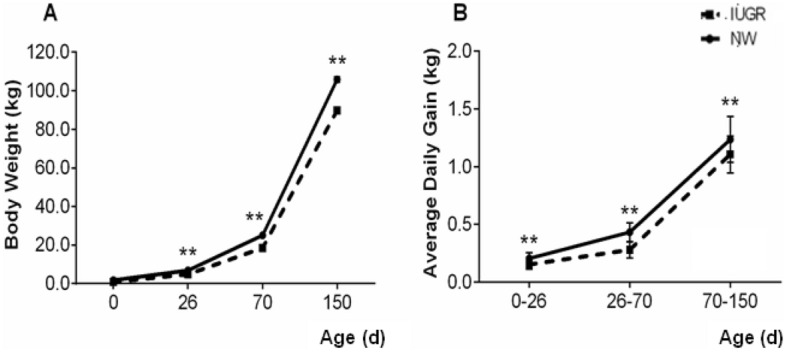
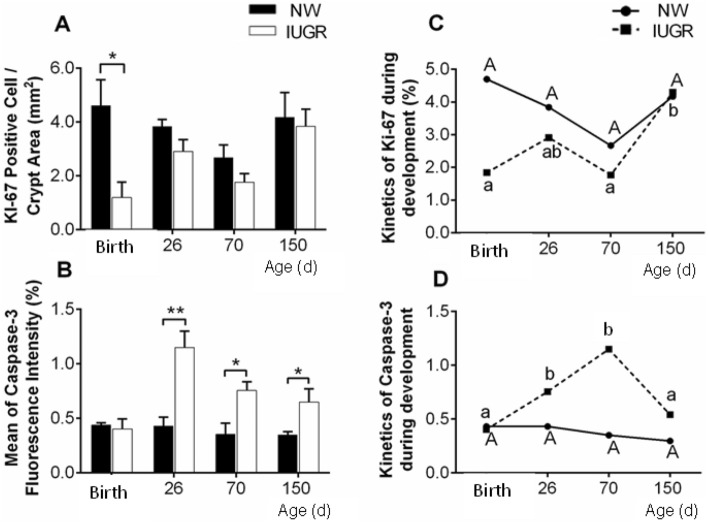
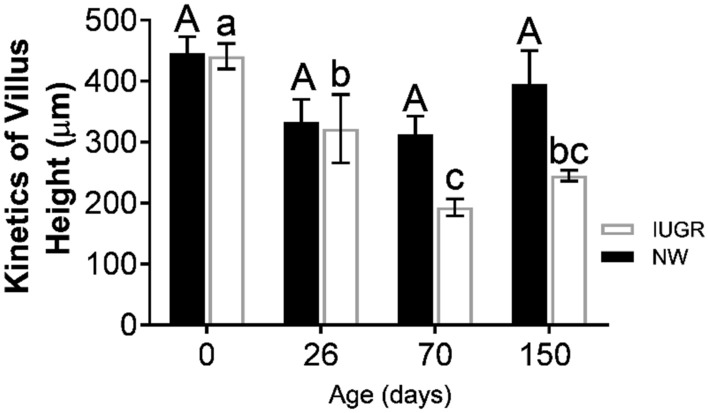
Intrauterine growth restriction (IUGR) compromises fetal development, leading to low birth weight, and predisposes to gastrointestinal disorders. Pigs that suffered IUGR present poor postnatal development, resulting in great economic losses to the industry. The small intestine may be involved with impaired development, but studies investigating this issue are still limited. Thus, the present study aimed to investigate small intestine morphofunctional alterations in IUGR pigs throughout the production phases (birth to 150 days). IUGR pigs presented lower body weight from birth to the finishing phase (P < 0.05). Although histomorphometrical parameters were not affected during the pre-weaning period, their commitment was observed specifically in the duodenum of the IUGR group at older ages (P < 0.05). The most detrimental effects on the small intestine, such as deeper duodenum crypts' depth, lower villus height:crypt depth ratio and absorptive area, increased apoptosis and lower proliferation of the duodenum epithelium were noticed at 70 days of age (P < 0.05). Additionally, IUGR pigs presented the lowest chymotrypsin and amylase activities at 70 and 150 days of age, respectively (P < 0.05). These findings may contribute to the elucidation of morphofunctional disorders of the small intestine in IUGR pigs throughout the different production phases, suggesting that poor postnatal development may be due to intestinal damage.
宫内生长受限(IUGR)会损害胎儿发育,导致出生体重低,并易患胃肠道疾病。患有 IUGR 的猪在出生后发育不良,给行业造成巨大经济损失。小肠可能参与了发育受损,但对此问题的研究仍然有限。因此,本研究旨在研究 IUGR 猪在整个生产阶段(出生到 150 天)中小肠的形态和功能变化。IUGR 猪从出生到育肥阶段的体重均较低(P<0.05)。尽管在断奶前的组织形态学参数没有受到影响,但在较老的时期(P<0.05),在 IUGR 组的十二指肠中观察到了特定的承诺。在 70 天龄时,IUGR 猪的小肠受到了最严重的影响,如十二指肠隐窝深度加深、绒毛高度:隐窝深度比和吸收面积降低、空肠上皮细胞凋亡增加和增殖减少(P<0.05)。此外,IUGR 猪在 70 天和 150 天龄时的糜蛋白酶和淀粉酶活性最低(P<0.05)。这些发现可能有助于阐明 IUGR 猪在不同生产阶段中小肠的形态和功能障碍,表明出生后发育不良可能是由于肠道损伤。