MRC/CSO Social and Public Health Sciences Unit, University of Glasgow, 99 Barkley Street, Glasgow, G3 7HR, UK.
Population Health Sciences, Bristol Medical School, University of Bristol, Canynge Hall, 39 Whatley Road, Bristol, BS8 2PS, UK.
Int J Behav Nutr Phys Act. 2022 Jul 14;19(1):84. doi: 10.1186/s12966-022-01303-2.
Early childhood education and care (ECEC) settings offer a potentially cost-effective and sustainable solution for ensuring children have opportunities to meet physical activity (PA) and sedentary time (ST) guidelines. This paper systematically reviewed the association between childcare environment and practice and children's PA and ST.
Three electronic databases were searched, and citation tracking of eligible studies performed between June-July 2020 (updated March 2022). Studies were eligible when (i) participants attended ECEC settings, (ii) they reported the association between use of outdoor space, including factors of time, availability, play, size and equipment, and children's device-measured PA and ST, and (iii) where applicable, they compared the exposure to use of indoor space. Risk of bias was assessed using the Critical Appraisal Skills Program (CASP) tools. A synthesis was performed using effect direct plots and charts to visualise effect sizes.
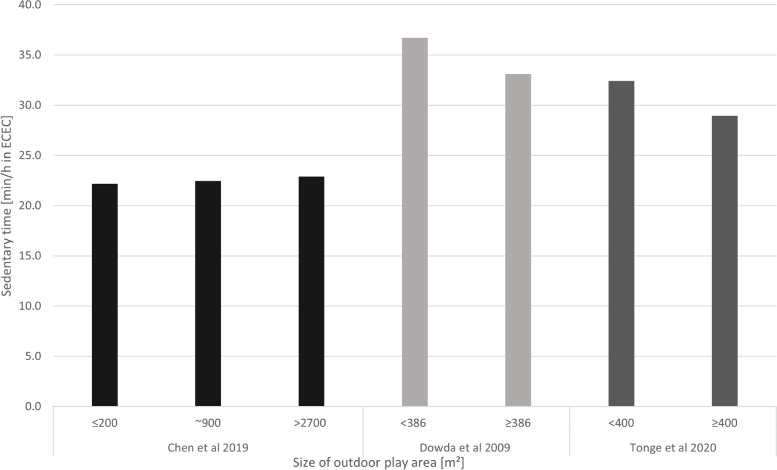
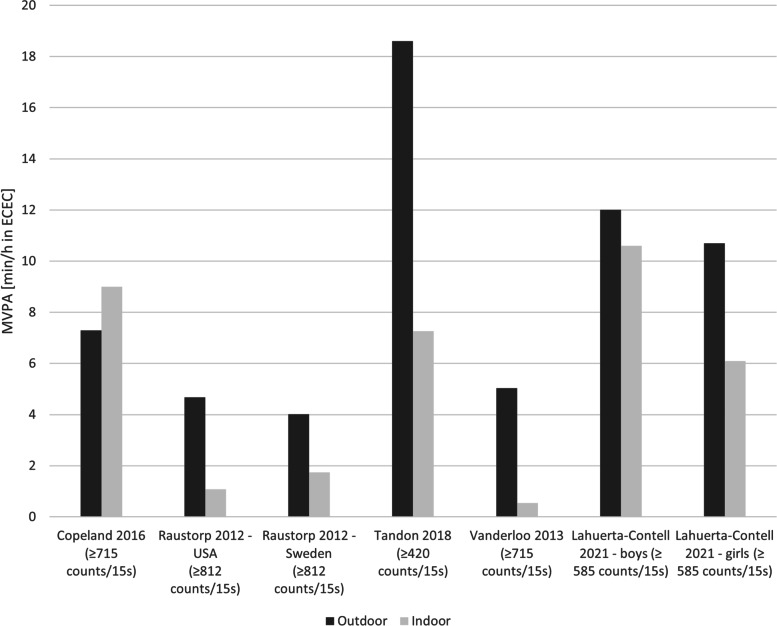
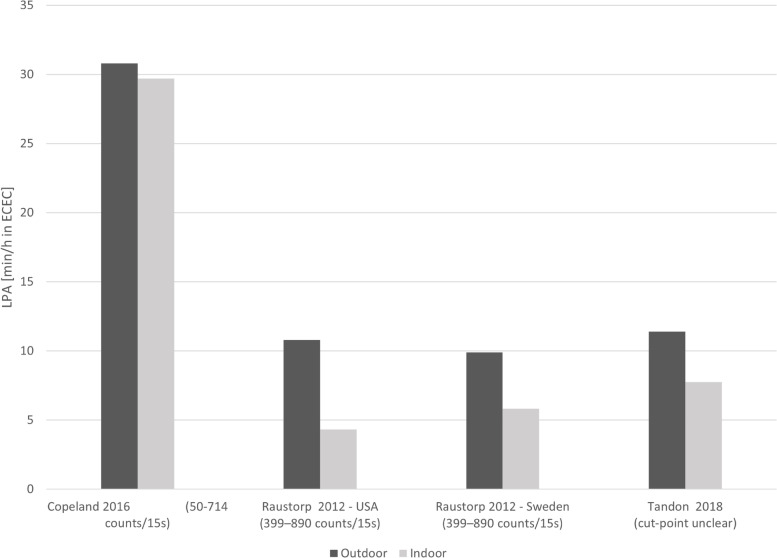
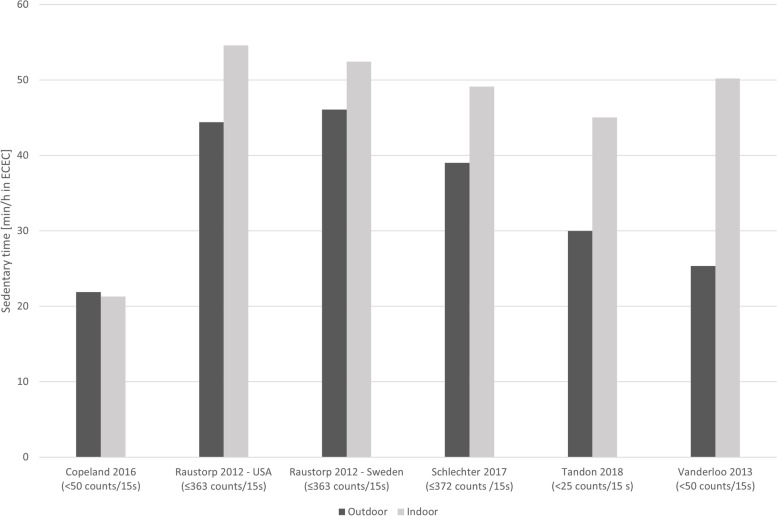
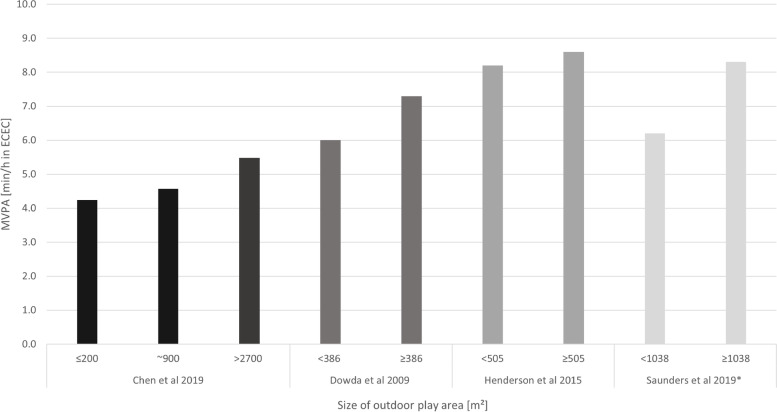
Of 1617 reports screened, 29 studies met the inclusion criteria. Studies provided data on outdoor versus indoor time (n = 9; 960 children), outdoor versus indoor play (n = 3; 1104 children), outdoor play space (n = 19; 9596 children), outdoor space use external to ECEC (n = 2; 1148 children), and portable (n = 7; 2408 children) and fixed (n = 7; 2451 children) outdoor equipment. Time spent outdoors versus indoors was associated with increased moderate-to-vigorous PA (MVPA), light PA (LPA) and total PA, while the association with ST was inconclusive. The mean (standard deviation) levels of outdoor MVPA (4.0 ± 3.2 to 18.6 ± 5.6 min/h) and LPA (9.9 ± 2.6 to 30.8 ± 11.8 min/h) were low, and ST high (30.0 ± 6.5 to 46.1 ± 4.3 min/h). MVPA levels doubled when children played outdoors versus indoors. Outdoor play space, and outdoor portable equipment, were associated with increased MVPA. A dose-response relationship for outdoor play area size was observed, demonstrating increased MVPA with areas ≥505m (5436 ft), but no further increases when areas were > 900m (9688 ft). No studies reported on injuries in outdoor settings.
ECEC policies and practices should promote not only outdoor time but also the availability of resources such as portable play equipment and sufficient size of outdoor play areas that enable children to be physically active for sustained periods while outdoors.
International prospective register of systematic reviews (PROSPERO) Registration Number: CRD42020189886.
早期儿童教育和保育(ECEC)环境为确保儿童有机会满足身体活动(PA)和久坐时间(ST)指南提供了一种潜在的具有成本效益和可持续的解决方案。本文系统地回顾了儿童保育环境和实践与儿童 PA 和 ST 之间的关联。
2020 年 6 月至 7 月(2022 年 3 月更新)期间在三个电子数据库中进行了搜索,并对合格研究进行了引文跟踪。当(i)参与者参加 ECEC 环境,(ii)他们报告了户外空间的使用与儿童设备测量的 PA 和 ST 之间的关联,包括时间、可用性、游戏、大小和设备因素,以及(iii)在适用的情况下,他们比较了室内空间的暴露情况时,研究符合纳入标准。使用关键评估技能计划(CASP)工具评估偏倚风险。使用效果直接图和图表来可视化效果大小进行综合。
在筛选出的 1617 份报告中,有 29 项研究符合纳入标准。这些研究提供了有关户外与室内时间(n=9;960 名儿童)、户外与室内游戏(n=3;1104 名儿童)、户外游戏空间(n=19;9596 名儿童)、ECEC 之外的户外空间使用(n=2;1148 名儿童)以及便携式(n=7;2408 名儿童)和固定(n=7;2451 名儿童)户外设备的户外时间与室内时间的比较数据。与在室内相比,户外活动时间与中等到剧烈强度的 PA(MVPA)、低强度 PA(LPA)和总 PA 增加有关,而与 ST 的关联尚无定论。户外活动的 MVPA(4.0±3.2 至 18.6±5.6 分钟/小时)和 LPA(9.9±2.6 至 30.8±11.8 分钟/小时)的平均(标准偏差)水平较低,而 ST 较高(30.0±6.5 至 46.1±4.3 分钟/小时)。当儿童在户外玩耍时,MVPA 水平增加了一倍。户外游戏空间和便携式户外设备与 MVPA 的增加有关。观察到户外游戏区大小的剂量反应关系,表明当区域≥505m(5436 英尺)时,MVPA 会增加,但当区域>900m(9688 英尺)时,不会进一步增加。没有研究报告户外环境中的伤害情况。
ECEC 政策和实践不仅应促进户外活动时间,还应促进便携式游乐设备等资源的可用性,以及足够大小的户外游乐区,以便儿童在户外持续进行身体活动。
国际前瞻性系统评价注册(PROSPERO)登记号:CRD42020189886。