Centre for Precision Health, Edith Cowan University, Joondalup, Perth, WA, 6027, Australia.
Collaborative Genomics and Translation Group, School of Medical and Health Sciences, Edith Cowan University, Joondalup, Perth, WA, 6027, Australia.
Commun Biol. 2022 Jul 18;5(1):691. doi: 10.1038/s42003-022-03607-2.
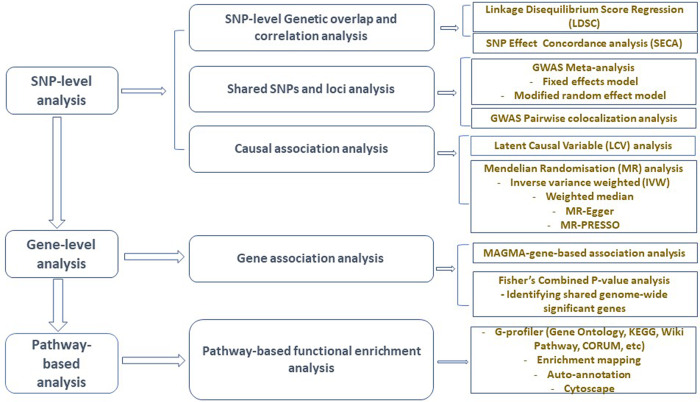
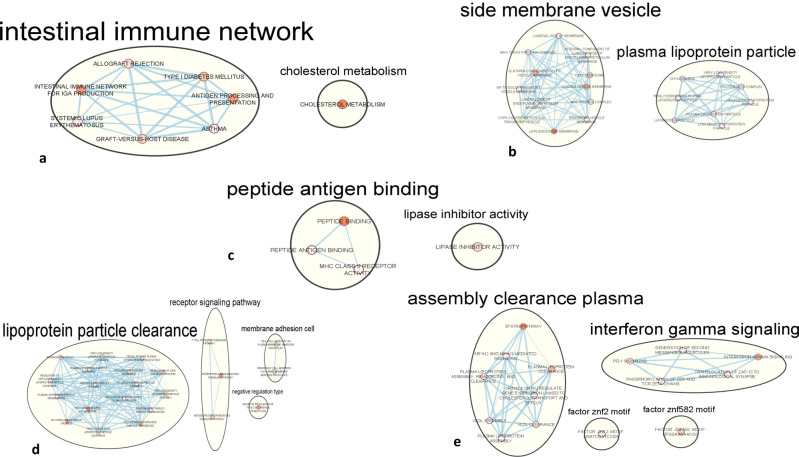
Consistent with the concept of the gut-brain phenomenon, observational studies suggest a relationship between Alzheimer's disease (AD) and gastrointestinal tract (GIT) disorders; however, their underlying mechanisms remain unclear. Here, we analyse several genome-wide association studies (GWAS) summary statistics (N = 34,652-456,327), to assess the relationship of AD with GIT disorders. Findings reveal a positive significant genetic overlap and correlation between AD and gastroesophageal reflux disease (GERD), peptic ulcer disease (PUD), gastritis-duodenitis, irritable bowel syndrome and diverticulosis, but not inflammatory bowel disease. Cross-trait meta-analysis identifies several loci (P < 5 × 10) shared by AD and GIT disorders (GERD and PUD) including PDE4B, BRINP3, ATG16L1, SEMA3F, HLA-DRA, SCARA3, MTSS2, PHB, and TOMM40. Colocalization and gene-based analyses reinforce these loci. Pathway-based analyses demonstrate significant enrichment of lipid metabolism, autoimmunity, lipase inhibitors, PD-1 signalling, and statin mechanisms, among others, for AD and GIT traits. Our findings provide genetic insights into the gut-brain relationship, implicating shared but non-causal genetic susceptibility of GIT disorders with AD's risk. Genes and biological pathways identified are potential targets for further investigation in AD, GIT disorders, and their comorbidity.
与肠道-大脑现象的概念一致,观察性研究表明阿尔茨海默病 (AD) 与胃肠道 (GIT) 疾病之间存在关系;然而,其潜在机制尚不清楚。在这里,我们分析了几项全基因组关联研究 (GWAS) 的汇总统计数据(N=34652-456327),以评估 AD 与 GIT 疾病的关系。研究结果显示,AD 与胃食管反流病 (GERD)、消化性溃疡病 (PUD)、胃炎-十二指肠炎、肠易激综合征和憩室病之间存在正显著遗传重叠和相关性,但与炎症性肠病无关。跨特征荟萃分析确定了几个与 AD 和 GIT 疾病(GERD 和 PUD)相关的位点(P<5×10),包括 PDE4B、BRINP3、ATG16L1、SEMA3F、HLA-DRA、SCARA3、MTSS2、PHB 和 TOMM40。共定位和基于基因的分析加强了这些位点。基于途径的分析表明,AD 和 GIT 特征存在显著的脂质代谢、自身免疫、脂肪酶抑制剂、PD-1 信号传导和他汀类药物机制等途径的富集。我们的研究结果为肠道-大脑关系提供了遗传见解,表明 GIT 疾病与 AD 风险存在共同但非因果的遗传易感性。确定的基因和生物途径是进一步研究 AD、GIT 疾病及其共病的潜在靶点。