Department of Political Science, University of Miami, Coral Gables, FL, United States of America.
Department of Political Science, University of Louisville, Louisville, KY, United States of America.
PLoS One. 2022 Jul 20;17(7):e0270429. doi: 10.1371/journal.pone.0270429. eCollection 2022.
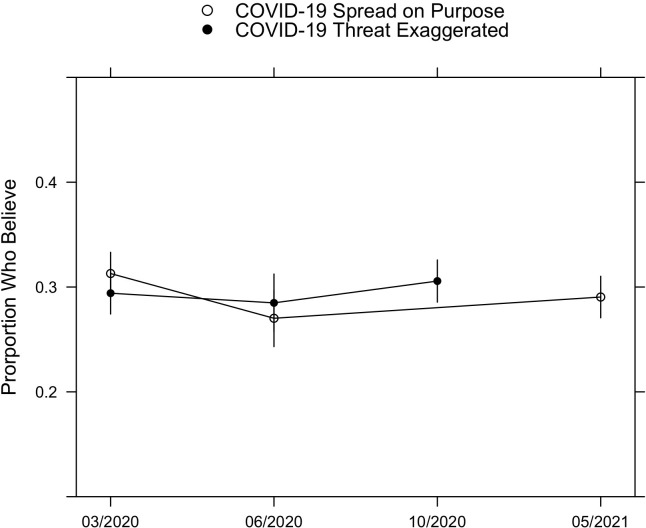
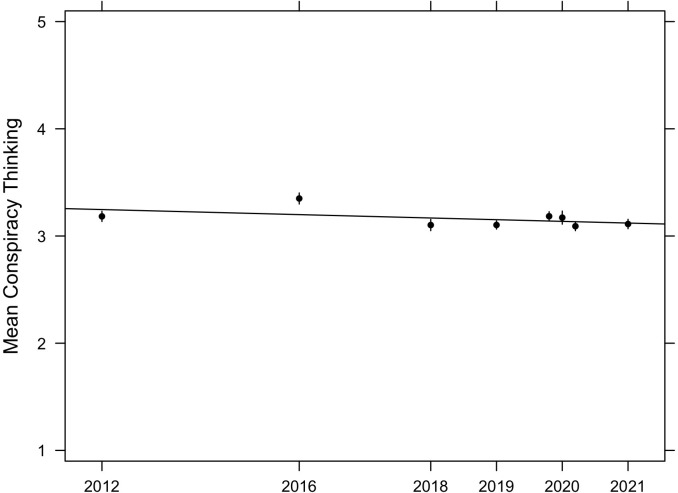
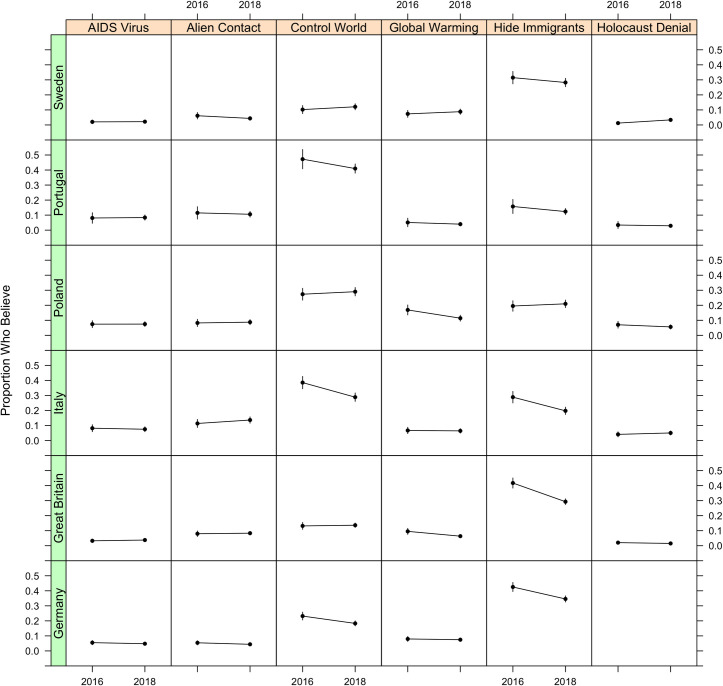
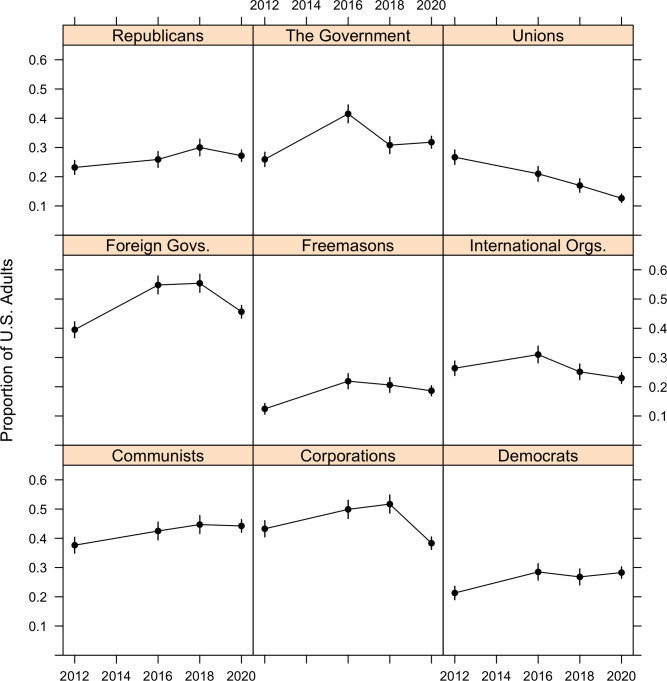
The public is convinced that beliefs in conspiracy theories are increasing, and many scholars, journalists, and policymakers agree. Given the associations between conspiracy theories and many non-normative tendencies, lawmakers have called for policies to address these increases. However, little evidence has been provided to demonstrate that beliefs in conspiracy theories have, in fact, increased over time. We address this evidentiary gap. Study 1 investigates change in the proportion of Americans believing 46 conspiracy theories; our observations in some instances span half a century. Study 2 examines change in the proportion of individuals across six European countries believing six conspiracy theories. Study 3 traces beliefs about which groups are conspiring against "us," while Study 4 tracks generalized conspiracy thinking in the U.S. from 2012 to 2021. In no instance do we observe systematic evidence for an increase in conspiracism, however operationalized. We discuss the theoretical and policy implications of our findings.
公众深信阴谋论信仰正在增加,许多学者、记者和政策制定者也持同样观点。鉴于阴谋论与许多非规范倾向之间存在关联,立法者呼吁出台政策来应对这些增加。然而,几乎没有证据表明阴谋论信仰实际上随着时间的推移而增加。我们解决了这一证据空白。研究 1 调查了美国人相信 46 种阴谋论的比例的变化;我们的观察结果在某些情况下跨越了半个世纪。研究 2 考察了六个欧洲国家的个人相信六种阴谋论的比例的变化。研究 3 追踪了关于哪些群体在针对“我们”密谋的信念,而研究 4 则追踪了 2012 年至 2021 年期间美国的普遍阴谋思维。然而,无论如何操作,我们都没有观察到有系统的证据表明阴谋论信仰增加。我们讨论了我们研究结果的理论和政策意义。