Enders Adam, Farhart Christina, Miller Joanne, Uscinski Joseph, Saunders Kyle, Drochon Hugo
Department of Political Science, University of Louisville, Louisville, KY 40292 USA.
Department of Political Science, Carleton College, Northfield, MN 55057 USA.
Polit Behav. 2022 Jul 22:1-24. doi: 10.1007/s11109-022-09812-3.
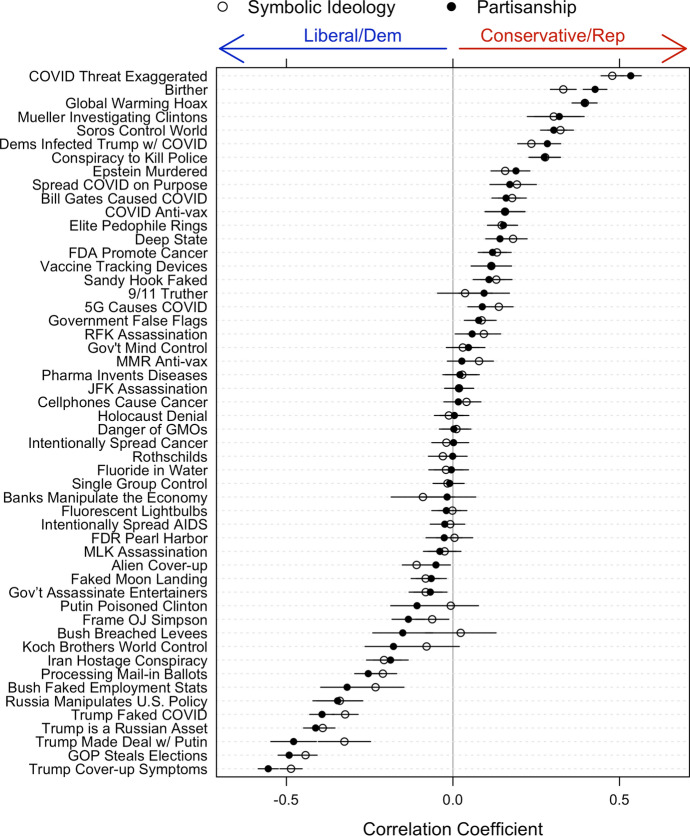
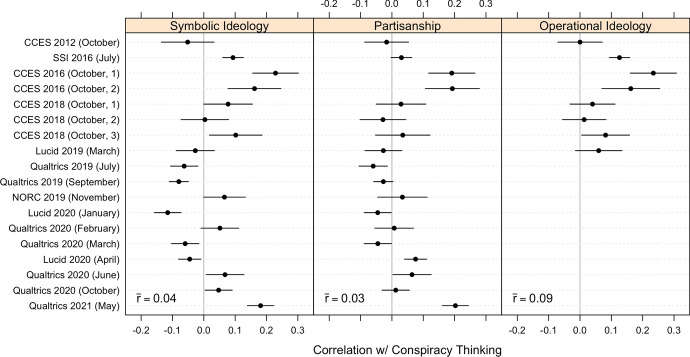
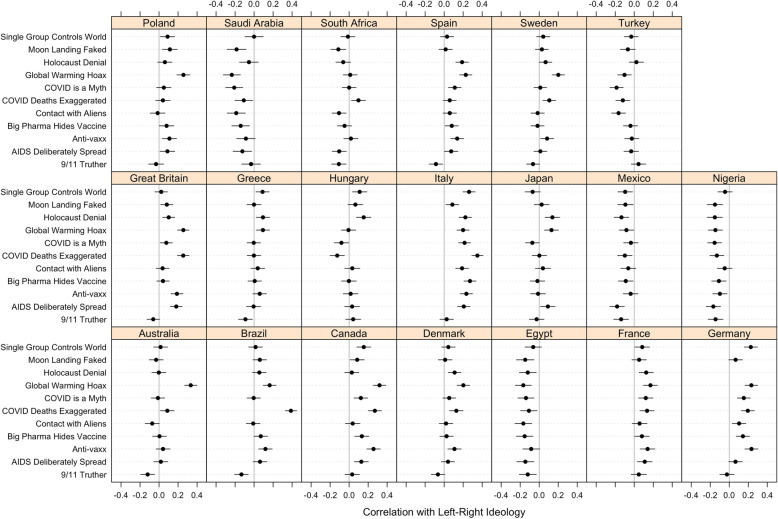
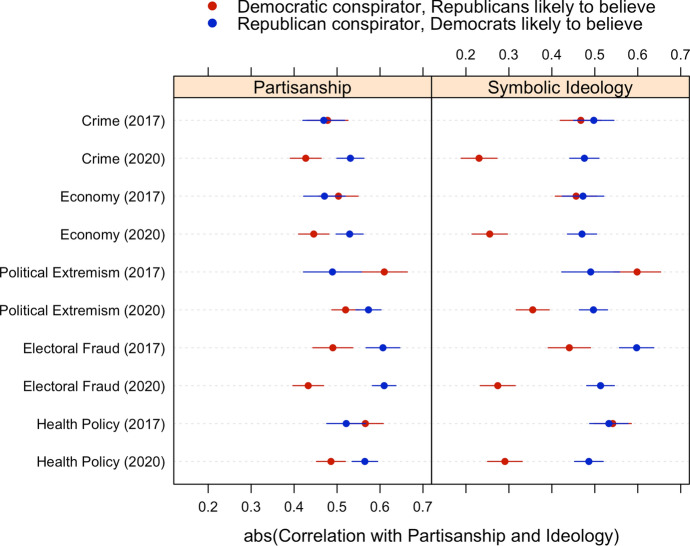
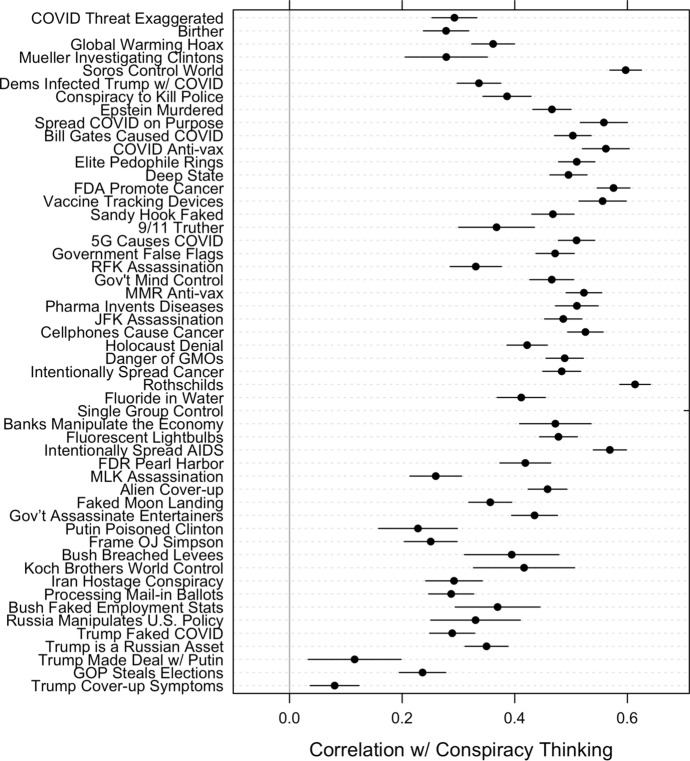
A sizable literature tracing back to Richard Hofstadter's (1964) argues that Republicans and conservatives are more likely to believe conspiracy theories than Democrats and liberals. However, the evidence for this proposition is mixed. Since conspiracy theory beliefs are associated with dangerous orientations and behaviors, it is imperative that social scientists better understand the connection between conspiracy theories and political orientations. Employing 20 surveys of Americans from 2012 to 2021 (total n = 37,776), as well as surveys of 20 additional countries spanning six continents (total n = 26,416), we undertake an expansive investigation of the asymmetry thesis. First, we examine the relationship between beliefs in 52 conspiracy theories and both partisanship and ideology in the U.S.; this analysis is buttressed by an examination of beliefs in 11 conspiracy theories across 20 more countries. In our second test, we hold constant the content of the conspiracy theories investigated-manipulating only the partisanship of the theorized villains-to decipher whether those on the left or right are more likely to accuse political out-groups of conspiring. Finally, we inspect correlations between political orientations and the general predisposition to believe in conspiracy theories over the span of a decade. In no instance do we observe systematic evidence of a political asymmetry. Instead, the strength and direction of the relationship between political orientations and conspiricism is dependent on the characteristics of the specific conspiracy beliefs employed by researchers and the socio-political context in which those ideas are considered.
The online version contains supplementary material available at 10.1007/s11109-022-09812-3.
大量可追溯到理查德·霍夫施塔特(1964年)的文献认为,共和党人和保守派比民主党人和自由派更有可能相信阴谋论。然而,这一观点的证据并不一致。由于阴谋论信仰与危险的倾向和行为相关,社会科学家必须更好地理解阴谋论与政治倾向之间的联系。我们利用2012年至2021年对美国人进行的20项调查(总样本量n = 37776),以及对六大洲另外20个国家进行的调查(总样本量n = 26416),对不对称论点进行了广泛的调查。首先,我们研究了美国52种阴谋论信仰与党派关系和意识形态之间的关系;对另外20个国家的11种阴谋论信仰的调查进一步支持了这一分析。在我们的第二项测试中,我们保持所调查的阴谋论内容不变——只操纵理论上的反派的党派关系——以解读左派或右派是否更有可能指责政治外群体搞阴谋。最后,我们考察了十年间政治倾向与相信阴谋论的总体倾向之间的相关性。我们在任何情况下都没有观察到政治不对称的系统性证据。相反,政治倾向与阴谋论之间关系的强度和方向取决于研究人员所采用的特定阴谋论信仰的特征以及这些观点被考虑时的社会政治背景。
在线版本包含可在10.1007/s11109-022-09812-3获取的补充材料。