Miszczyk Marcin, Sajdok Mateusz, Nożyński Jerzy, Cybulska Magdalena, Bednarek Jacek, Jadczyk Tomasz, Latusek Tomasz, Kurzelowski Radoslaw, Dolla Łukasz, Wojakowski Wojciech, Dyla Agnieszka, Zembala Michał, Drzewiecka Anna, Kaminiów Konrad, Kozub Anna, Chmielik Ewa, Grza Dziel Aleksandra, Bekman Adam, Gołba Krzysztof Stanisław, Blamek Sławomir
IIIrd Radiotherapy and Chemotherapy Department, Maria Skłodowska-Curie National Research Institute of Oncology, Gliwice, Poland.
Department of Electrocardiology, Upper Silesian Heart Center, Medical University of Silesia, Katowice, Poland.
Front Cardiovasc Med. 2022 Jul 7;9:919823. doi: 10.3389/fcvm.2022.919823. eCollection 2022.
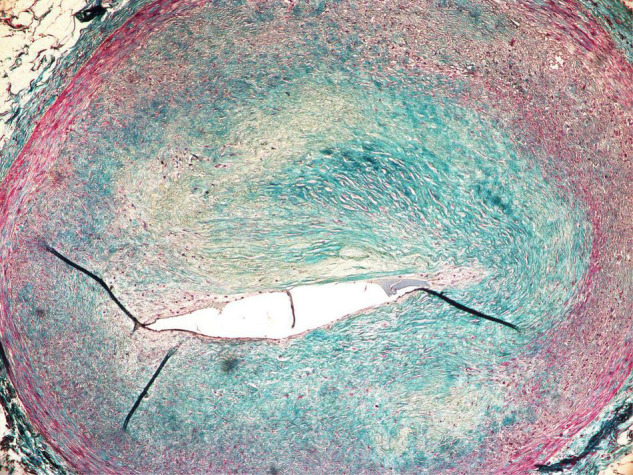
Cardiac stereotactic body radiotherapy is an emerging treatment method for recurrent ventricular tachycardia refractory to invasive treatment methods. The single-fraction delivery of 25 Gy was assumed to produce fibrosis, similar to a post-radiofrequency ablation scar. However, the dynamics of clinical response and recent preclinical findings suggest a possible different mechanism. The data on histopathological presentation of post-radiotherapy hearts is scarce, and the authors provide significantly different conclusions. In this article, we present unique data on histopathological examination of a heart explanted from a patient who had a persistent anti-arrhythmic response that lasted almost a year, until a heart failure exacerbation caused a necessity of a heart transplant. Despite a complete treatment response, there was no homogenous transmural fibrosis in the irradiated region, and the overall presentation of the heart was similar to other transplanted hearts of patients with advanced heart failure. In conclusion, our findings support the theorem of functional changes as a source of the anti-arrhythmic mechanism of radiotherapy and show that durable treatment response can be achieved in absence of transmural fibrosis of the irradiated myocardium.
心脏立体定向体部放射治疗是一种针对侵入性治疗方法难治的复发性室性心动过速的新兴治疗方法。假定单次给予25 Gy会产生纤维化,类似于射频消融术后的瘢痕。然而,临床反应动态及近期临床前研究结果提示可能存在不同机制。关于放疗后心脏组织病理学表现的数据稀缺,且作者给出了显著不同的结论。在本文中,我们展示了关于一名患者心脏组织病理学检查的独特数据,该患者有持续近一年的抗心律失常反应,直至心力衰竭加重导致需要进行心脏移植。尽管治疗反应完全,但照射区域并无均匀的透壁纤维化,且心脏的整体表现与晚期心力衰竭患者的其他移植心脏相似。总之,我们的研究结果支持功能改变作为放疗抗心律失常机制来源的理论,并表明在照射心肌无透壁纤维化的情况下可实现持久的治疗反应。