Miszczyk Marcin, Jadczyk Tomasz, Gołba Krzysztof, Wojakowski Wojciech, Wita Krystian, Bednarek Jacek, Blamek Sławomir
IIIrd Department of Radiotherapy and Chemotherapy, Maria Sklodowska-Curie National Research Institute of Oncology, 44-102 Gliwice, Poland.
Department of Cardiology and Structural Heart Diseases, Medical University of Silesia, 40-055 Katowice, Poland.
J Clin Med. 2021 Mar 17;10(6):1238. doi: 10.3390/jcm10061238.
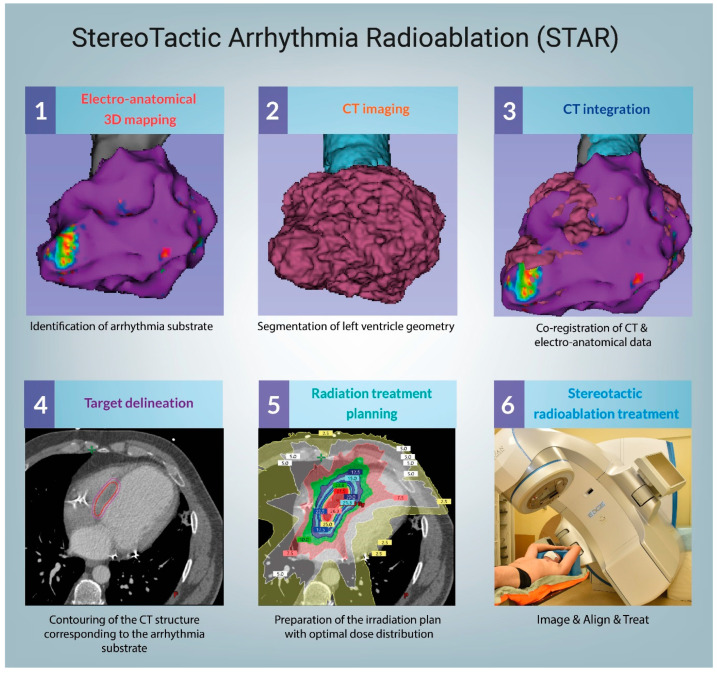
The electrophysiology-guided noninvasive cardiac radioablation, also known as STAR (stereotactic arrhythmia radioablation) is an emerging treatment method for persistent ventricular tachycardia. Since its first application in 2012 in Stanford Cancer Institute, and a year later in University Hospital Ostrava, Czech Republic, the authors from all around the world have published case reports and case series, and several prospective trials were established. In this article, we would like to discuss the available clinical evidence, analyze the potentially clinically relevant differences in methodology, and address some of the unique challenges that come with this treatment method.
电生理引导下的非侵入性心脏射频消融术,也称为STAR(立体定向心律失常射频消融术),是一种用于持续性室性心动过速的新兴治疗方法。自2012年首次在斯坦福癌症研究所应用,以及一年后在捷克共和国俄斯特拉发大学医院应用以来,来自世界各地的作者发表了病例报告和病例系列,并开展了多项前瞻性试验。在本文中,我们将讨论现有的临床证据,分析方法学上潜在的临床相关差异,并探讨这种治疗方法带来的一些独特挑战。